An AI draft reads the same whether its numbers are right or wrong. A price from last year and a price from this morning look identical on the page. So I stopped trusting how a draft reads, and I started checking it against a file.
The file is a source ledger. Every dollar amount and every percentage in a draft needs a row in it: where the number came from, the day it was read, and the exact words on the page. A short script fails any draft that states a figure with no row.
On 27 November 2026 I ran it on two guides before they went live. The first run failed four times. One of the four was a number I'd made up without noticing.
What you'll have when you're done
- A
ledger.jsonfile with one row per sourced figure - Five rules for what counts as a source
- A script that fails a draft when a dollar amount or a percentage has no row
- A re-read schedule, so old numbers get checked again
- [SCREENSHOT: terminal, four FAIL lines from the first run and two ok lines from the second]
Before you start
- Drafts saved as text or markdown files. One file per piece.
- Node.js 20 or newer for the gate script.
- About 30 minutes to set it up, then a few minutes per draft.
There's no download pack for this one. The script and the ledger format are on the page.
Step 1: Write the ledger row before the sentence
The order matters. If you write the sentence first, you go looking for a source that agrees with it. If you write the row first, the sentence can only say what the source said.
One row looks like this. It's a real one from my run:
{
  "claim": "Rev human transcription starts at $1.99 a minute",
  "figures": ["$1.99"],
  "source": "https://www.rev.com/pricing",
  "read": "2026-11-27",
  "quote": "Human transcription starts at $1.99/min.",
  "used_in": ["sell-video-subtitles-whisper.mdx"]
}
figures is the list of numbers exactly as they'll appear in the draft. quote is copied from the page, not retyped. read is the day you had the page open, and used_in is the draft the row belongs to.
The quote is the field people skip, and I think it's the one that does the most work. When you have to paste the exact words, you notice things. The page says "starts at", so the draft has to say "starts at" too.
Check it worked: you have a ledger.json with one row, and the quote in it was pasted from the page.
Step 2: Decide what counts as a source
These are the five rules I hold my own drafts to.
1. The vendor's own page beats an article about the vendor.
2. A forecast is written as a forecast, with who made it.
3. A sum you did yourself gets a row that shows the sum.
4. A number from your own run points at the log or the file.
5. If you can't find the page today, the number is cut.
Rule 2 came up in this run. Adobe's press release says it expects AI traffic to US retail sites to rise 130% this holiday season. That's a forecast, so the draft says "Adobe expects". It doesn't say traffic rose.
Rule 3 is for arithmetic. One draft said a 10-minute video would start at $19.90 at Rev's human rate. No page says $19.90. The row for it says "source": "arithmetic: 10 x $1.99", so a reader of the ledger can check the sum.
Rule 5 is the hard one. A number you remember is usually a number that was true once. Twice in this run, what I expected to write was out of date. I expected a step about checking out inside ChatGPT, and OpenAI's merchants page now says it's moving away from that. And my brief for the week said one keyword had no guide yet. A search of the files showed it already did.
Check it worked: for every row so far, you can say which of the five rules it passes.
Step 3: Save the gate script
Save this as numbers-gate.mjs.
// node numbers-gate.mjs ledger.json draft.md [more drafts]
// Fails (exit 1) when a draft states a dollar amount or a percentage that has no row in the source ledger.
import { readFileSync } from "node:fs";
import { basename } from "node:path";

const [ledgerPath, ...drafts] = process.argv.slice(2);
const ledger = JSON.parse(readFileSync(ledgerPath, "utf8"));
const FIGURE = /\$\d[\d,]*(?:\.\d+)?|\d[\d,]*(?:\.\d+)?%/g;
const MAX_AGE_DAYS = 30;
let fails = 0;

for (const [i, row] of ledger.entries()) {
  for (const key of ["figures", "source", "read", "quote"]) {
    if (!row[key] || !row[key].length) { console.log(`FAIL  ledger row ${i + 1}: no ${key}`); fails++; }
  }
  const age = (Date.now() - new Date(row.read)) / 86400000;
  if (age > MAX_AGE_DAYS) console.log(`WARN  ledger row ${i + 1}: read ${Math.floor(age)} days ago, re-read ${row.source}`);
}

for (const path of drafts) {
  const name = basename(path);
  const prose = readFileSync(path, "utf8").replace(/```[\s\S]*?```/g, "");
  const known = new Set(ledger.filter((r) => !r.used_in || r.used_in.includes(name)).flatMap((r) => r.figures));
  const found = [...new Set(prose.match(FIGURE) || [])];
  const missing = found.filter((f) => !known.has(f));
  for (const f of missing) {
    const line = prose.split("\n").find((l) => l.includes(f)).trim().slice(0, 70);
    console.log(`FAIL  ${name}: ${f} has no ledger row  ("${line}...")`);
    fails++;
  }
  console.log(`${missing.length ? "    " : "ok  "}  ${name}: ${found.length} figures, ${found.length - missing.length} sourced`);
}
process.exit(fails ? 1 : 0);
It does two jobs. First it checks the ledger itself: a row with no source, no date or no quote fails, and a row older than 30 days gets a warning. Then it reads each draft, skips the code blocks, and pulls out every dollar amount and every percentage. Any figure that isn't in a row for that draft fails, with the line it was found on.
Check it worked: the script is saved next to ledger.json and you haven't changed it.
Step 4: Run it on a real draft
node numbers-gate.mjs ledger.json drafts/guide-one.mdx drafts/guide-two.mdx
This is my first run on 27 November 2026, on two finished drafts with five rows in the ledger:
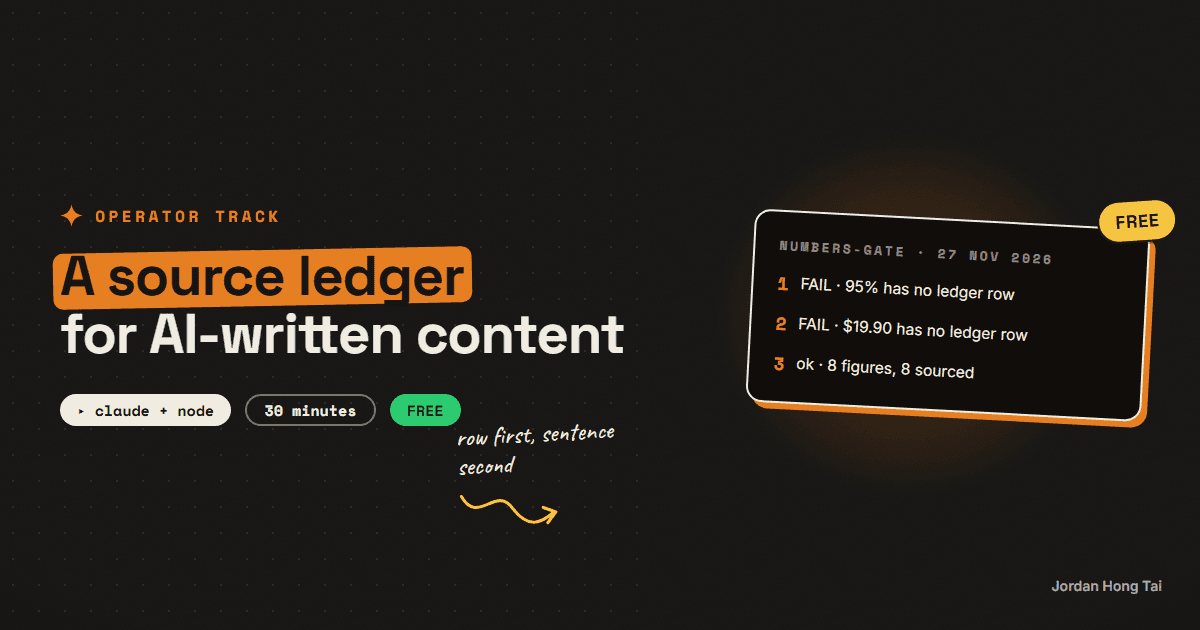
FAIL  chatgpt-shopping-product-feed.mdx: $25 has no ledger row  ("Open ChatGPT and ask the question a customer would ask, without the br...")
      chatgpt-shopping-product-feed.mdx: 3 figures, 2 sourced
FAIL  sell-video-subtitles-whisper.mdx: 100% has no ledger row  ("I think you should say the first line out loud every time. Some seller...")
FAIL  sell-video-subtitles-whisper.mdx: $19.90 has no ledger row  ("Notice the gap. A 10-minute video is $10 on Fiverr and would start at ...")
FAIL  sell-video-subtitles-whisper.mdx: 95% has no ledger row  ("The software does the easy 95% and you're paid for the rest. That mean...")
      sell-video-subtitles-whisper.mdx: 9 figures, 6 sourced
Four fails, and each one was a different kind of thing.
| Figure | What it was | What I did |
|---|---|---|
| $25 | An example prompt a shopper might type | Added a row with "source": "example" |
| 100% | A phrase quoted from a seller's listing | Added a row with the listing's words |
| $19.90 | My own multiplication | Added a row that shows the sum |
| 95% | A figure of speech with nothing behind it | Cut it from the draft |
The last one is the reason I run this. "The software does the easy 95%" sounds fine, and nobody measured it. I wrote it and read past it twice. The sentence now says "the easy part", which is all I actually knew.
The second run, after three new rows and one cut:
ok    chatgpt-shopping-product-feed.mdx: 3 figures, 3 sourced
ok    sell-video-subtitles-whisper.mdx: 8 figures, 8 sourced
The exit code went from 1 to 0, so a publish script can stop on it.
Check it worked: put a made-up percentage in a draft and run the script. It prints a FAIL line with that figure and exits 1.
Step 5: Give the AI the ledger, not the open web
Once the ledger exists, it changes how you prompt. I think this is where most of the benefit is. You stop asking the model to find numbers, and you hand it the ones you've checked.
Write the section using ONLY the figures in this ledger.
Each figure must keep the wording of its quote: if the quote says
"up to" or "starts at" or "expects", the sentence says it too.
If the section needs a number that is not in the ledger, do not
supply one. Write [NEEDS SOURCE: what you need] and carry on.

LEDGER:
[paste ledger.json]
A [NEEDS SOURCE] marker is a good outcome. It's the model telling you where the gap is, and you go and read the page or you cut the sentence.
Check it worked: your next draft comes back with either sourced figures or a marker, and no number you can't trace.
Step 6: Re-read on a schedule
Prices change. The script warns on any row read more than 30 days ago, and it prints the source so you can open it. When you re-read a page, update read and paste the quote again. If the quote changed, the draft changes.
For anything already published, I'd keep the rows and run the script over the live pages once a month. A guide that says "read 27 November 2026" beside a price is being straight with the reader about how old the number is, and I think that line is worth keeping in the text.
Check it worked: every row has a read date, and you have a monthly reminder to run the script on what's already live.
What it doesn't catch
Be clear with your team about the limits.
The script only looks at dollar amounts and percentages. It doesn't see "13 minutes", "4 times faster" or "eleven fields". I check those by hand against the same ledger, and you could extend the pattern if your content leans on them.
It can't tell that a quote is real. If someone types a quote from memory, the script passes it. That's why rule one in Step 1 is to paste.
And it can't tell that a source is good. A row that cites a blog post about a vendor passes the same as a row that cites the vendor. Those calls are yours to make.
What I'd do differently
Start the ledger before the outline. The outline should come from what the sources say.
Paste every quote. A retyped quote is a memory, and the gate can't tell.
Treat a figure of speech as a figure. If it has a percent sign, a reader takes it as measured.
Put the gate in the publish step. A check you run by hand gets skipped the week you're busy.
FAQ
How do you fact-check AI-written content?
Check the numbers against a file, not against how the draft reads. Keep a source ledger with one row per figure: the source, the date you read it and the exact quote. Then run a script that fails any draft where a dollar amount or percentage has no row.
What goes in a source ledger row?
Six fields: the claim in plain words, the figures exactly as they appear in the draft, the source URL, the date read, a quote pasted from the page, and which draft uses it. A sum you did yourself gets a row that shows the sum.
What does the numbers-gate script check?
It reads each draft, skips code blocks, and extracts every dollar amount and percentage. Any figure with no ledger row for that draft prints a FAIL line and the script exits 1. It also fails ledger rows that have no source, date or quote, and warns on rows read more than 30 days ago.
What can't the script catch?
It only looks at dollar amounts and percentages, so durations and counts are checked by hand. It can't tell whether a quote was really pasted from the page, and it can't judge whether a source is a good one.
How do I stop an AI model from inventing statistics?
Give it the ledger and tell it to use only those figures, keep qualifiers like 'up to' and 'starts at', and write a [NEEDS SOURCE] marker when it needs a number that isn't there. Then run the gate script on what comes back.
Related guides
Get the next build in your inbox
One email a week: the newest guides, plus one thing I only share with the list.
No spam. Unsubscribe anytime.

I can build this for you.
If you would rather not do the steps yourself, tell me what you need and I will show you how I would approach it.