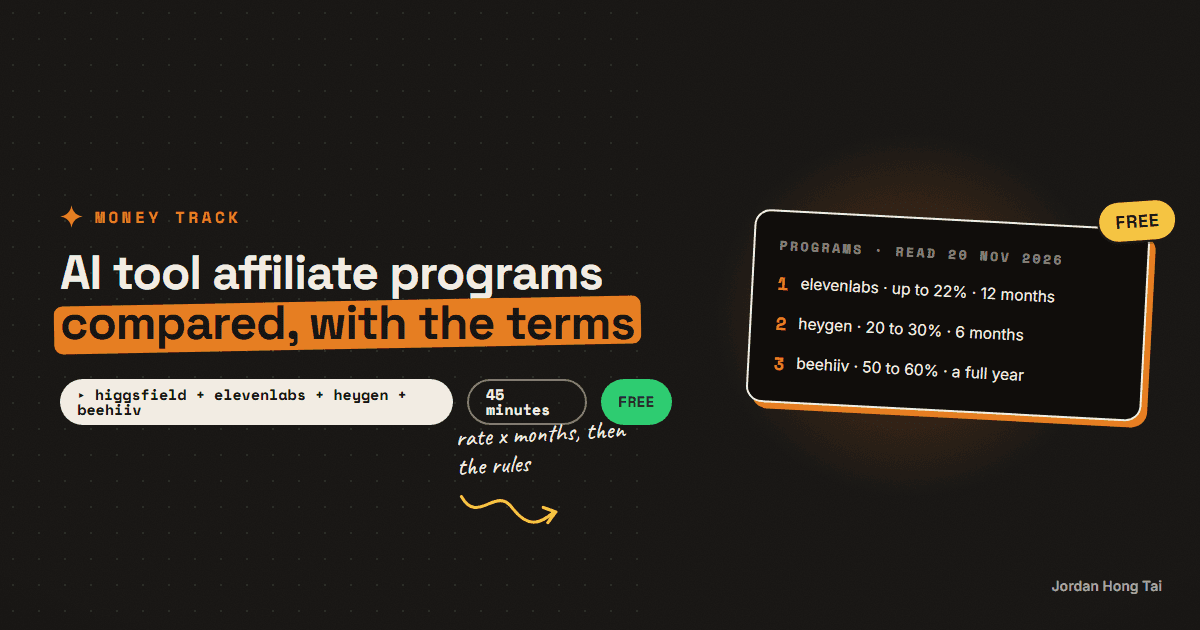
Most AI tools you already pay for will pay you to recommend them. The terms are public, and they're very different from each other. One pays for 6 months and another for 12. One won't accept a blog post at all.
I joined one of these programs in August 2026. A commission only arrives if someone signs up, so I don't treat it as income. I treat it as a link I have to get right every time: the tracking has to survive, and the reader has to be told. This guide is the terms of four programs as their own pages state them today, and the small check I run so a broken or undisclosed link can't go out.
No link on this page is an affiliate link.
What you'll have when you're done
- A side-by-side of four AI tool programs, read from each vendor's page
- A sum you can run for any program before you bother joining
- One registry file that holds your links, the rules and the disclosure line
- A script that fails when a draft has a partner link with no tracking or no disclosure
- [SCREENSHOT: terminal, one FAIL line and one ok line]
Before you start
- A tool you really use and would recommend unpaid. Start with one.
- Node.js 20 or newer for the check script.
- Somewhere you publish: a channel, a newsletter or a site. Some programs ask for an audience.
- About 45 minutes.
There's no download pack for this one. The script and the registry are on the page.
Step 1: Read the terms at the source
Read 20 November 2026 from each program's own page. Rates say "up to" because most programs have tiers.
| Program | Commission | Paid for | What to know |
|---|---|---|---|
| Higgsfield | up to 25% | up to 12 months | Paid in cash. No paid ads, no bidding on the brand name, no coupon or cashback sites. |
| ElevenLabs | up to 22% | first 12 months | Its page states 22% of a new subscriber's payments for 12 months, with no limit. |
| HeyGen | 20%, 25% or 30% | 6 months | Tier depends on conversions: under 100, 100 to 299, 300 or more. Credit if they subscribe within 30 days of the click. $100 minimum payout by PayPal after a 60-day clearing window. Original video content only. |
| beehiiv | 50%, 55% or up to 60% | a full year | 60-day cookie. Paid on the 15th for the month before. No Google or Bing ads on branded terms. |
Two things stood out to me. The first is that length matters as much as rate: 30% for 6 months and 22% for 12 months are not far apart on a subscriber who stays. The second is HeyGen's content rule. Its page says no SEO or blog-only promotion and asks for roughly 5,000 followers on one platform, so a written guide like this one wouldn't qualify there even if I wanted it to.
Check it worked: for the tool you picked, you can state the rate, how many months it pays, and one thing the program forbids. If you can't find one of those on the vendor's page, ask before you join.
Step 2: Run the sum before you join
Do this once per program. It takes a minute and it stops you from building a content plan around a number that's too small to matter.
commission per referral = plan price x rate x months paid

Example (an illustration, not a vendor's plan):
a $30 a month plan, 22% for 12 months
30 x 0.22 = $6.60 a month
6.60 x 12 = $79.20 if they stay the full year
Then be realistic about volume. The sum above is per paying subscriber who stays. A click isn't a subscriber, and plenty of subscribers cancel in month two. I think the right way to hold it is as a bonus on content you'd make anyway. Results vary; none of this is an earnings forecast.
Check it worked: you have one number: what a single referral is worth if they stay for the whole paid window. Write it in the registry in the next step.
Step 3: Keep one registry file
Every link, rule and disclosure line lives in one file. Anything that writes a caption, a guide or a post reads from it. Nobody types an affiliate link from memory.
[
  {
    "tool": "ExampleTool",
    "host": "exampletool.com",
    "param": "ref=yourname",
    "link": "https://exampletool.com?ref=yourname",
    "disclosure": "I earn a commission if you sign up through this link, at no extra cost to you.",
    "terms_read": "2026-11-20"
  }
]
Save it as partners.json. The param is the part of the link that sets the referral. If it gets dropped, the click still works and you earn nothing, and you won't notice. That's the failure this whole setup exists to catch.
Three rules I keep in mine, next to the link:
Use the link exactly as the program gave it.
Extra tracking is fine, but add it with & so the referral param survives.
No link shorteners on the affiliate link: a redirect can drop the param.
Check it worked: the file has one entry per program you've actually joined, and each entry has the date you last read the terms.
Step 4: Say it where the reader will see it
The US Federal Trade Commission's guidance covers this directly. Its endorsement FAQ says the same rules apply any time you endorse a product and get paid through affiliate links. It also says the words "affiliate link" on their own may not be enough, because readers might not understand that the person placing the link is getting paid.
So write a plain sentence, and put it beside the link. The FTC's own line is that "the closer the disclosure is to your recommendation, the better." It also says a disclosure only in a video description is easy to miss and isn't enough on its own, so say it in the video too.
Good     I earn a commission if you sign up through this link, at no extra cost to you.
Weak     affiliate link
Missing  a link in the description and nothing said in the video
I'm not a lawyer, and this is the FTC's guidance for the US. Other countries have their own rules, and each platform has its own paid-partnership label on top.
Check it worked: read your last post that has a partner link. The sentence that says you get paid is within one line of the link, in words a stranger would understand.
Step 5: Gate every draft with a script
Save this as affiliate-gate.mjs. Point it at your registry and a folder of drafts.
// node affiliate-gate.mjs partners.json drafts/
// Fails (exit 1) when a draft links a partner without the tracking param or without a disclosure.
import { readFileSync, readdirSync } from "node:fs";
import { join } from "node:path";

const [registry, dir] = process.argv.slice(2);
const partners = JSON.parse(readFileSync(registry, "utf8"));
const DISCLOSURE = /(i earn a commission|i get paid if you|paid commission|#ad\b)/i;
const SHORTENER = /\b(bit\.ly|tinyurl\.com|t\.co|rebrand\.ly)\//i;

let fails = 0;
for (const name of readdirSync(dir)) {
  const text = readFileSync(join(dir, name), "utf8");
  for (const p of partners) {
    const host = p.host.replace(/\./g, "\\.");
    const links = text.match(new RegExp(`https?://(www\\.)?${host}[^\\s)"'<>]*`, "gi")) || [];
    if (!links.length) continue;
    const untracked = links.filter((l) => !l.includes(p.param));
    if (untracked.length) {
      console.log(`FAIL  ${name}: ${p.tool} link without ${p.param} (no commission): ${untracked[0]}`);
      fails++;
    }
    if (!DISCLOSURE.test(text)) {
      console.log(`FAIL  ${name}: ${p.tool} link with no disclosure. Add: "${p.disclosure}"`);
      fails++;
    }
    if (!untracked.length && DISCLOSURE.test(text)) console.log(`ok    ${name}: ${p.tool} tracked and disclosed`);
  }
  if (SHORTENER.test(text)) console.log(`WARN  ${name}: shortened link found. A redirect can drop the tracking param.`);
}
process.exit(fails ? 1 : 0);
node affiliate-gate.mjs partners.json drafts/
I ran it on 20 November 2026 against two test drafts. One had the tracked link and the sentence. The other linked the tool's pricing page with neither:
FAIL  bad.md: ExampleTool link without ref=yourname (no commission): https://exampletool.com/pricing
FAIL  bad.md: ExampleTool link with no disclosure. Add: "I earn a commission if you sign up through this link, at no extra cost to you."
ok    good.md: ExampleTool tracked and disclosed
The exit code was 1, so a scheduler or a publish script stops there.
Check it worked: put one draft with a bare partner link in the folder. The script prints two FAIL lines and exits 1. Fix the draft and it prints ok and exits 0.
Step 6: Decide where a link belongs
A link earns its place when the content would exist without it. That's the test I use.
Use the link     a tutorial where the tool does the visible work
Skip the link    a comparison or ranking, where being paid by one side spoils the result
Skip the link    anything a program forbids (paid ads, brand-name bidding, coupon sites)
Never            a tool you don't use
I also don't owe any program a slot. A commission that depends on someone signing up isn't a sponsorship, so no week has to feature a partner. That was my call in September 2026 and I think it's kept the recommendations clean.
Check it worked: for your next three pieces, you can say for each one whether a partner link belongs and why. At least one of them should be a "no".
The honest part
I think most people overestimate this. The rates look large, and the sum per referral is real, but it only pays when a stranger signs up and stays. Programs change terms too. Every row in the table above has "up to" in it somewhere, and HeyGen's page describes tiers that move with your numbers.
So re-read the terms page on a schedule and update terms_read. If a rate on this page has changed by the time you read it, trust the vendor's page.
What I'd do differently
Read the forbidden list before the rate. One program rules out the only kind of content I'd have used.
Put the link in a file on day one. Typed from memory, a link loses its param sooner or later.
Write the disclosure once and reuse it. The same plain sentence everywhere is easier to check.
Gate drafts in code. A rule that only lives in a document gets skipped on a busy week.
FAQ
How much does the ElevenLabs affiliate program pay?
ElevenLabs' affiliate page says you can earn up to 22% commission, and states 22% of a new paid subscriber's payments for the first 12 months with no limit. Read 20 November 2026; check the page for current terms.
How much does the HeyGen affiliate program pay?
HeyGen's affiliate page lists three tiers by conversions: 20% under 100, 25% from 100 to 299, and 30% at 300 or more, each paid for 6 months per subscription. It credits a referral that subscribes within 30 days of the click, pays monthly by PayPal with a $100 minimum after a 60-day clearing window, and accepts original video content only. Read 20 November 2026.
Do I have to disclose affiliate links?
In the US, yes. The FTC's endorsement FAQ says its guidance applies any time you endorse a product and get paid through affiliate links. It asks for a clear disclosure close to the recommendation, and says the words 'affiliate link' alone may not be understood by readers.
Is a disclosure in the video description enough?
Not on its own, according to the FTC's endorsement FAQ, because viewers can easily miss it. Say it in the video as well, and keep the written sentence next to the link.
Why would an affiliate link stop earning without me noticing?
Because the link still opens the site. If a shortener, a redirect or a hand-typed URL drops the tracking parameter, the visitor arrives as normal and no referral is recorded. A script that checks every draft for the parameter catches it before you publish.
Related guides
Get the next build in your inbox
One email a week: the newest guides, plus one thing I only share with the list.
No spam. Unsubscribe anytime.

I can build this for you.
If you would rather not do the steps yourself, tell me what you need and I will show you how I would approach it.