Sell one AI automation to a local business: the 3 to pitch first and what they pay
Last updated August 2026 · 3 hours to build the first one · Make.com free tier or about $9/mo (Core, annual); Twilio number about $1.15/mo plus about $0.0079 per SMS segment in the US · Comfortable
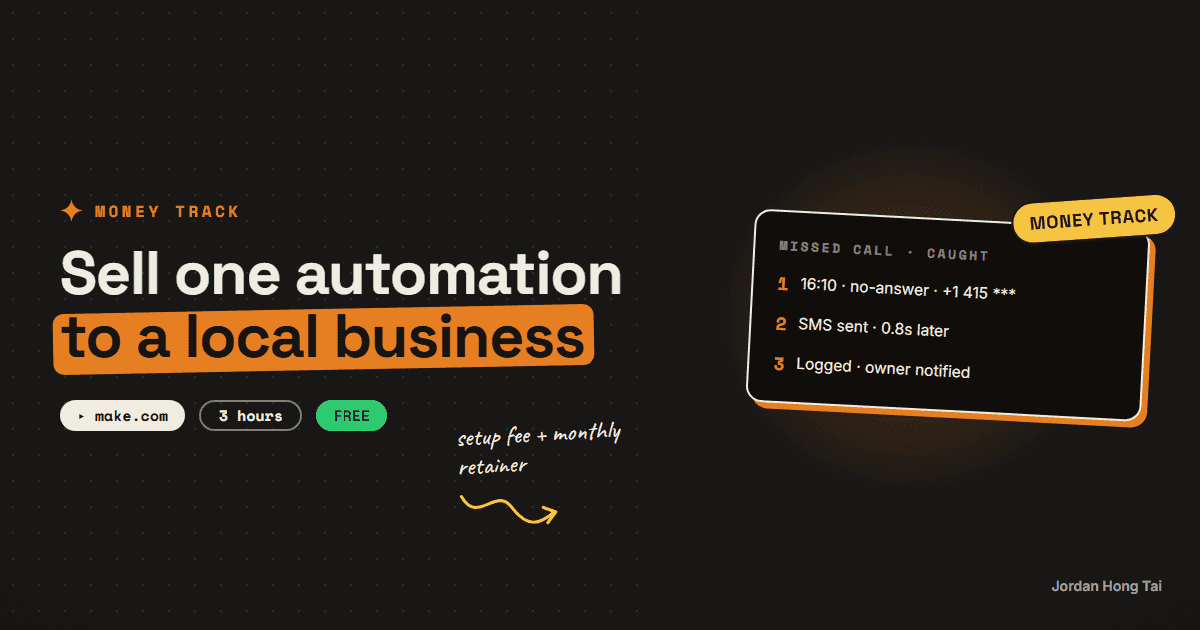
A dentist who misses 20 calls a month is not losing 20 calls. They are losing the ones that ring a competitor 30 seconds later. This guide covers the three automations local businesses will actually pay for, how to build each one in Make.com in an afternoon, what freelancers publicly charge for this category of work, and the outreach move that turns a cold walk-in into a paid setup fee plus a monthly retainer.
A dentist who misses 20 calls a month is not losing 20 calls. They are losing the handful that ring a competitor 30 seconds later. That gap is the easiest thing in the world to close with software, and almost nobody local has closed it.
This is the money-track version of automation work: not "AI transformation", not a strategy deck. Three specific automations, built in Make.com, that a dentist, a gym, a restaurant or a trades business will pay for because each one maps to a number they already track.
One thing up front about the money in this guide. Every price here is a public rate for this category of work on freelance marketplaces and agency price pages, quoted so you have an anchor before you invent one. They are not a forecast of what you will earn. What people charge and what any one person earns are different numbers, and yours depends on your market, your evidence and how many conversations you have.
What you'll have when you're done
- Three working Make.com scenarios you can demo live from your laptop
- A build-time and cost estimate for each, so you can quote without guessing
- A pricing structure: one-time setup fee plus a monthly retainer, with the public rate band behind it
- A list of 20 local businesses that failed a 60-second test you ran yourself
- The outreach message, which leads with their number and not your service
- [SCREENSHOT: the missed-call scenario running in Make.com with a live execution log]
Before you start
- A Make.com account. The free tier gives you 1,000 operations a month, which is enough to build and demo all three. The Core plan is about $9 a month on annual billing. Check current pricing before you quote.
- A Twilio account for the SMS legs. A US number is about $1.15 a month and outbound SMS is about $0.0079 per segment. US business texting requires A2P 10DLC registration: a form, a one-time fee, and a few days of waiting. Start it on day one, not the day before your first client goes live.
- A Google account for Sheets, which is the free stand-in for a CRM in every build below.
- A Claude or OpenAI API key for the third build only. Classification of a short inbound message costs a fraction of a cent.
- About 3 hours for your first scenario. The second and third take less.
Why these three and not the flashy ones
Local business owners do not buy automation. They buy a number moving. Every build below attaches to a number the owner can already say out loud.
| Automation | The number it moves | Why the owner feels it |
|---|---|---|
| Missed-call-to-text | Calls that never became a booking | They already know they miss calls. They hate it. |
| Review requests after a job | Google reviews per month | Reviews are how they get found. Asking is awkward. |
| Inbound lead triage | Hours spent sorting the inbox | Somebody is doing this by hand right now, badly. |
The builds that do not sell, from watching people try: chatbots on the website (owners think they look cheap), social media content automation (they do not believe it works), and anything whose benefit arrives in six months.
Automation 1: Missed-call-to-text follow-up
What it does. Someone calls the business. Nobody picks up. Within 30 seconds their phone buzzes with a text from the business: an apology, a question, and a way to book. The conversation continues by text, which the owner can answer between jobs.
Why they pay. This is the shortest line between an existing problem and a booking. A plumber on a roof cannot answer a phone. They can answer a text at 6pm.
What it is built from in Make.com
| Piece | Module | What it does |
|---|---|---|
| Trigger | Custom webhook | Twilio posts the call status here when a call ends |
| Filter | Route filter | Continue only if status is no-answer, busy or failed |
| Guard | Data store (search) | Skip if this number was already texted in the last 24 hours |
| Action | Twilio: send SMS | The follow-up message, from the business number |
| Log | Google Sheets: add a row | Time, caller number, message sent, outcome |
| Alert | Email or Slack | Tell the owner a missed call was caught |
| Guard | Data store (add) | Write the number so the 24-hour rule works next time |
The data store step is the one beginners skip and it is the one that stops the automation embarrassing your client. Without it, a caller who tries three times gets three identical texts.
The message itself is where most of the value is. Not this:
Thanks for calling! We'll get back to you soon.
This:
Hi, this is Sam at Northside Plumbing. Sorry we missed you just now,
we're on a job. What's the issue and which suburb are you in? I'll
text you back a time today. Reply STOP to opt out.
Name, reason, a question that is easy to answer, a commitment with a deadline, and the opt-out that keeps it compliant. The question is doing the work: a text that ends in a question gets answered, a text that ends in a promise does not.
Build time: 2 to 3 hours the first time, including the Twilio webhook setup. Under an hour once you have done it.
Check it worked: call the business number from your own phone, let it ring out, and your phone buzzes inside 30 seconds. Then call again immediately and confirm you get nothing the second time.
Automation 2: Review-request sequence after a job
What it does. A job is marked complete. Two hours later the customer gets one text with a direct link to the business's Google review form. If they have not left one after three days, they get exactly one reminder. Then it stops, forever.
Why they pay. Every local owner knows reviews matter and almost none of them ask consistently, because asking feels awkward in person and gets forgotten by evening.
What it is built from in Make.com
| Piece | Module | What it does |
|---|---|---|
| Trigger | Watch Google Sheets rows, or a webhook from their CRM | Fires when a job is marked complete |
| Delay | Sleep, or a scheduled scenario | Two hours, so the text lands after they have left |
| Action | Twilio: send SMS | One message, one link, the customer's first name |
| Wait | Scheduled second scenario | Runs daily, finds jobs 3 days old with no review flagged |
| Action | Twilio: send SMS | The single reminder |
| Stop | Google Sheets: update a row | Mark as complete so nothing sends again |
Get the review link right or the sequence dies at the last step. Use the Google Business Profile "Ask for reviews" short link, which opens the review box directly. A link to the business's Maps listing makes the customer hunt for the button, and most of them will not.
Hi Dana, thanks for having us out today. If the work was good,
a quick Google review helps a lot: <short link>
Takes about 20 seconds. Sam, Northside Plumbing.
One thing you must refuse to build. Clients will ask for a version that asks "how did we do?" first and only sends the review link to the happy ones. That is review gating, it is against Google's policies, and it can cost the business its reviews. Say no, explain why, and build the honest one. Handling that conversation well is a large part of why they keep paying you.
Build time: 2 to 4 hours, depending on whether their job data lives somewhere with an API or in a spreadsheet.
Check it worked: mark a test job complete, get the text two hours later, click through, and land on the review box with the star selector visible. Then confirm the row is flagged so the reminder never fires.
Automation 3: Inbound-lead triage and routing
What it does. Everything that comes in through the website form, the email inbox and the Facebook Page lands in one place. Each message is read, classified, and routed: a real job request pings the owner's phone, a supplier email drops into a folder, spam is discarded, and every one of them lands in a sheet with the fields already extracted.
Why they pay. The other two builds save a missed opportunity. This one saves a person's morning, and the owner can name the person.
What it is built from in Make.com
| Piece | Module | What it does |
|---|---|---|
| Triggers | Webhook, Gmail watch, Facebook Lead Ads | Every inbound path into one scenario |
| Brain | HTTP request to Claude, or the Anthropic module | Classify and extract fields, return JSON |
| Parse | JSON parse | Turn the model's answer into usable variables |
| Router | Router with 4 routes | New job, existing customer, supplier, spam |
| Actions | Twilio SMS, Gmail label, Sheets row | Different handling per route |
| Log | Google Sheets: add a row | One row per lead with the extracted fields |
Claude is the engine inside this build, not the subject of the pitch. The client never hears the word. They hear "your inbox sorts itself".
The classification prompt is the whole build. Keep it boring and make it return strict JSON:
You are triaging inbound messages for a plumbing business.

Classify the message below into exactly one category:
NEW_JOB, EXISTING_CUSTOMER, SUPPLIER, SPAM.

Then extract these fields. Use null when the message does not say.

Return ONLY this JSON, no commentary:
{
  "category": "",
  "name": null,
  "phone": null,
  "suburb": null,
  "problem": null,
  "urgency": "emergency | this week | flexible | unknown",
  "confidence": 0.0
}

Rules:
- "No hot water", "leak", "burst", "flooding" are emergency urgency.
- Anything selling something to the business is SUPPLIER, even if
  it is addressed to a person by name.
- If confidence is below 0.6, use category UNKNOWN so a human reads it.

MESSAGE:
[the message]
That UNKNOWN escape hatch is what makes the build safe to hand over. A triage system that silently mislabels a real job is worse than no triage, and the owner will find out about it from an angry customer, not from you.
Build time: 3 to 5 hours. Most of it is deciding, with the owner, what their four categories actually are. Do not guess this. Sit with them and read 30 real messages.
Check it worked: paste five real messages from their inbox through the scenario. All five land in the right route, the emergency one produces a text to the owner's phone within a minute, and the sheet has the fields filled.
What this kind of work is priced at
Here is what the market publicly asks for this category, so you have a floor and a ceiling before your first conversation.
| Line item | Public rate band | Where the number comes from |
|---|---|---|
| Automation freelancer, hourly | $25 to $75 per hour | Rates listed on Upwork and similar marketplaces for Make.com and Zapier specialists |
| One workflow, fixed price | $300 to $1,500 | Fixed-price listings for single-scenario builds in this category |
| Three-workflow package | $1,500 to $3,500 | Small-agency packages that bundle setup, testing and handover |
| Monthly management | $100 to $500 per month | Ongoing maintenance retainers listed alongside those builds |
| What the client already pays | $100 to $300 per month | Typical price of a home-service CRM plan that bundles some of this |
That last row matters more than the others. If a business already pays $200 a month for a CRM they barely use, a $250 monthly retainer that makes the whole stack work is an easy conversation. A $250 retainer offered as a brand new line item is a hard one.
How to find the businesses
Do not buy a list. Run a test that produces evidence you can put in the first sentence of your outreach.
The missed-call test, 60 minutes.
- Open Google Maps. Search one category in one suburb: "plumber", "dentist", "gym", "auto repair". Pick businesses with 20 or more reviews. Under that, they usually cannot afford you. Over about 200, they usually have somebody already.
- Build a list of 20 with name, phone, website and review count.
- Between 3pm and 5pm on a weekday, call each one. This is the busiest, most understaffed window of the day.
- Log three things: did a human answer, how long did it ring, and did you get any follow-up at all in the next hour.
- Fill in a website form on the same 20 and start a timer.
You will finish with a column that says something like "rang out at 4:10pm on Tuesday, no follow-up" next to 12 of the 20 names. That column is your entire pitch. You are not selling automation. You are handing them a fact about their own business that they did not have this morning.
Filter the list once more before you write: skip anyone whose website already shows a chat widget and an instant text-back, skip franchises where the phone is answered by a call centre, and prioritise businesses whose reviews mention slow responses.
What to say
Short, specific, and about them. Text or email beats a call, because a call makes you the person who interrupted their job.
Hi Sam, I called Northside Plumbing on Tuesday at 4:10pm and it
rang out. I called five other plumbers in the same hour and four
of them did the same.

I build the thing that fixes that: if a call goes unanswered, the
caller gets a text from your number within 30 seconds asking what
they need. You reply when you're off the roof.

I can show you it running on my phone in 10 minutes, this week.
Worth a look?

Jordan
What that message does, line by line: it opens with a fact about their business rather than a claim about you, it makes the problem a category problem so nobody feels accused, it describes the mechanism in one sentence with no product name in it, and it asks for 10 minutes rather than a meeting.
On the call, demo before you talk. Have the scenario live on your own Twilio number. Ask them to call it from their phone and let it ring. Their phone buzzes while you are still on the call with them. That 30 seconds sells more than any deck.
Then price it as two numbers, not one.
- Setup fee, paid before you build: covers the build, the Twilio registration, the testing and a handover walkthrough. Anchor inside the $300 to $1,500 band above, at the low end for your first two clients.
- Monthly retainer, starting the month after handover: covers monitoring, message changes, adding a step, and fixing it when an API changes underneath. Anchor in the $100 to $500 band.
Say the retainer out loud in the first conversation, never as a surprise after the build. The honest framing is the one that works: the setup fee is for the thing, the retainer is for it still working in six months. Automations break when a vendor changes an endpoint, and somebody has to be watching.
The upgrade path is already written. Land the missed-call build. Six weeks later, when the sheet shows how many calls it caught, propose the review sequence using the phone numbers you are already collecting. Then propose triage. Three builds at one business beats one build at three businesses on every measure that matters, including how much of your week you spend selling.
Check it worked: you have sent 20 messages, each one opening with a fact you personally collected about that business, and you have at least one demo call booked.
If the client wants to self-host
Some clients, especially anyone handling medical or legal data, will not put customer messages through a third-party cloud. That is a legitimate objection and it has a clean answer: n8n, which is open source, self-hostable, and free if they run it themselves.
The three builds above port over almost one for one. The webhook, the router, the HTTP request to Claude, the delay and the sheets writes all exist in n8n. What changes is who maintains the server, and that is a real scope difference: hosting, updates and backups are a job. Either charge for it as part of the retainer or hand it to their IT provider in writing. Do not absorb it silently.
The honest comparison, since you will be asked:
| Make.com | n8n (self-hosted) | |
|---|---|---|
| Cost | Free tier, about $9/mo Core | Free software, you pay for the server |
| Who maintains it | Make.com | You or the client |
| Data location | Make.com's cloud | Wherever they run it |
| Setup speed | Minutes | An afternoon, if the client has infrastructure |
| Best for | Almost every local business | Regulated data, or a client who wants to own it |
The local automation pack: 3 Make.com scenario specs, outreach scripts, pricing sheet
FAQ
Why Make.com and not Zapier or n8n?
Make.com sits in the right place for this work: it has a visual canvas a non-technical owner can look at without panic, a webhook module and an HTTP module that cover anything without a native integration, and pricing that starts free and runs about $9 a month on the annual Core plan. Zapier is easier but gets expensive fast at the task volumes a busy trades business hits. n8n is the free self-hosted alternative and is a better answer if the client wants to own the server or the data cannot leave their infrastructure. The three builds in this guide are the same logic in any of the three; only the module names change.
Do I need to be technical to build these?
You need to be comfortable reading an API doc and copying a webhook URL. There is no code in any of the three builds. The hardest part is Twilio's US A2P 10DLC registration for business texting, which is a form, a wait of a few days, and a one-time fee, not a programming problem.
What do I charge for the first one?
Look at what the category charges before you invent a number. Automation freelancers on public marketplaces bill roughly $25 to $75 an hour, and single-workflow projects in this category are commonly listed at $300 to $1,500. Ongoing management is usually a separate $100 to $500 a month. Your first build takes longer than your fifth, so many people price the first one at the bottom of that band or free in exchange for a written testimonial and a referral, then move up.
Who owns the automation, me or the client?
Decide this before you build, in writing. The clean version: the scenario lives in the client's own Make.com account, on their own Twilio number, paid on their card, and you have access as a team member. They own the asset, you own the maintenance relationship. Building it in your account gives you leverage that evaporates the moment they ask for their data, and it makes you the single point of failure for their phone system.
What if they already have a CRM that does this?
Many home-service CRMs bundle missed-call text back and review requests already, usually inside a plan that runs $100 to $300 a month. Ask what they pay for and what they actually have switched on. In practice the feature is often bought and never configured, which is still work worth being paid for, and the lead-triage build almost never exists off the shelf because it depends on how that specific business sorts its own jobs.
Is a missed-call text legal to send?
In the US, business texting on a Twilio number requires A2P 10DLC registration, and consent rules apply. A reply to someone who just called the business is the easiest case to defend because they initiated contact, but the message still needs the business name and a way to stop. Marketing blasts to a purchased list are a different thing entirely and are not what this guide builds. Check the current rules for the country you are operating in before you send.
Related guides
Automations that work while you sleep (free, no Zapier)
You'll put your AI research on a timer: it runs at 7 in the morning and the results are waiting when you wake up. Twenty minutes of setup, no Zapier, no subscription.
The comment-to-DM system that grows your email list on autopilot
You'll build the flow where one word in your comments turns into a DM with your link and an email on your list. Twenty-five minutes in ManyChat, on the free plan.
I stopped filming my reels (my AI avatar reads the script)
You'll set up a pipeline where a text file becomes a talking-head clip of your own AI avatar, in your voice, with no camera. Claude Code calls HeyGen's API from a skill file, waits for the render, and drops the clip in your editing folder. After the 30-minute setup, a reel starts with a paragraph, not a tripod.
Get the next build in your inbox
One email a week: the newest guides, plus one thing I only share with the list.
No spam. Unsubscribe anytime.
Build alongside others
Join the free community and share what you're shipping.

Jordan Hong Tai
I've scaled products to over 500K users, and now I build AI systems in public from a balcony in Tokyo.