Sell an AI search visibility audit to a small business: Otterly's $29 tracker, what agencies quote for GEO, and the 15-question report
Last updated October 2026 · About 4 hours of work per audit, spread over 2 to 4 weeks · From $0 by hand; Otterly.AI Lite $29/mo (about $25/mo billed yearly) · Comfortable
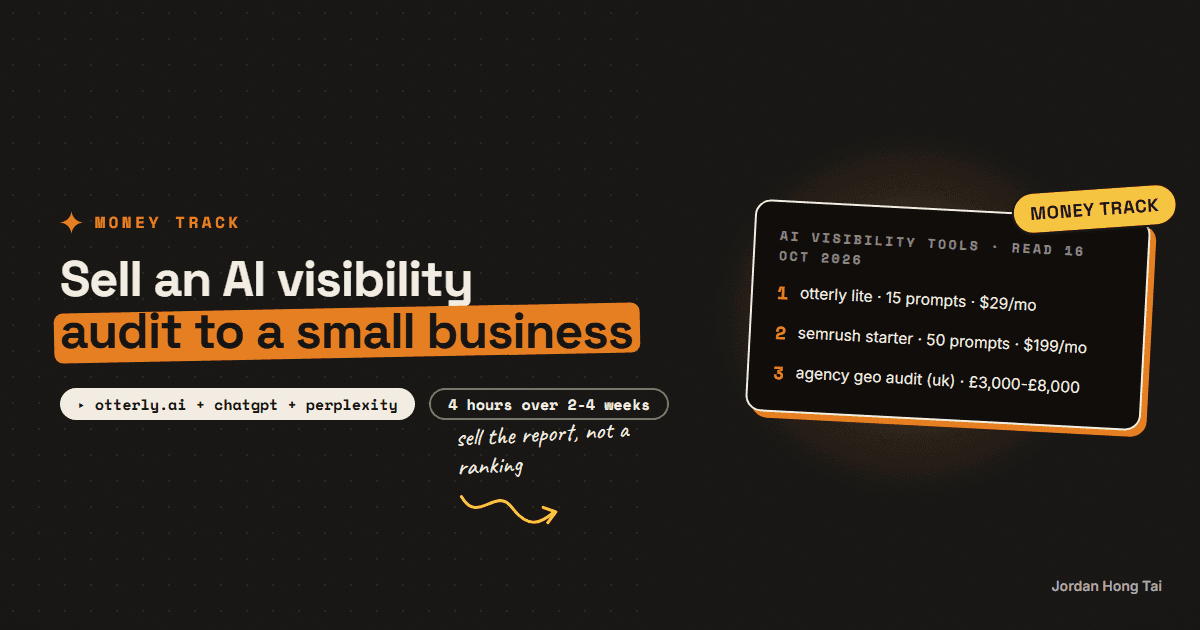
Otterly.AI's Lite plan tracks 15 questions across ChatGPT, Google AI Overviews, Perplexity and Microsoft Copilot for $29 a month. A UK agency pricing guide from July 2026 puts a standalone GEO audit at £3,000 to £8,000. A small business won't pay agency prices, but it will pay someone to tell it, with screenshots, whether AI answers name it and what to fix first.
Otterly.AI's Lite plan tracks 15 questions across four AI engines for $29 a month: ChatGPT, Google AI Overviews, Perplexity and Microsoft Copilot. That's from its pricing page, read on 16 October 2026. Gripped's B2B SaaS pricing guide, updated in July 2026, puts a standalone GEO audit from a UK agency at £3,000 to £8,000.
A dentist or a roofer isn't going to pay agency prices. But a lot of owners have started to wonder whether ChatGPT mentions them, and they'll pay someone to find out, with screenshots, and to tell them what to fix first. That's the service in this guide.
It's built on the two free guides I already wrote, the 5-question audit and the tracking spreadsheet. This one turns them into something you can sell: the questions, a by-hand baseline, a month of tracking, a report and a price you can defend. Results vary a lot. Nothing here is a forecast of what you or anyone will earn.
What you'll have when you're done
- A list of 15 buying questions for one real business, written the way its customers type them
- A by-hand baseline: who ChatGPT, Perplexity and Google name for each question today
- A month of tracked answers from Otterly.AI, or a spreadsheet if you start at $0
- A two-page report that ends on three fixes and a re-check date
- A fixed-price offer that says plainly what you can and can't promise
- [SCREENSHOT: the Otterly.AI prompt table for one client, with the brand-mention column filled in]
Before you start
- Accounts in ChatGPT and Perplexity, free tiers are fine for the baseline, and a normal Google search for AI Overviews.
- Otterly.AI, optional. Lite is $29 a month for 15 prompts, or about $25 a month billed yearly, and new users get a free trial. You can do the first audit without it.
- A spreadsheet. Google Sheets is fine.
- One business that will let you audit it. A friend's clinic, a local shop, the agency you used to work at.
- About four hours of work, spread over two to four weeks so the tracker has time to collect.
Otterly.AI: otterly.ai
There's no download pack for this one. The question template, the report outline and the offer are all on the page.
Step 1: Know what the tools cost before you price anything
Here's what the main trackers list, read on 16 October 2026.
| Tool and plan | Price a month | Tracked prompts | Engines |
|---|---|---|---|
| Otterly.AI Lite | $29 (about $25 billed yearly) | 15 | ChatGPT, Google AI Overviews, Perplexity, Copilot |
| Otterly.AI Standard | $189 (about $160 billed yearly) | 100 | Same four |
| Otterly.AI Premium | $489 | 400 | Same four |
| Semrush Starter (SEO + AI Search) | $199 billed monthly ($165.17 billed yearly) | 50, tracked daily | Google, ChatGPT, Perplexity, Gemini and more |
Otterly sells Google AI Mode, Gemini and Claude as add-ons. On Lite they're $9, $9 and $29 a month. You don't need them for a first audit.
So the per-client tool cost depends on how many clients share a plan. Lite's 15 prompts are one client at a time, so one client is $29. Standard's 100 prompts fit six clients at 15 questions each, which is $189 split six ways, about $31.50 a client. I'd start on Lite with one client and only move up when a second one says yes.
Tool cost sheet (one row per month)
plan:                    lite $29 / standard $189
clients on the plan:     ______
prompts per client:      15
tool cost per client:    plan price / clients
your hours per audit:    ______  (start at 4)
Check it worked: you can say what one client costs you in tools and in hours for one month. If you can't, you aren't ready to quote yet.
Step 2: Write 15 questions the way customers type them
The whole audit is only as good as the questions. Don't use the business name, because nobody types "is Smith Dental good". Use what a stranger types when they don't know who to pick yet. Sit with the owner for 20 minutes and ask what customers ask on the phone before they book.
15 buying questions for [business]
5 "best" questions:     best [service] in [town] / for [type of customer]
4 "how much" questions: how much does [service] cost in [town]
3 "vs" questions:       [service A] or [service B] for [problem]
3 "problem" questions:  [symptom or problem] what should I do
Write them in plain words, with the town in, and keep a copy. You'll run the same 15 again at the re-check, so they can't change halfway through.
Check it worked: read each question out loud. If it sounds like something a real customer would say to a friend, keep it. If it sounds like a keyword, rewrite it.
Step 3: Run the baseline by hand, with screenshots
Before any tool, run every question yourself in ChatGPT, Perplexity and a Google search, logged out or in a private window. Screenshot each answer. That's 45 screenshots, and they're the part of the report an owner actually looks at.
Log three things for each answer in the sheet.
Baseline log (one row per question per engine)
question | engine | named? (yes/no) | who was named instead | cited domains
Answers change from one run to the next, so one run is a snapshot, not a score. The tracking guide runs each question three times for that reason, and I'd do the same for the five "best" questions at least.
Check it worked: you have 45 rows and a screenshot for each. You can say, out of 45 answers, how many named the business and which competitor got named most.
Step 4: Put the 15 questions in a tracker for the month
The baseline is one day. A tracker shows the month. In Otterly.AI, add the business as a brand, add its main competitors, paste the same 15 questions as prompts and pick the country. Then leave it alone for two to four weeks.
If you're starting at $0, the spreadsheet version does the same job, just by hand. Re-run the five "best" questions once a week and log them in a new tab.
What you're watching for is pattern, not a single answer. Which competitor keeps getting named? Which domains keep getting cited, a directory, a review site, a Reddit thread, a news page? Those cited domains are where the fixes come from.
Check it worked: after two weeks, you can name the three domains the engines cite most for this business's questions. If you can't, add the cited-domains column and wait another week.
Step 5: Turn the data into three fixes
An owner can't act on a spreadsheet. So the report ends on three fixes, picked from what the data showed. The GEO playbook has the full set. For a small business, the three that come up most are these.
The plain sentence. One sentence that says what the business is, who it's for and where, used word for word on the homepage, the Google Business Profile and every directory. Engines repeat what they can find stated plainly.
The answer page. If the "how much" questions name nobody, a page that answers "how much does [service] cost in [town]" in its first two sentences, with a real price range, is the fix.
The cited domain. If one directory or review site keeps getting cited, the business needs to be on it, with the same plain sentence.
Check it worked: each fix names the question it should change and the page or listing to edit. If a fix doesn't point at something the owner can open and change, cut it.
Step 6: Write the two-page report
Keep it short enough to read on a phone.
AI visibility audit: [business], [month]
1. The 15 questions (one line each)
2. Baseline: named in [N] of 45 answers. Named most instead: [competitor]
3. Three screenshots: one good, two where a competitor won
4. The month: what changed, which domains got cited most
5. Three fixes, each with the question it should move
6. Re-check date: [date], same 15 questions, same engines
Note: AI answers vary from run to run and no one can guarantee a citation.
Check it worked: the owner can read it in five minutes and say what they'll change first. If they need you on a call to explain it, cut it down.
Step 7: Price it, and say what you can't promise
Agency prices are a ceiling, not your price. Gripped's guide, first published 15 June 2026, says a standalone GEO audit "might cost £3,000 to £8,000 as a fixed project", and UK agencies charge £1,500 to £5,000 a month on retainer for mid-market SaaS. An Australian agency, Optimising, lists one-off AI readiness audits at $10,000 to $20,000. Those are bigger clients and bigger sites.
For a small business I'd price the audit as one fixed fee, built from the hours on your cost sheet plus the month of tracking, and offer the re-check as a second, smaller fee. That's an easier yes than a retainer, and the re-check is where the owner sees whether the fixes moved anything.
Hi [name], I asked ChatGPT, Perplexity and Google the 15 questions
your customers ask before they book, like "[best question]".
You were named in [N] of 45 answers. [Competitor] was named in [M].

For a fixed fee I'll track those 15 questions for a month, send you
a two-page report with screenshots and three fixes, and re-check the
same questions after you've made them.

I can't promise ChatGPT will cite you. Nobody can. I can show you
exactly where you stand and what to change.

Jordan
Check it worked: your offer says the fee, what's in the report, the re-check date and the line that citations aren't guaranteed. If it promises a ranking, rewrite it.
The honest part about this market
The tracker is $29 and the baseline is free, so the tooling won't protect your price for long. Some owners will just buy Otterly themselves, and that's fine.
What I think an owner pays for is the 15 questions being the right ones, the screenshots that make it real, and fixes they can actually do. And you can't promise the outcome. AI answers move from run to run and no one controls what an engine cites. If anyone pitches you a guaranteed ChatGPT ranking, that's the tell.
What I'd do differently
Write the questions with the owner. Twenty minutes on what customers ask on the phone beats an hour of keyword tools.
Screenshot everything. The screenshots sell the audit. The numbers back it up.
Sell the re-check up front. It's the only way the owner sees whether the fixes worked.
Start on Lite with one client. Move to a bigger plan when a second client says yes, not before.
FAQ
What is an AI visibility audit?
An AI visibility audit, often called a GEO audit, checks whether AI answer engines like ChatGPT, Perplexity and Google AI Overviews name a business when people ask the questions its customers ask. It records who does get named and which pages get cited. Then it turns that into a short list of fixes.
How much does Otterly.AI cost?
Otterly.AI's pricing page, read 16 October 2026, lists Lite at $29 a month for 15 search prompts, Standard at $189 for 100 and Premium at $489 for 400, with about 15% off billed yearly. Lite covers ChatGPT, Google AI Overviews, Perplexity and Microsoft Copilot. Google AI Mode, Gemini and Claude are paid add-ons, and new users get a free trial.
What do agencies charge for a GEO audit?
Gripped's B2B SaaS pricing guide, first published 15 June 2026 and updated 1 July 2026, says a standalone GEO audit might cost £3,000 to £8,000 as a fixed project, and UK agencies charge £1,500 to £5,000 a month for mid-market SaaS retainers. An Australian agency, Optimising, lists one-off AI readiness audits at $10,000 to $20,000. Those are agency asking prices for bigger clients, not what a local business will pay.
Can I do an AI visibility audit without a paid tool?
Yes. Run each buying question by hand in ChatGPT, Perplexity and Google, screenshot the answer and log who gets named in a spreadsheet. It takes longer and you only get a snapshot, which is why a tracker helps once a client pays for a month of data.
Can I guarantee a business will get cited by ChatGPT?
No, and I wouldn't try. AI answers change from run to run, and no one controls what an engine cites. Sell the measurement, the fixes and a re-check date, and say in writing that citations aren't guaranteed.
Which businesses should I pitch first?
Pick businesses whose customers ask a question before they buy: a dentist, an accountant, a roofer, a local software shop. If the honest buying question is 'best [service] in [town]', AI answers already have an opinion about it, and the owner will want to see it.
Related guides
Does ChatGPT cite you? The 5-question AI visibility audit (30 minutes, free)
You'll find out, in about 30 minutes, whether ChatGPT, Perplexity and Google's AI Overviews name you when your customers ask the questions that lead to a purchase. Five questions, three engines, one sheet, and a score out of 15. Then you'll know which of three levers to pull first.
Track whether AI answers name you, with a spreadsheet and Claude
Ask ChatGPT the same buying question twice and you will often get two different lists of sources. NJIT researchers measured it across 11,500 real queries and found AI Overview source sets overlapping at a Jaccard score of 0.66 between two runs of the identical query, against 0.78 for the ordinary results page. A newer paper ran 50 questions across 6 engines 15 times each and found five of the six still naming brands they had never named before at run 15. So a single audit is not a measurement, it is one draw from a distribution. The repetition is the product, and you can get it with a spreadsheet for nothing.
GEO for a small brand: entity, quotable structure, third-party mentions
There are three things that decide whether an AI answer names your brand, and only three. A clear entity, pages that can be quoted without editing, and mentions on the sites the engines already trust. This is what to do for each one, in the order that works when you have no team and no budget.
Get the next build in your inbox
One email a week: the newest guides, plus one thing I only share with the list.
No spam. Unsubscribe anytime.
Build alongside others
Join the free community and share what you're shipping.

Jordan Hong Tai
I've scaled products to over 500K users, and now I build AI systems in public from a balcony in Tokyo.