GEO for a small brand: entity, quotable structure, third-party mentions
Last updated August 2026 · 30 days (2 hours to start) · Free · Comfortable
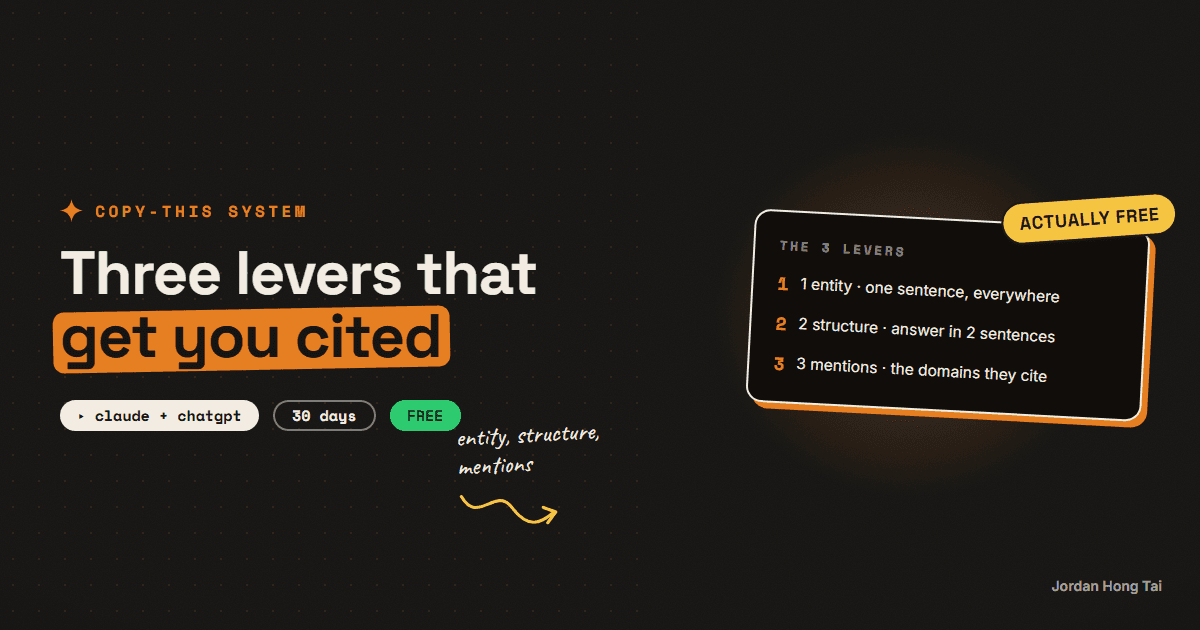
There are three things that decide whether an AI answer names your brand, and only three. A clear entity, pages that can be quoted without editing, and mentions on the sites the engines already trust. This is what to do for each one, in the order that works when you have no team and no budget.
When someone asks ChatGPT which tool to buy, the answer names two or three brands and the click never happens. Getting named is what GEO, generative engine optimization, is for. Ranking is not the same job any more.
For a small brand there are three levers, and I have never found a fourth that matters. A clear entity, so the engines can describe what you are. Quotable structure, so a paragraph of yours can be lifted without editing. Third-party mentions, so the sites the engines already trust say your name. This guide is what to do for each one, in the order that works when you have no team.
If you have not measured yet, do that first: the 5-question AI visibility audit takes 30 minutes and tells you which of these three levers you are on. The rest of this page assumes you know your score.
What you'll have when you're done
- One entity sentence, written down, live word for word on your site, your profiles and your schema
- Five pages that answer your five buying questions in the first two sentences
- A ranked list of the domains AI engines actually cite for your niche, with a next action against each one
- A 30-day sequence with something concrete in it every week
- A monthly re-measurement so you can tell movement from noise
- [SCREENSHOT: the three-lever worksheet filled in for a real brand]
Before you start
- Your 5 buying questions. If you do not have them, write them first: the questions a customer types the week before they choose, none of them containing your brand name.
- Your visibility score out of 15 from the audit, and the list of sources that got named instead of you.
- Access to edit your own site, your LinkedIn, and your profiles on any directory that lists you.
- A Claude or ChatGPT account for the drafting steps. Free plans are fine.
- Two hours to start. The full sequence runs 30 days.
Lever 1: Entity
An entity, in this context, is the engines' internal answer to "what is this thing?". If they cannot answer that in one sentence, they will not risk naming you in a buying answer. This is the least glamorous lever and it is first for a reason: the other two do very little until it is fixed.
Test whether you have a problem
Fresh chat, no memory, three engines:
What is [your brand name]?Read the answer like a stranger. There are four outcomes and only one of them is fine:
- It describes you correctly and specifically. No problem here, move to Lever 2.
- It hedges: "I do not have specific information about..." You have no entity.
- It guesses a category: "appears to be a marketing agency". You have a vague entity.
- It describes a different company with a similar name. You have a collision, and it is the most urgent version of this problem.
Write the sentence
One sentence, three parts: what you are, who it is for, what makes it different. No adjectives that a competitor could also claim.
Before and after, from a real cleanup:
We help ambitious brands unlock their full potential through
data-driven, human-centered growth strategy.
Nothing in that can be indexed. "Ambitious brands" is not a customer, "unlock potential" is not a service, and "data-driven" is claimed by everyone. An engine reading this cannot decide when to name you.
Hongtai Ventures builds AI marketing systems for early-stage AI and
crypto companies: growth automation, content engines and GTM tooling,
run by one operator instead of an agency team.
Now there are handles: a category (AI marketing systems), a customer (early-stage AI and crypto companies), three concrete services, and a differentiator that is falsifiable. When someone asks "who does growth for early-stage AI startups", that sentence can be matched.
Draft yours with help, then cut it yourself:
Here is what my company does, in messy form:
[paste your about page, your pitch, whatever exists]

Write 5 candidate one-sentence descriptions. Rules:
- Structure: [name] does [specific thing] for [specific customer],
  [what makes it different].
- No adjectives a competitor could also use (leading, innovative,
  data-driven, human-centered, best-in-class, cutting-edge).
- Name the actual category a customer would search, not a category
  you invented.
- Under 35 words. Plain sentence, no marketing rhythm.
- Then list, for each candidate, which specific customer question it
  would let an AI answer with my name.
Pick one. Read it out loud. If it sounds slightly boring, it is probably right.
Put it everywhere, word for word
The point is repetition without variation. Same name, same sentence, same spelling:
- Homepage, in the first 200 words of visible text
- About page, first paragraph
- The site's meta description
- LinkedIn company page and your personal LinkedIn About
- Every social bio (shortened, but never rewritten with different nouns)
- Every directory, marketplace or partner page that lists you
- Your
Organizationschemadescriptionfield
That last one, minimally:
{
  "@context": "https://schema.org",
  "@type": "Organization",
  "name": "Hongtai Ventures",
  "url": "https://jordanhongtai.com",
  "description": "Hongtai Ventures builds AI marketing systems for early-stage AI and crypto companies: growth automation, content engines and GTM tooling, run by one operator instead of an agency team.",
  "sameAs": [
    "https://www.linkedin.com/in/jordanhongtai",
    "https://x.com/TheJordude",
    "https://github.com/hongtaiventures"
  ]
}
sameAs is doing real work: it ties the profiles together so three mentions of the same name resolve to one entity instead of three weak ones.
Check it worked: the entity test on all three engines returns a description you would accept on a slide, and you can point at six places where the identical sentence is live.
Lever 2: Quotable structure
The engines are looking for a passage they can lift and attribute. Most marketing pages make that impossible, not because the writing is bad but because the answer arrives in paragraph four.
The shape of a quotable paragraph
Unquotable, and typical:
## Why AI visibility matters in 2026

The search landscape has shifted dramatically over the past two years.
Marketers who built their playbooks around blue links are discovering
that the ground has moved beneath them. In this article, we'll explore
what that means for your brand and share some strategies we've found
effective in our work with clients.
There is no sentence in there an engine can quote as an answer to anything. It is throat-clearing, and it is the default output of most content briefs.
Quotable:
## What is an AI visibility audit?

An AI visibility audit checks whether AI answer engines name your brand
when customers ask the questions that lead to a purchase. You run 5
buying questions through ChatGPT, Perplexity and Google AI Overviews,
log which sources each answer names, and score how often you appear out
of 15 answers.

It takes about 30 minutes and needs no paid tools. The output is a
score and a list of the domains that get cited instead of you.
The differences are mechanical, and you can apply them to any page today:
- The heading is the question, phrased the way a person asks it.
- The first sentence is a definition that stands alone. Delete the heading and it still makes sense, which is exactly what an engine does when it lifts it.
- The second paragraph adds the constraints: time, cost, output. Those are what get quoted next.
- No pronoun with an antecedent above it. "This approach" and "it" are un-liftable, because the referent stays behind on your page.
- Numbers, not adjectives. "About 30 minutes" survives being quoted. "Quick and easy" does not.
Three page shapes that get lifted
Definition-first pages. One question per H2, direct answer underneath, then the detail. Build one for each of your five buying questions.
Comparison tables. Engines quote tables often, and a fair table naming your competitors is more likely to be cited than a page that pretends they do not exist.
| Your tool     | Alternative A | Alternative B
---------------|---------------|---------------|---------------
Starting price | $X/mo         | $Y/mo         | free tier
Best for       | one case      | another case  | another case
Setup time     | 10 minutes    | 2 hours       | 10 minutes
The catch      | your honest   | theirs        | theirs
               | limitation    |               |
Write the "the catch" row honestly, including for yourself. A table that only flatters you reads as marketing and gets skipped; a table that concedes something is the kind of source an engine quotes.
FAQ blocks. Four to six questions at the end of every important page, phrased as people ask them, each answered in two to four self-contained sentences with no "as mentioned above". Add FAQPage schema. Google mostly stopped showing FAQ rich results in 2023, but the AI crawlers still read the markup, and the format itself is the point.
Rewrite an existing page with this prompt:
Here is a page from my site:
[paste the page]

Rewrite it so an AI answer engine could quote it. Rules:
- Turn each section heading into the question a customer would type.
- Under each heading, sentence one is a complete, standalone answer
  that still makes sense with the heading deleted.
- Sentence two or three carries the concrete constraints: time, cost,
  requirements, output.
- No opening sentence may start with "In this article", "The landscape",
  or any variation of throat-clearing.
- No pronoun whose referent is in an earlier paragraph.
- Replace every adjective of degree with a number or delete it.
- Keep my facts. Do not invent numbers. If a number is missing, mark it
  [NEEDS NUMBER] instead of guessing.
- At the end, add 5 FAQ questions phrased the way people ask them, each
  answered in 2 to 4 self-contained sentences.
Check it worked: open any of your five pages, read only the first two sentences under the main heading, and they answer the question completely. If you have to keep reading, it is not done.
Lever 3: Third-party mentions
Your own site is one vote. In my audit runs, the sources AI answers actually named were mostly not the brands' own sites: roundups, review platforms, community threads and comparison articles carried far more of the citations. That means the third lever is not on your website at all.
Find the domains that matter for your niche
Do not use a generic list of "high authority sites". Build the list from your own questions.
- Run each of your 5 buying questions in ChatGPT, Perplexity and Google AI Overviews. Clean context: a temporary chat, a new thread, an incognito window.
- For each answer, write down every domain cited or linked, in the order it appears.
- Count. Fifteen answers gives you 40 to 80 domain mentions.
- Rank by frequency.
Let Claude do the tallying:
Below are 15 AI answers to buying questions in my niche, each under a
heading like "Q1 / chatgpt". Extract every domain that is cited or
linked in each answer.

Output:
1. A table: domain, times cited, which questions, which engines.
   Sort by times cited, descending.
2. Classify each domain: REVIEW SITE / ROUNDUP OR LISTICLE /
   COMMUNITY (forum, Reddit, Discourse) / NEWS OR PUBLICATION /
   BRAND OWN SITE / DOCS / OTHER.
3. For the top 10, one line each on the realistic way a small brand
   gets mentioned there: submit a listing, pitch the author, answer a
   thread, get reviewed, contribute a guest piece, or "no realistic
   path".

Do not include domains that are not in the text below.

ANSWERS:
[paste]
The "no realistic path" verdict is doing useful work. Some citations come from publications you will not get into this year. Naming that honestly stops you burning a month on it.
The realistic ways in, ranked by effort
- Directory and marketplace listings. Lowest effort, and often the fastest citation. If a listing site appears twice in your tally, get listed this week. Use the entity sentence verbatim in the listing.
- Review platforms. Ask your five happiest customers for a review on the platform that appears most in your tally. Not on all of them, on the one the engines cite.
- Community threads. Find the threads the engines cited, and answer the question properly, with your reasoning and one link, in the voice of someone who knows the subject. A thread from 2024 that gets cited today will still be cited next year.
- Roundups and listicles. Email the author with a specific reason you belong in the list: the case they do not cover, the customer segment none of the current entries serve. Reference the actual article. One paragraph.
- Guest contributions. Slowest, and worth it only for the publication at the top of your tally.
Every one of these uses the same entity sentence. That is the compounding: Lever 1 makes Lever 3 legible.
Check it worked: you have a ranked table of cited domains with a next action against the top 10, and at least one action already done this week.
The 30-day sequence
Order matters more than speed. Entity first, because everything else references it.
Week 1: entity. Run the entity test on three engines. Write the sentence. Roll it out to all six or more surfaces including schema. Update every profile. Two focused hours, then done.
Week 2: structure, on five pages. One page per buying question. Heading as the question, answer in the first two sentences, constraints in the second paragraph, FAQ block at the bottom with schema. If the page does not exist, write it; if it exists, rewrite the top of it.
Week 3: the citation list. Fifteen answers, tally the domains, rank them, classify them, write the next action for the top 10. Then execute the cheapest three: listings, a review ask, one community answer.
Week 4: outreach and one comparison page. Two or three roundup pitches, referencing the actual article. Publish one honest comparison page including the "the catch" row about yourself.
Day 30: re-run the audit. Same five questions, same three engines, same sheet, new date. Compare the score, and compare the top-sources list.
How to measure without lying to yourself
Track three numbers, monthly, in the same sheet:
- Score out of 15. How many of your 15 answers name you.
- Engine spread. 5 out of 15 concentrated in one engine is a very different position from 5 spread across three, and it tells you whether you have a general problem or an engine-specific one.
- Repeat sources. Domains cited in both this month's and last month's runs. That is your real target list; anything appearing once is probably noise.
What not to track: how many words you published, how many pitches you sent, whether your rankings moved. Those are inputs. The output is whether the answer says your name.
Check it worked: a second dated run exists in your sheet, you can state the score change in one sentence, and you know which lever you are working next month and why.
FAQ
What is GEO, and is it different from SEO?
GEO stands for generative engine optimization: getting named and cited inside AI-generated answers rather than ranked in a list of links. It overlaps with SEO because the engines still crawl the web, but the unit of success is different. SEO wins a position; GEO wins a sentence inside somebody else's answer. That changes what you write and where you spend your outreach time.
I have no backlinks and no budget. Is this pointless?
No, and small brands actually have one advantage: a narrow entity is easier to describe than a broad one. If you sell one thing to one kind of person, one sentence covers you completely, and the engines pick that up faster than they pick up a company with nine product lines. Start with the entity lever, which costs nothing but an afternoon.
Does schema markup help with AI answers?
It helps as a consistency signal, not as a magic switch. Organization schema that repeats the same name, description and sameAs profiles as the rest of your site makes your entity harder to get wrong. What it will not do is get you cited on its own. Treat it as the last 10% of the entity lever, after the visible sentences already agree everywhere.
How long before I see a change?
In my runs the entity fix showed up fastest, within a few weeks, measured by asking an engine what your brand is and getting a correct answer instead of a hedge. Structure changes need the page to be recrawled. Third-party mentions are the slowest and the most durable. Re-run the audit monthly and expect the trend line, not a jump.
Should I write a page for every question my customers ask?
Start with five. One page per buying question, each answering its question in the first two sentences. Five good answer-first pages beat forty thin ones, and the engines do not reward volume the way a keyword tool implies. Add five more next month if the audit shows those five getting quoted.
How do I know which sites to pitch?
Do not guess. Run your five buying questions through ChatGPT, Perplexity and Google AI Overviews, write down every domain that gets cited, and count. The domains that appear three or more times across fifteen answers are your target list, in frequency order. That list is specific to your niche and it changes what you pitch.
Related guides
Does ChatGPT cite you? The 5-question AI visibility audit (30 minutes, free)
You'll find out, in about 30 minutes, whether ChatGPT, Perplexity and Google's AI Overviews name you when your customers ask the questions that lead to a purchase. Five questions, three engines, one sheet, and a score out of 15. Then you'll know which of three levers to pull first.
I'm rebuilding my whole site with AI, in public (part 1)
I'm tearing my website down and letting AI rebuild it, with every phase documented in public. Part 1 covers the three documents that made the whole thing survivable, and what actually happened in the first phases.
The exact system that writes a week of my content in an hour
You'll build the AI content creation system that turns one topic into a week of platform-ready drafts, in your voice. One hour to set it up, and after that Monday runs the week.
Get the next build in your inbox
One email a week: the newest guides, plus one thing I only share with the list.
No spam. Unsubscribe anytime.
Build alongside others
Join the free community and share what you're shipping.

Jordan Hong Tai
I've scaled products to over 500K users, and now I build AI systems in public from a balcony in Tokyo.