Does ChatGPT cite you? The 5-question AI visibility audit (30 minutes, free)
Last updated August 2026 · 30 min · Free · Beginner
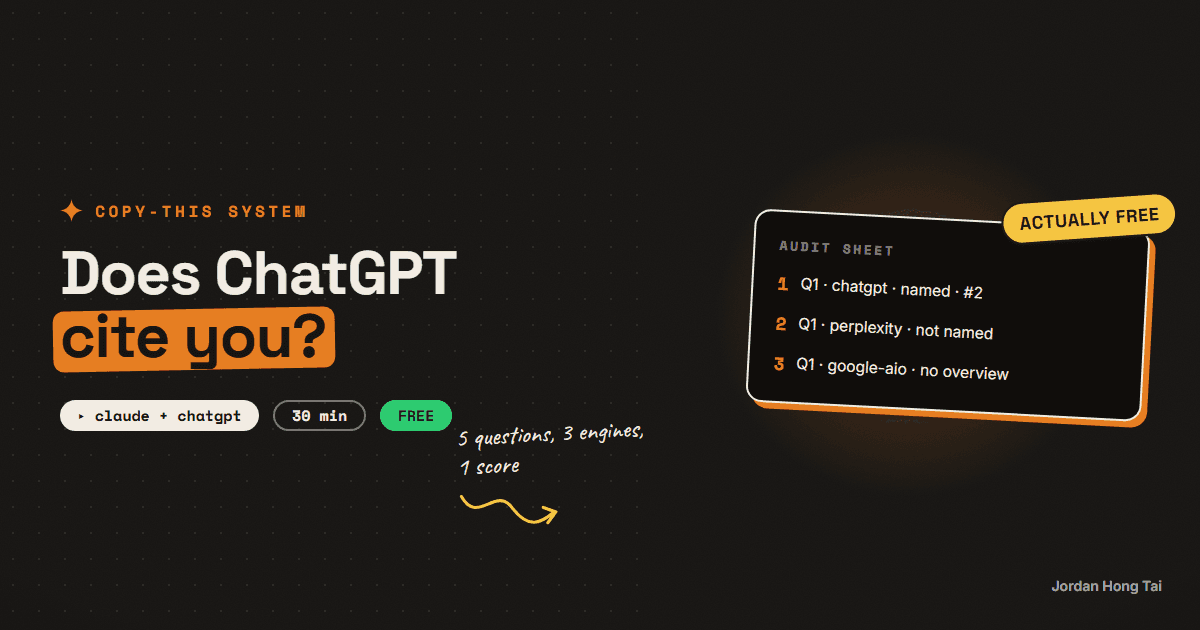
You'll find out, in about 30 minutes, whether ChatGPT, Perplexity and Google's AI Overviews name you when your customers ask the questions that lead to a purchase. Five questions, three engines, one sheet, and a score out of 15. Then you'll know which of three levers to pull first.
An AI visibility audit answers one question: when your customers ask ChatGPT, Perplexity or Google what to buy, does the answer name you? Not "do you rank", not "do you have traffic". Does the answer, the paragraph someone reads instead of clicking, say your name.
Most small brands have never checked. This is the manual method I use: 5 buying questions, 3 engines, one spreadsheet, and Claude doing the grading. It takes about 30 minutes, costs nothing, and ends with a score and one thing to fix.
What you'll have when you're done
- A sheet with 15 rows: your 5 buying questions across 3 AI engines, each row showing who got named and whether you did
- A visibility score out of 15, plus a per-engine breakdown
- A tally of the sources that keep getting named instead of you (that list is your to-do list)
- One lever chosen out of three, with a concrete first action written next to it
- A re-run you can do next month in 20 minutes with the same sheet
- [SCREENSHOT: the finished sheet with 15 graded rows and the score at the bottom]
Before you start
- A ChatGPT account (free plan works; you want the answers that show sources).
- Perplexity (free, the web version).
- Google in a browser you can open in incognito. AI Overviews show on some queries and not others, and vary by country. If a query shows no overview, that is a data point, not a failure.
- A Claude account (free plan) for grading the answers.
- Any spreadsheet: Google Sheets, Excel, Numbers, or the CSV template from the pack below.
- Your product or service in one sentence, and the names of your 3 closest competitors.
- 30 minutes.
Step 1: Write the 5 buying questions
The audit is only as good as the questions, so spend 10 of your 30 minutes here.
A buying question is what someone types right before they choose. It never contains your brand name. It sounds like a customer, not like your marketing. Shapes that work:
- "best [category] for [specific person or situation]"
- "[thing you sell] vs [alternative]"
- "how do I [the job your product does]"
- "is [category] worth it for [situation]"
- "cheapest / fastest / easiest way to [outcome]"
Let Claude draft the long list so you only have to choose. New chat, paste this, fill in the brackets:
I sell: [one sentence, e.g. "done-for-you Notion templates for freelance
designers who hate admin"]
My 3 closest competitors: [names]
My customers are: [one line, e.g. "solo designers, 25 to 40, mostly in
the US and UK, buying with their own money"]

Write 15 questions a customer like that would type into ChatGPT or
Google in the week before they buy something in my category. Rules:
- Never include my brand name or a competitor's name in the question.
- Write them the way a real person types, not the way a marketer would.
- Cover a mix: "best X for Y", "X vs Y", "how do I [job]", "is X worth
  it", "cheapest way to".
- One line each, no numbering commentary, no explanations.
Pick 5 from the 15. The test for each one: if the AI answered it by naming three brands, would you want to be one of them? If yes, keep it. If it is a curiosity question with no purchase behind it, drop it.
Check it worked: you have 5 questions written down, none of them contain your brand name, and you would genuinely want to be named in the answer to every one.
Step 2: Set up the audit sheet
One sheet, six columns. Copy the header row exactly, because the grading prompt in Step 4 outputs rows in this order:
question,engine,named?,sources named,position,notesWhat goes in each column:
- question: the exact text you pasted, so a re-run next month is comparable.
- engine: chatgpt, perplexity, or google-aio.
- named?: yes or no. Yes means your brand or your domain appears in the answer text or in the listed sources. Not "a category you belong to", your actual name.
- sources named: every brand, site or domain the answer names or links, comma separated, in the order they appear. This column is the audit's real output.
- position: if you are named, where in the order (1 = first name mentioned). If not, a dash.
- notes: anything odd. "No overview shown", "named a competitor's comparison page", "answer was about a different product with a similar name".
Now add 15 rows: question 1 with three engines, question 2 with three engines, and so on. Leave the last four columns empty for now.
Check it worked: your sheet has the six-column header and 15 rows, each with a question and an engine filled in, everything else blank. [SCREENSHOT: the empty 15-row sheet]
Step 3: Run the 15 answers
Rules for a clean run, so you are measuring the engine and not your own history:
- Fresh context every time. ChatGPT: use a temporary chat, or at minimum a brand new chat, and if you have memory turned on, turn it off for the run. Perplexity: a new thread per question. Google: an incognito window.
- Paste the question exactly. No "for me", no follow-ups, no "be more specific". One message, one answer.
- Copy the whole answer, including the sources. Paste it into a doc under a heading like "Q1 / chatgpt". Where the sources live differs by engine: ChatGPT shows source chips or a "Sources" list when it searched the web (if it answered without searching, note that and try the question once with search turned on); Perplexity numbers its sources at the top; Google's AI Overview has a link panel next to or under the text, sometimes behind "show more".
- Date the doc. Answers change from run to run and from week to week; the date is what makes next month's re-run mean something.
If Google shows no AI Overview for a question, write "no overview" in notes and move on. If ChatGPT names you but only because you typed the question while logged into an account it associates with your site, that is why rule 1 exists.
Fifteen answers takes about 10 minutes once you get the rhythm.
Check it worked: you have a doc with 15 headed sections, each holding the full answer text and its sources, with today's date at the top. [SCREENSHOT: the answers doc, one engine's section visible with sources]
Step 4: Grade the answers with Claude
You could grade by hand, but Claude does it in one pass and does not get bored on answer 12. New chat, paste this prompt, then paste your answers doc under it:
You are grading AI-answer visibility for one brand. I will paste 15 AI
answers below, each under a heading like "Q1 / chatgpt". For each
answer, produce one CSV row with exactly these columns, in this order:

question,engine,named?,sources named,position,notes

Rules:
- BRAND: [your brand name] (also match: [your domain], [common
  misspellings or short forms]).
- named? is "yes" only if the brand or its domain appears in the answer
  text or in the answer's listed sources. A category mention is "no".
- sources named: every brand, product, site or domain the answer names
  or links, comma separated, in the order they first appear. Include
  the brand itself if it appears. Do not invent sources that are not
  in the pasted text.
- position: if named? is "yes", the 1-based position of the brand in
  the sources-named list. Otherwise "-".
- notes: 10 words or fewer. Flag: no sources shown, wrong product with
  a similar name, answer refused or generic, competitor comparison page
  named.
- Quote the question exactly as it appears in the heading. Wrap any
  field containing a comma in double quotes.

After the 15 rows, add a short summary:
1. SCORE: number of "yes" rows out of 15, and per engine (x/5 each).
2. TOP SOURCES: the 5 sources that appear most across all 15 answers,
   with a count for each.
3. NEAREST MISS: the 2 questions where a competitor was named and the
   brand was not.

Output the CSV rows first in one code block, then the summary. Nothing
else.

ANSWERS:
[paste your answers doc here]
Copy the 15 rows out of the code block and paste them into your sheet (a CSV paste splits into columns in Google Sheets and Excel; if it lands in one column, use the split-text-to-columns option). Spot-check three rows against the original answers. If Claude marked "yes" on a row where you cannot find your name in the answer, fix the row and tell it; grading errors are usually the similar-name kind, and the notes column will show it.
Your score is the count of "yes" rows out of 15. Write it at the bottom of the sheet with the date.
Check it worked: 15 rows filled in, a score out of 15 written down, and the TOP SOURCES list saved somewhere you will see it again. [SCREENSHOT: Claude's CSV block and summary]
Step 5: Read the results and pick one lever
The score tells you where you are. The sources-named column tells you why. There are three levers that move AI-answer visibility, and your score points at which one comes first.
Lever 1: a clear entity. The engines have to know what you are before they can name you. Test it directly: ask ChatGPT "What is [your brand]?" in a fresh chat. If it hedges, guesses, or describes a different company, you have an entity problem. Fix: one plain sentence that says what you are and who it is for, used word for word on your homepage, your About page, your LinkedIn and social bios, and any directory that lists you. Same name, same sentence, everywhere. This is unglamorous and it is the foundation.
Lever 2: quotable, answer-first pages. Look at the pages that did get named for your questions. In my runs they tended to be pages that answered the question in the first two sentences, then explained; a heading phrased like the question, a direct answer under it, then the detail. Story-first pages that build to the point rarely got lifted. Fix: for each of your 5 questions, have one page on your site whose heading is the question and whose first paragraph is the answer someone could quote in isolation. Comparison pages ("[you] vs [competitor]", written fairly) and FAQ blocks are the same idea.
Lever 3: third-party mentions. Your TOP SOURCES list is the engines telling you who they trust for your questions. In my runs it was mostly roundups, review sites, community threads and comparison articles, not the brands' own sites. Fix: get onto those pages. Pitch the roundup author with a real reason to include you, answer the thread properly, list in the directory, get reviewed. Every entry in that list is a specific place to earn a mention.
My rule of thumb for which lever comes first:
- Score 0 to 3: entity. They do not know you exist yet. Pages and mentions come after.
- Score 4 to 8: structure. They know you; they are not quoting you. Make your best pages liftable.
- Score 9 to 15: third-party. You are in the conversation; widen the set of sources that vouch for you.
Pick one. Write the first concrete action next to it in your sheet: "rewrite homepage first sentence", "build the [question 3] page", "pitch [roundup] for the [category] list". One lever, one action, this week.
Check it worked: one lever circled, one action written in the sheet with a date, and you can say in one sentence why that lever and not the other two.
Step 6: Re-run it monthly
Same 5 questions, same sheet, new date. Add the new rows under the old ones or duplicate the tab. Compare the score and, more importantly, compare the TOP SOURCES list: a source that shows up on both runs is a real signal, a source that appeared once is probably noise.
Do not over-read a single month. AI answers move around; what you want is your name showing up in more answers, across engines, run after run. Three runs is when the trend is real.
Check it worked: a calendar reminder exists for the next run, and the sheet has a second tab or section ready with the same 15 question-and-engine rows.
The AI visibility audit pack: audit sheet, Claude grading prompt, lever table
FAQ
Do I need paid ChatGPT or Perplexity for this?
No. The free tiers of ChatGPT and Perplexity both answer with sources, and Google AI Overviews are free by definition. Claude's free plan handles the grading. If you already pay for one of them, use it, but nothing in the audit needs a paid feature.
The answers change every time I run them. Is the audit still valid?
Yes, as long as you treat it as a sample, not a ranking. AI answers vary between runs, so one row moving is noise. What you are looking for is the pattern across 15 answers: are you named at all, which sources keep showing up, and where. Log the date on every run so a re-run a month later is comparable.
Why only 5 questions?
Because you will actually finish it. Five buying questions across three engines is 15 answers, which fits in 30 minutes and still shows the pattern. Fifty questions is a project you put off. Run 5 this month; if the results are interesting, add 5 more next month.
I'm not named in a single answer. Where do I start?
Start with the entity lever. If the engines cannot describe what you are in one sentence, they will not name you when someone asks a buying question. Ask ChatGPT "What is [your brand]?" and see if it hedges or guesses. Fix the one-line description on your homepage, About page and profiles first, then work on quotable pages.
I rank on Google for these questions. Doesn't that mean I'll be cited?
Not automatically. In my runs the pages the AI engines named were often not the pages ranking first in classic search; roundups, review sites and community threads showed up a lot. Ranking gets you crawled. Being quotable and being mentioned by third parties is what tends to get you named. That is why the audit checks the answers themselves instead of your rankings.
Related guides
Turn Claude into your trend researcher (10 minutes, free)
You'll set up a Claude Project that answers the question 'what should I post about today?' with a ranked, source-linked list on demand. It takes 10 minutes and works on the free plan.
The exact system that writes a week of my content in an hour
You'll build the AI content creation system that turns one topic into a week of platform-ready drafts, in your voice. One hour to set it up, and after that Monday runs the week.
I'm rebuilding my whole site with AI, in public (part 1)
I'm tearing my website down and letting AI rebuild it, with every phase documented in public. Part 1 covers the three documents that made the whole thing survivable, and what actually happened in the first phases.
Get the next build in your inbox
One email a week: the newest guides, plus one thing I only share with the list.
No spam. Unsubscribe anytime.
Build alongside others
Join the free community and share what you're shipping.

Jordan Hong Tai
I've scaled products to over 500K users, and now I build AI systems in public from a balcony in Tokyo.