Turn one guide into 21 X posts with a voice file
Last updated August 2026 · 45 min · Free · Beginner
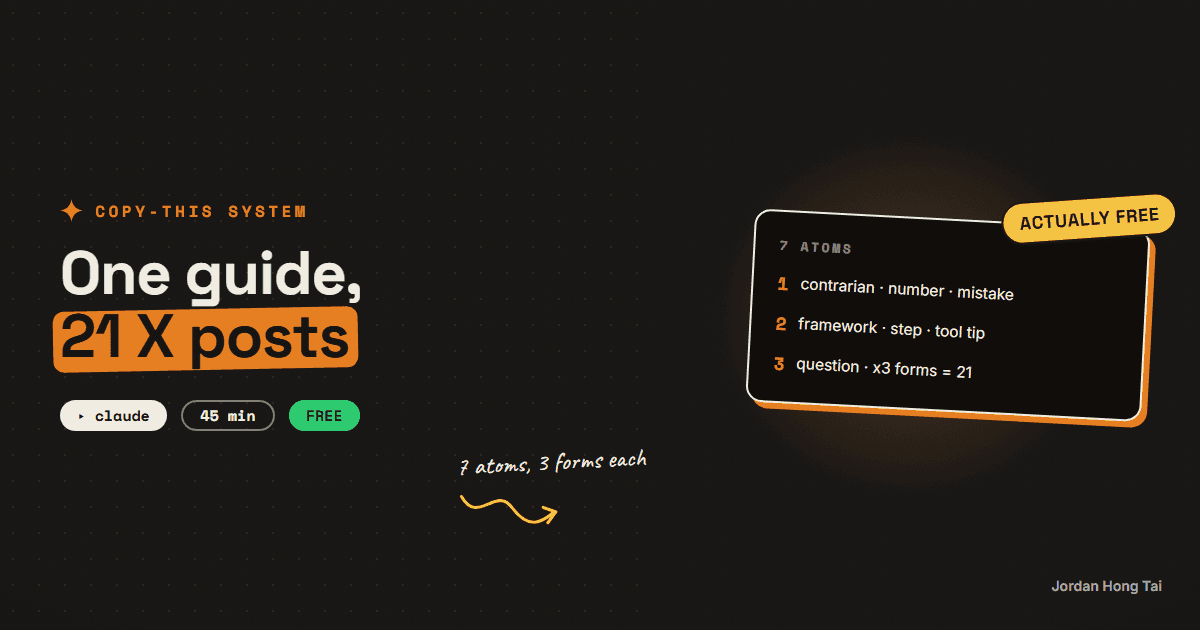
One guide holds about seven reusable atoms: a contrarian claim, a number, a mistake, a framework, a step, a tool tip and a question. Each atom becomes three posts in different forms, which is 21. A voice file keeps all 21 sounding like you instead of like a content calendar.
Writing 21 posts a week from scratch is a job. Extracting 21 posts from something you already wrote is a 45-minute pass, and the posts are better, because every one of them is backed by a thing you actually did.
The system has three parts. A guide contains about seven reusable atoms. Each atom becomes three posts in different forms. A voice file keeps all 21 from sounding like a content calendar wrote them. That is the whole method, and the rest of this page is the prompts.
What you'll have when you're done
- 7 atoms extracted from one guide, each one a standalone idea with the evidence attached
- 21 posts, three forms per atom, none of them repeating a shape on the same day
- A voice file you write once and reuse for every guide after this one
- A 7-day mix that decides which post goes in which slot, so you never stare at a schedule
- A rule list that keeps the output from reading as AI
- [SCREENSHOT: the 21 posts laid out against the 7-day mix]
Before you start
- One guide, blog post, case study or long document you wrote. It needs real specifics in it; a 400-word opinion piece has maybe two atoms, not seven.
- Claude or ChatGPT. Free plans handle this.
- 20 to 30 of your own sentences to build the voice file from. Old posts, emails, Slack messages, anything you wrote without trying to sound professional.
- 45 minutes for the first guide. About 15 for each one after, once the voice file exists.
Step 1: Build the voice file
Do this first. Every other step reads it, and doing it last means redoing the other steps.
A voice file is evidence, not instruction. "Write conversationally" produces a different flavor of generic. Twelve of your own sentences produce your rhythm. There is a longer version of this in make AI sound like you; here is the minimum that works for X.
# Voice file

## Who is writing
One line: what I do and who I am talking to.
Example: I build AI marketing systems and post for marketers and
founders who want to copy them.

## Sentences I actually wrote
[Paste 12 to 20 sentences from your own writing. Not your best
sentences. Your normal ones. Mix short and long.]

## Two posts I wrote myself, in full
[Paste two, exactly as posted, including the line breaks.]

## Hard rules
- No hashtags.
- No emoji.
- No em-dashes. Use a comma, a colon, or two sentences.
- No rhetorical question as the opening line.
- No "Here's the thing", "Let that sink in", "The result?", "Game
  changer", "unlock", "leverage", "seamless", "dive in", "in today's
  landscape".
- No listicle voice: no "5 ways to", no numbered thread bait.
- Numbers over adjectives. "48 posts in one run", not "a huge batch".
- First person. I did this, I got that, it broke here.
- Never claim a metric I cannot back with something I ran.

## Sentence shape
Most sentences under 18 words. One long sentence per post at most.
Line breaks between thoughts, not between every sentence.

## What I sound like when I am wrong
[One or two sentences where you admitted a mistake. This is the
hardest register to fake and the most convincing when it lands.]
That last section does disproportionate work. The tell of AI-written posts is that they are never uncertain.
Check it worked: you can paste voice.md into a model, ask it for one post about anything, and the output does not make you wince. If it does, your samples are too polished; swap in messier ones.
Step 2: Extract the 7 atoms
An atom is the smallest piece of the guide that stands on its own. Seven types, and almost every real guide contains all seven:
- Contrarian claim: the thing in the guide most people would argue with.
- Number: a real figure from the work. Cost, time, count, rate.
- Mistake: something that broke, and what it cost.
- Framework: the named structure. Three levers, four stages, the mix.
- Step: one concrete instruction someone could do today.
- Tool tip: a specific setting, field, flag or trick.
- Question: the thing you are genuinely unsure about.
Extraction prompt, verbatim:
Read the guide below. Extract exactly 7 atoms, one of each type:

1. CONTRARIAN CLAIM: the statement in this guide that most people in
   my field would push back on. Quote the line or idea it comes from.
2. NUMBER: a real figure from the guide (cost, duration, count, rate).
   Give the number, its unit, and what it measures. If the guide has
   no real number, say "none" rather than inventing one.
3. MISTAKE: something that went wrong, was hard, or is easy to get
   wrong, and what it cost in time or money.
4. FRAMEWORK: the named structure in the guide (the levers, the
   stages, the mix). Give its name and its parts in order.
5. STEP: one instruction a reader could execute today in under 20
   minutes, stated concretely.
6. TOOL TIP: a specific field, setting, flag, prompt or trick that a
   practitioner would not already know.
7. QUESTION: the open question the guide leaves, phrased as something
   I could genuinely ask my audience.

For each atom output:
- TYPE
- ATOM: one sentence
- EVIDENCE: the specific detail from the guide that backs it (number,
  command, field name, quote). If there is no evidence in the text,
  write NO EVIDENCE. Do not invent any.

No preamble. No summary. Just the 7 blocks.

GUIDE:
[paste the full guide]
Read the EVIDENCE lines before going further. Any atom marked NO EVIDENCE either gets a real detail from you or gets dropped. This is the step that keeps the whole batch honest.
Check it worked: 7 atoms, each with a concrete detail attached, and you would defend every one of them in a reply.
Step 3: Expand each atom into three forms
One atom, three shapes. The shapes are what stop a week of posts feeling like one post repeated.
Here is my voice file:
[paste voice.md]

Here is one atom:
[paste one atom with its evidence]

Write 3 posts for X from this atom. Same idea, three different shapes:

FORM 1 - THE CLAIM. State it flat in the first line, no setup. Then
2 to 4 lines of the specific evidence. Under 60 words.

FORM 2 - THE BUILD LOG. Tell it as something that happened to me,
in order, with the number in it. "I did X. It broke at Y. Here is
what I changed." Under 80 words.

FORM 3 - THE QUESTION. Open with the situation in one or two lines,
then ask the audience the real question. Never a rhetorical question.
Under 50 words.

Rules, all three:
- Obey every hard rule in the voice file.
- First line must work alone, because that is all most people see.
- No hashtags, no emoji, no em-dashes.
- Do not end with a summary line. Stop at the last real sentence.
- Never state a number that is not in the evidence.
- No links unless I say so.

Output the three posts separated by "---". Nothing else.
Seven atoms, three forms, 21 posts. Run it seven times, once per atom, rather than asking for all 21 in one go; batching them makes the model start optimizing for variety across the batch and it drifts off the evidence.
Check it worked: 21 posts drafted, and reading any three consecutive ones, the shapes are different even when the idea is not.
Step 4: A worked example
Take one section of a real guide: the payload step of my Metricool automation, where each network needs its own object and three of them fail quietly. The tool-tip atom that comes out of it:
TYPE: TOOL TIP
ATOM: The Instagram Reel thumbnail field in Metricool's scheduling API
is a string, not an array, and passing an array fails silently.
EVIDENCE: videoThumbnailUrl takes "https://host/cover.jpg" directly;
wrapped in [], the post is created and publishes without the cover.
Cost me an afternoon and one reel that went out with a frame grab.
Three forms out of that one atom:
The worst API errors are the ones that return 200.

Metricool's scheduling endpoint takes videoThumbnailUrl as a string.
Pass an array and the post is created, accepted, and publishes with a
random frame grab as the cover.

No error. Just a bad thumbnail on a reel you spent two hours on.Spent an afternoon last week on a cover image that would not stick.
Scheduled the reel, got a 200, opened the planner, cover was a frame
grab from the middle of the video. Re-uploaded. Same thing. Checked the
file, the URL, the CDN.
It was the brackets. videoThumbnailUrl is a string. I was sending an
array of one.
That line is now in my operating manual so no future run repeats it.Half my automation debugging is finding fields that accept the wrong
type and fail silently instead of erroring.
An array where a string was expected. A 200 response and a broken post.
What is the worst silent failure you have hit in a marketing API?Same fact three times. The claim is for people who want the answer, the build log is for people who want to trust you, and the question is for replies. Different people respond to each, which is the point.
Check it worked: you can take one of your own atoms and produce these three shapes without re-reading the prompt.
Step 5: The daily mix
Three posts a day, and each slot draws from a different pool. This is what stops the week collapsing into one register.
- Morning slot: one of contrarian, insight, framework.
- Midday slot: one of build log, tool tip, guide link. Maximum one link per day.
- Evening slot: one of GEO or AEO angle, bridge post to your older audience, question.
Two constraints worth keeping. One link per day, maximum. X down-ranks posts carrying links, so a link post spends real reach; make it earn the slot. And the bridge post exists because your existing audience did not follow you for your new topic. Mine came for crypto and gaming, so roughly one post in five connects the old subject to the new one. That ratio drops as the audience turns over.
Sort your 21 into the pools, then schedule them. The 21 will not distribute evenly, which is fine: pad from the previous guide's leftovers.
Here are 21 posts I drafted.

Assign each one to exactly one pool:
MORNING (contrarian / insight / framework)
MIDDAY (build log / tool tip / guide link)
EVENING (GEO or AEO / bridge / question)

Then lay them out over 7 days, 3 per day, one from each pool, with
these rules:
- No two posts from the same atom on the same day.
- No two posts of the same form on consecutive days in the same slot.
- Maximum one post containing a link per day.
- Day 1 morning gets the strongest contrarian post.

Output a table: day, slot, form, first line of the post. Then flag any
slot you could not fill from the 21 and say which pool is short.

POSTS:
[paste all 21]
Check it worked: a 7-by-3 table with no empty cells, or a clear note telling you which pool to write two more posts for.
Step 6: The edit pass that stops it reading as AI
Ten minutes on all 21. Look for five things, in this order:
- The last line. Models add a summary sentence that repeats the post. Delete it. This alone fixes about half of them.
- The em-dash. They come back no matter what the voice file says. Replace with a comma, a colon, or a full stop.
- Adjectives standing where a number should be. "Significantly faster" becomes "40 minutes instead of a day", or it goes.
- The rhetorical opening. "Ever wondered why..." is not a first line, it is a stall. Replace with the flat claim underneath it.
- Any number you cannot source. If you cannot point at where it came from, cut it. One invented metric costs more than 21 posts are worth.
Check it worked: you have read all 21 out loud, changed at least one thing in each, and there is nothing in the batch you would be embarrassed to have quoted back at you.
Why this holds up over months
The failure mode of repurposing is that it goes thin: the same claim in slightly different words until the account reads like a bot. This system avoids that for one structural reason. Every atom is tied to evidence from work you did, so the ceiling on how many posts you can make is set by how much you actually build, not by how many angles a model can generate.
Which means the honest constraint is upstream. Write one real guide a week and 21 posts is easy. Write nothing and no prompt saves you.
FAQ
Won't 21 posts from one guide bore the people who follow me?
They would if all 21 were the same shape. That is why each atom becomes three different forms: a claim, a story and a question say the same thing three ways, and only the shape repeats across the week, not the sentence. The other reason it works is that on X almost nobody sees all 21. Reach per post is a fraction of your following, so repetition across a week is closer to coverage than to spam.
How is a voice file different from telling the model to write like me?
A voice file is evidence, not instruction. It holds 10 to 20 of your own sentences, your banned words, your sentence-length habit and two example posts you actually wrote. The model imitates samples far better than it follows adjectives. Telling it to be conversational gets you a different flavor of generic; showing it five of your paragraphs gets you your rhythm.
Do I have to post all 21 in one week?
No. I run 3 a day for 7 days because that fits my slots, but the same 21 stretched over two weeks works fine, and holding 5 back as filler for a busy week is smart. What you should not do is post all 21 in two days, because the mix depends on shapes being spaced apart.
How much do I edit before posting?
Every post, briefly. My rule is that I change at least one thing in every post, usually cutting the last sentence, because models keep adding a summary line you do not need. Budget about 10 minutes for all 21. If a post needs more than a 20-second fix, delete it instead of rescuing it; the atom will come back in another guide.
Can I use this for LinkedIn or a newsletter?
The atoms transfer, the forms do not. LinkedIn wants a longer setup and a hiring-manager framing, so the same contrarian atom becomes six lines instead of two. Extract once, expand per platform. What you should not do is post the identical text to both; the shape that works on X reads clipped on LinkedIn.
Related guides
Make AI sound exactly like you (the voice file trick)
AI content sounds like AI because the model has never met you. In 15 minutes you'll build the one file that fixes it: a voice file the AI loads before writing anything.
The exact system that writes a week of my content in an hour
You'll build the AI content creation system that turns one topic into a week of platform-ready drafts, in your voice. One hour to set it up, and after that Monday runs the week.
Automate your weekly social calendar with Metricool + Claude Code
You'll build the task that plans and schedules your whole week of social posts while you're asleep. Claude Code reads last week's numbers out of Metricool, writes them back into your calendar, plans the next seven days, and pushes every post into the scheduler with autoPublish on. My first full run put 48 posts across 5 networks in one pass.
Get the next build in your inbox
One email a week: the newest guides, plus one thing I only share with the list.
No spam. Unsubscribe anytime.
Build alongside others
Join the free community and share what you're shipping.

Jordan Hong Tai
I've scaled products to over 500K users, and now I build AI systems in public from a balcony in Tokyo.