A hook lab without trial reels: test 3 openers per reel when Instagram locks you out
Last updated September 2026 · 30 minutes to set up, 10 minutes a week to run · Free. Metricool has a free tier; the analytics you need are in every platform's native dashboard too. · Comfortable
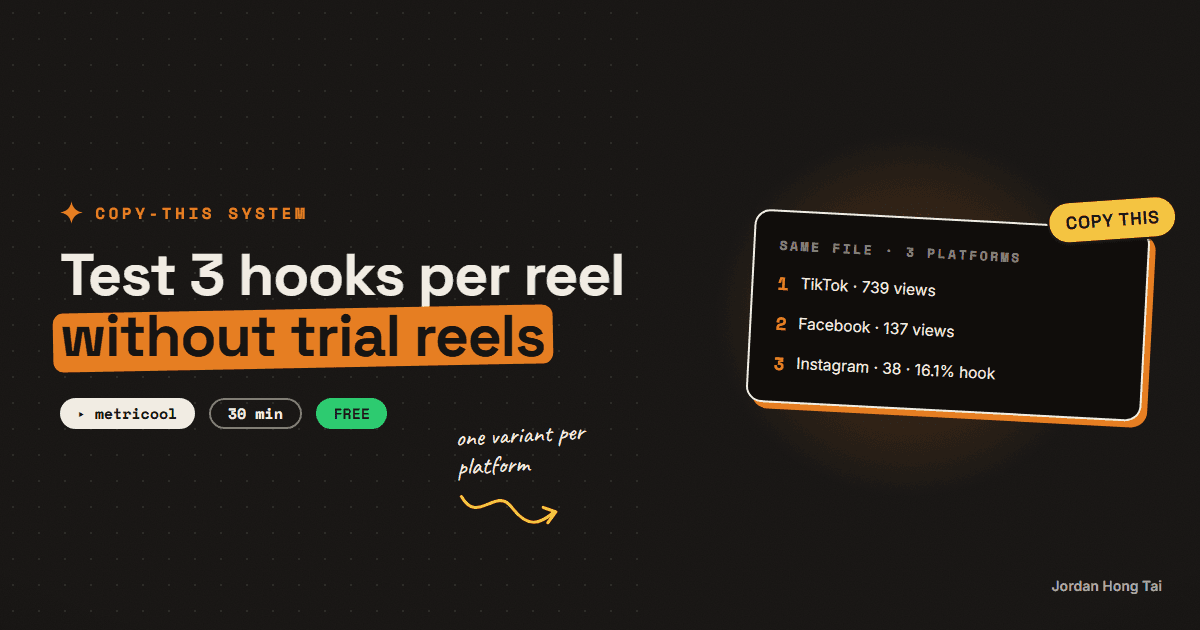
Instagram's trial reels feature needs roughly 1,000 followers. My account had 13. That is not a small gap you close in a month, so the entire trial-reel A/B protocol was unusable and I had to replace it with something that works at any account size. This guide is that replacement: three hooks per reel in different archetypes, one variant shipped per platform so every reel gets three real reads instead of one, every post tagged so the clicks are separable, and a set of hard decision rules that stop you retiring a hook on noise.
Instagram's trial reels feature needs roughly 1,000 followers. My account had 13.
I found that out the way you usually find these things out: a variant scheduled as a trial reel came back with The instagram account does not meet the trial reel follower requirement to create trial reels. No post, no data, one lost slot in the week. That is not a gap you close in a month, so the entire trial-reel A/B protocol was unusable and needed replacing with something that works at any account size.
This is the replacement. It is less clean than a trial reel and it produces real answers, which is the trade every small account has to make.
What you'll have when you're done
- Three hooks per reel, each tagged with an archetype, written in one pass with the script
- A rotation that gives every reel three real reads instead of one
- Every post carrying a tag so link clicks are separable by hook
- Four decision rules that turn a spreadsheet into a call
- Two caveats that will stop you making the two mistakes I made
- [SCREENSHOT: the results log with archetype, platform, hook rate and views columns filled in]
Before you start
- A scheduler that posts one video to several platforms with different captions. Metricool does this and has a free tier. Native apps plus a spreadsheet work too; the cost is that you copy the numbers by hand every week.
- At least three platforms you publish short-form to. The whole method rests on having three surfaces. With two, you get two reads per reel and everything below takes half again as long to reach a verdict.
- Somewhere to log results. A sheet is fine. Six columns, listed in step 4.
- A cadence you can hold. Three reels a week for six weeks is the minimum to reach a verdict. Two a week works, slower.
Why the trial reel was the right tool, and what it did instead
Worth being precise about what is lost, because it explains what the replacement has to fake.
A trial reel shows a video only to non-followers. That is a clean read on whether a hook works on a stranger, uncontaminated by an audience that already likes you, and you get it before committing the video to your feed. There is no substitute for that.
What replaces it is not a better test. It is a way of getting three readings per reel instead of one, so the sample builds three times faster, plus rules strict enough that no single reading can make a decision on its own. You are buying statistical power with volume because you cannot buy it with clean conditions.
Step 1: Write three hooks per reel, in three archetypes
The unit of testing is the archetype, not the sentence. Testing "this exact wording versus that exact wording" needs sample sizes you will never have. Testing "does the contrarian shape beat the demo shape on this account" is answerable in six weeks.
Six archetypes worth keeping in rotation:
| Archetype | The shape | Opener example |
|---|---|---|
| CONTRARIAN | Kill a thing the viewer believes | "Posting more is why your reach is falling." |
| DEMO | Show the result before explaining it | "Watch this schedule 48 posts while I do nothing." |
| MISTAKE | The error you made, named up front | "I tested hooks for a month and threw the data away." |
| PROOF | Lead with the number | "Seven videos. $14.71. Here is the bill." |
| MONEY | A third-party money figure | "People charge $300 to build this for one shop." |
| QUESTION | Ask the thing they are already wondering | "Why does the same video do 700 views here and 38 there?" |
Three per reel, three different archetypes, all 10 to 14 words, all delivering the same body. That last part is the rule people break: if the three hooks promise different videos, you are not testing hooks, you are testing three videos.
Write 3 opening hooks for a short-form video. Same body, same promise,
different archetypes.

BODY (what the video actually delivers):
[one sentence]

Write one hook in each archetype:
- CONTRARIAN: contradict something the viewer believes
- DEMO: state the visible result they are about to watch
- PROOF: lead with a specific number

Rules for all three:
- 10 to 14 words
- Spoken out loud, so no clauses that need punctuation to parse
- Each one must be true of the SAME body. If a hook promises
  something the body does not deliver, rewrite the hook.
- No hype words, no emojis, no questions unless the archetype is QUESTION

Return three lines, each labelled with its archetype.
Check it worked: read the three hooks aloud back to back. All three should sound like openers to the same video. If one of them makes you expect a different video, it fails and gets rewritten.
Step 2: Ship one variant per platform, rotating
Here is the mechanic that replaces the trial reel.
You have three hooks and three platforms. Ship variant A to one platform, B to the second, C to the third, all on the same day, same video body, same everything else. Next reel, rotate which archetype goes where.
| Reel | TikTok | YouTube Shorts | |
|---|---|---|---|
| 1 | CONTRARIAN | MONEY | DEMO |
| 2 | MONEY | DEMO | CONTRARIAN |
| 3 | DEMO | CONTRARIAN | MONEY |
| 4 | CONTRARIAN | MONEY | DEMO |
That is a Latin square: every archetype appears on every platform equally often across the cycle. It does not make platforms comparable to each other. It makes sure no archetype is permanently attached to your best platform, which is the confound that would otherwise quietly decide your results for you.
The honest limitation, stated plainly: a hook read on TikTok and a hook read on Instagram are not a controlled comparison. Different audience, different distribution. The rotation fixes the systematic half of that problem and the four-data-point rule handles the rest.
Check it worked: your scheduler shows three posts, same video file, three different first lines, three different platforms, same day. If two platforms got the same hook, the reel produced two readings instead of three.
Step 3: Tag every post so the clicks are separable
The hook rate tells you who kept watching. The link click tells you who acted. You want both, and you only get the second one if you tag the link.
Append a utm_content parameter naming the variant:
https://yoursite.com/guides/your-slug?utm_source=instagram&utm_medium=reel&utm_campaign=your-slug&utm_content=hook-a

https://yoursite.com/guides/your-slug?utm_source=tiktok&utm_medium=reel&utm_campaign=your-slug&utm_content=hook-b

https://yoursite.com/guides/your-slug?utm_source=youtube&utm_medium=short&utm_campaign=your-slug&utm_content=hook-c
Two things people get wrong here.
A UTM is a label, not a counter. The tags do nothing unless something on the destination is watching page loads. You need an analytics tool on the receiving site. Without one, you have tagged links that record nothing and you will not find out for a month.
A link that goes through a shortener can lose the query string. Test every tagged link end to end, once, and confirm the parameters survive to the destination. A redirect that drops them kills the attribution silently, which is the worst way for a measurement to fail.
Check it worked: click one tagged link yourself and find that hit in your analytics broken out by utm_content. If it does not appear under the variant name, the tagging is decorative.
Step 4: Log six columns and nothing else
One row per post, not per reel. A reel that went to three platforms is three rows.
| Column | What goes in it |
|---|---|
| Reel | The slug, so the three rows group |
| Platform | Where this row was published |
| Variant | A, B or C |
| Archetype | CONTRARIAN, DEMO, MONEY and so on |
| Hook rate | The platform's own retention-at-a-few-seconds figure |
| Views | Total, read at a consistent age |
Read at a consistent age. Reading one post at 48 hours and another at 7 days and putting the numbers in the same column produces a comparison of ages, not of hooks.
Resist adding columns. Likes, saves, shares and comments are all interesting and none of them is what this log is for. A log that takes four minutes a week gets filled in. A log with fourteen columns stops being filled in around week three, and a log with a gap in it is worth less than no log.
Step 5: The four decision rules
The rules exist so the spreadsheet makes the call instead of your mood on a Friday.
Rule 1. No archetype verdict under four data points. Four posts of that archetype on that platform. Three is a story, four is a signal. With three archetypes rotating across three platforms, four to six weeks of a three-reel cadence gets you there.
Rule 2. Best median gains a ship slot, worst loses one. Compare medians, never means, because one reel that got picked up distorts a mean and tells you nothing about the hook. Once an archetype reaches four data points with the best median, it gets one extra slot next week. The worst loses its default slot. Nothing is deleted; it just stops being the automatic choice.
Rule 3. Under a 25 percent hook rate is flagged, not retired. A flag means look at it. Compare that reel's other platforms, check whether the opener promised the body, check whether the visual matched the words. Then decide. The distinction between flagging and retiring is the single most valuable rule here, and rule 4 is why.
Rule 4. Retire on cross-platform evidence, never on one platform's rate. This one is expensive to learn and I learned it.
The two caveats that are now proven in my own data
These are not theoretical. Both of them almost made me delete hooks that were working.
Never retire a hook on one platform's rate while that platform is cold
In one week, five of nine Instagram reels came in under the 25 percent line, across four different archetypes. By the letter of rule 3, that retires most of a hook library in a single week.
The same video files did 269 to 761 views on TikTok and 624 to 1,449 on YouTube in the same window.
Instagram was distributing to about eleven followers. The hook was not what was failing. A cold platform produces low rates for every hook you put on it, and if you read that as a hook verdict you will systematically retire your library based on which platform happens to be small.
The same effect from the other direction: one quick-hit reel did 739 views on TikTok, 137 on Facebook, and 38 on Instagram with a 16.1 percent hook rate, the worst number the account had produced. Same file, same day, same hooks. Read the Instagram number alone and that is a dead format. Read all three and it is a format that travels on some surfaces and not others, which is a completely different and much more useful conclusion.
Never retire on 48-hour numbers
One reel read 297 views at 48 hours. At day five the same reel read 975 views, 826 reach, a 51.3 percent view rate, 9 saves and 5 shares.
It tripled between day two and day five. Anything decided at 48 hours about that reel would have been wrong.
Short-form distribution is not front-loaded the way a feed post is; a video can sit quietly and then get picked up. So the 48-hour read exists to flag, and the weekly read exists to decide. Two different jobs, and collapsing them into one is how you end up retiring your best hook.
Check it worked: look back at your log and find one reel whose 48-hour number and 7-day number disagree by more than double. Every account that publishes enough has one. That reel is your reason to keep the two reads separate.
What this method cannot tell you
Worth being clear about the ceiling, because a method that claims more than it can do is worse than a rough one that is honest.
It cannot tell you that one sentence beats another. It compares archetypes, and it needs four readings to do even that. Wording-level tests need traffic you do not have.
It cannot compare platforms to each other. An Instagram hook rate and a TikTok hook rate are measured differently against different denominators. Compare a platform to itself over time, and nothing else.
It cannot separate hook from thumbnail, sound, or first visual frame. Everything that happens in the first second is bundled into one number. If you change the cover image and the opener in the same week, you have learned nothing about either.
And it is slower than a trial reel. Four to six weeks to a verdict against a trial reel's few days. That is the actual price of being under the follower bar, and the only way to shorten it is to publish more, not to lower the evidence bar.
The hook lab pack: archetype library, rotation table, results log spec, decision rules
FAQ
What exactly is a trial reel and why can't I use it?
A trial reel is an Instagram feature that shows a reel only to people who do not follow you, so you get a clean read on how it performs with strangers before deciding whether to publish it to your followers. It is genuinely the right tool for hook testing. The problem is the eligibility bar: it requires roughly 1,000 followers. Scheduling one below that returns an error, produces no post and no data, which means a variant you planned as a trial reel is a silently lost slot. If your account is under the bar, do not schedule them at all.
Isn't testing one hook per platform confounded by the platforms being different?
Yes, and that is the honest limitation of this method. A hook tested on TikTok and a hook tested on Instagram are not a controlled comparison, because the audiences and the distribution are different. What the Latin square fixes is the systematic part: by rotating which archetype goes to which platform every reel, no archetype is permanently attached to your best platform. Over enough reels the platform effect averages out across archetypes even though it is present in every individual reading. That is why the four-data-point rule exists and why single results are never a verdict.
What counts as a hook rate?
The share of people who were still watching a few seconds in, out of everyone the platform started the video for. The platforms name it differently and measure the threshold slightly differently, so the absolute number is not comparable across networks and you should never put an Instagram hook rate next to a TikTok one and call it a comparison. What is comparable is the same platform's numbers over time, which is the only comparison the decision rules ask you to make.
Why 25 percent as the flag line?
It is a working threshold, not a law of nature. It sits low enough that a genuinely functional hook clears it comfortably and high enough that a hook nobody is watching falls under it. Set your own line from your own first ten reels if you have them: take the median and put the flag a little below it. The important part is not the number, it is that a flag triggers a look rather than a deletion.
How long until this actually tells me something?
Four data points per archetype is the minimum for a verdict, and with three archetypes rotating across three platforms that is roughly four to six weeks of a three-reel-a-week cadence. That feels slow and it is the correct speed. Every time I have been tempted to call it earlier, the early answer has been the opposite of the eventual one, including one week where the standings almost exactly inverted once retired content dropped out of the sample.
Do I need Metricool for this?
No, but it removes the tedious part. What the method needs is somewhere to schedule the same video to several platforms with different captions, and somewhere to read per-post metrics back without opening four apps. Metricool does both and has a free tier. Native dashboards plus a spreadsheet do the same job for free at a small volume; the cost is that you are the one copying the numbers across every week, which is exactly the kind of job that quietly stops happening.
Related guides
Automate your weekly social calendar with Metricool + Claude Code
You'll build the task that plans and schedules your whole week of social posts while you're asleep. Claude Code reads last week's numbers out of Metricool, writes them back into your calendar, plans the next seven days, and pushes every post into the scheduler with autoPublish on. My first full run put 48 posts across 5 networks in one pass.
I stopped filming my reels (my AI avatar reads the script)
You'll set up a pipeline where a text file becomes a talking-head clip of your own AI avatar, in your voice, with no camera. Claude Code calls HeyGen's API from a skill file, waits for the render, and drops the clip in your editing folder. After the 30-minute setup, a reel starts with a paragraph, not a tripod.
The exact system that writes a week of my content in an hour
You'll build the AI content creation system that turns one topic into a week of platform-ready drafts, in your voice. One hour to set it up, and after that Monday runs the week.
Get the next build in your inbox
One email a week: the newest guides, plus one thing I only share with the list.
No spam. Unsubscribe anytime.
Build alongside others
Join the free community and share what you're shipping.

Jordan Hong Tai
I've scaled products to over 500K users, and now I build AI systems in public from a balcony in Tokyo.