AI avatar videos for local businesses: the build, the pitch and the price
Last updated September 2026 · Two hours for the first video, about twenty minutes after that · About $2 of render per 40-second video; ElevenLabs Starter $6/mo for a commercial voice licence · Comfortable
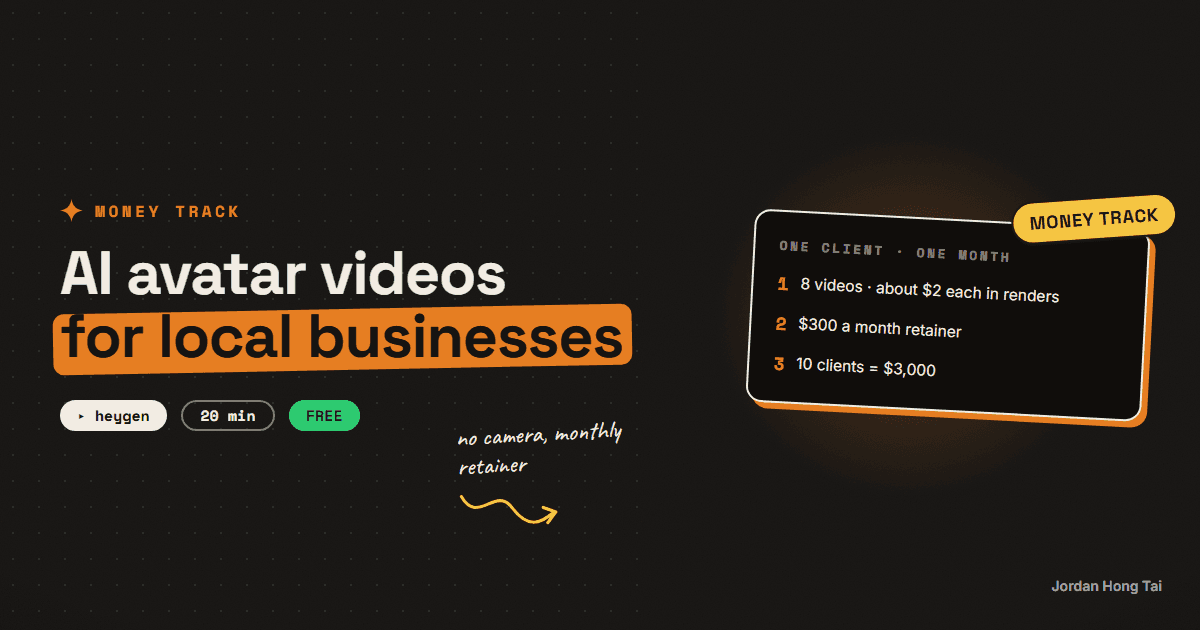
A 40-second AI avatar video costs about $2 to produce. On Fiverr the cheapest gigs selling that work start at $5. That gap is why the marketplace is crowded and why the marketplace is the wrong place to sell this, and the rest of this page is the version that works instead: the three videos a local business will actually pay for, the real per-video cost from my own render log, the public asking range read off live listings, and the three ways the deal goes wrong.
Start with what this work actually sells for, because people get that wrong in both directions.
On 18 September 2026 I read the Fiverr search results for heygen. Fiverr reported 304 gigs. Of the 48 that showed a starting price on the pages I read, the band was $5 to $60. The most common starting price was $10, on 16 of the 48. Nine of them opened at $5. The median was $10.
Then I read the broader search, ai avatar video, and logged another 48 priced gigs. Same floor, longer tail: $5 to $350, with most of the pack still between $5 and $30 and a handful opening at $100, $145 and $350.
I tried to read Upwork for the same thing. Upwork's Cloudflare wall refused me twice, so there is no Upwork number on this page. I'd rather say that than pretend I checked two marketplaces.
Now the other half of the arithmetic. A finished 40-second avatar video costs me about $2 to produce, and I know that because I have been booking the invoice on my own pipeline for a month. So the cheapest gig on Fiverr is selling for roughly two and a half times its raw cost, before anyone's time.
That gap is the whole story. I think it is why the marketplace is so crowded, and it is also why the marketplace is the wrong place to do this work.
What you'll have when you're done
- A repeatable way to turn a paragraph of text into a finished 9:16 or 16:9 talking-head video
- A real per-video cost, in dollars, that you can quote without guessing
- The three video shapes a local business will actually pay for
- The public asking range for this work, read off live listings rather than a blog post
- The three reasons a deal like this goes wrong, before you sign one
- [SCREENSHOT: a HeyGen photo avatar render finishing, with the cost line from the API wallet]
Before you start
- A HeyGen account. The app plans start free. The API is separate and prepaid, covered in step 3.
- An ElevenLabs account if you want a voice that is not the stock one. Their Starter plan is $6 a month and it is the first tier that carries a commercial licence and instant voice cloning.
- A face, and permission to use it. This is the requirement everyone skips, and it has a whole section near the bottom.
- About two hours for the first video. After that it is twenty minutes.
The three videos a local business will actually buy
Most people trying to sell this lead with "AI videos", which I'd guess means nothing to a dentist. What a local business buys is a job that was already on their list.
There are three, and they are all boring on purpose.
The explainer. Sixty to ninety seconds saying what the business does and who it is for, for the homepage and the Google Business Profile. The owner has wanted one for two years and has not booked a film crew.
The offer video. Twenty to forty seconds on one promotion, with a date on it. This is the one that recurs, because the offer changes every month and each change is a new invoice.
The FAQ answer. Thirty to sixty seconds answering one question the front desk gets fifteen times a week. Parking. Insurance. What to bring to the first appointment. A gym's cancellation policy. Each one is a separate video, which is why this shape sells in packs of five or ten.
The FAQ pack is the one I'd lead a pitch with. It has an obvious unit, it has an obvious quantity, and the owner can tell you what the questions are in about four minutes, which means the discovery call is also the scoping call.
Step 1: Make the avatar
In HeyGen, a photo avatar is built from one still image and is ready in a few minutes. A digital twin is trained from real footage of a person, moves more like them, and needs a recorded consent step before you can generate with it.
Start with a photo avatar. It is faster, it is cheaper per second, and for a sixty-second explainer at phone size I think it holds up fine.
For a client job the face should be the owner's face, not a stock model. A local business sells on the person behind the counter, and a stranger reading their script is worse than no video. Get a good still: even light, plain background, shoulders in frame, looking down the lens.
Check it worked: generate a ten-second test clip and watch it on a phone, not a monitor. If the mouth reads wrong at phone size it will read worse on a website hero.
Step 2: Make the voice
HeyGen's stock voices are fine for a draft and, honestly, thin for a deliverable. The upgrade is an ElevenLabs voice cloned from a couple of minutes of the owner talking, which you then use as the audio track.
ElevenLabs publishes these plans:
| Plan | Monthly | Credits | Voice cloning | Commercial licence |
|---|---|---|---|---|
| Free | $0 | 10,000 | none | no |
| Starter | $6 | 30,000 | instant | yes |
| Creator | $22 | 121,000 | professional | yes |
| Pro | $99 | 600,000 | professional | yes |
Read from elevenlabs.io/pricing on 18 September 2026. Starter is the line that matters, because it is the cheapest tier where you are allowed to sell the output. Do not ship client work off the free tier.
Check it worked: play the cloned voice to the owner before you build anything around it. About one in three people dislike their own cloned voice on the first listen, in my experience, and it is much cheaper to find that out on day one.
Step 3: Know what a finished video costs you
This is the number that makes or breaks the pitch, so here is mine, measured rather than guessed at.
HeyGen bills API renders against a prepaid dollar wallet that is separate from the app subscription. Their help centre is clear that API access is standalone, that there have been no free API credits since February 2026, and that pay-as-you-go balance expires after twelve months.
On my own pipeline the rate has been steady at $0.05 per finished second at 1080p. Four renders from my build log:
| Render | Finished length | Cost |
|---|---|---|
| Reel A | 46.3s | $2.32 |
| Reel B | 43.0s | $2.16 |
| Reel C | 37.2s | $1.86 |
| Reel D | 35.8s | $1.79 |
So a 40-second video is about $2.00, and a 90-second explainer is about $4.50. Add the voice and the working file and a ten-video FAQ pack costs you somewhere around $25 in tool spend, most of it render time.
HeyGen's app plans, for the version of this where you never touch the API:
| Plan | Monthly | Annual | Credits |
|---|---|---|---|
| Free | $0 | $0 | 3 videos, up to 1 min |
| Creator | $29 | $24 | 600 |
| Pro | $49 | $40.75 | 1,000 |
| Business | $149 + $20/seat | about $124 | 1,500 |
Read from heygen.com/pricing on 18 September 2026.
Step 4: Write the script the way the business talks
The script is where these videos are won, and I mean that literally, because it is also the only part that costs nothing.
Four beats, in this order, for every one of the three shapes:
- Name the person. "If you're looking for a dentist in Camberwell who takes NHS patients." Not "welcome to our practice".
- Answer the thing. One sentence. The whole question, answered, before any context.
- One reason to believe. A number, a year, a name. "We've been on the same street since 2004."
- One next step. One. A phone number or a booking link, never both.
Then read it out loud and cut every word you would not say standing at the counter.
If you're looking for a dentist in [area] who takes [insurance], we do,
and we can usually see a new patient inside a week.

We've been on [street] since [year], and [first name] has run the
practice for [n] of those years.

Book at [phone number] or on the site. Either is fine.
Check it worked: time the read at a natural pace before you render. Forty seconds of speech is roughly 95 to 110 words. If your draft is 160 words you are about to pay for a 70-second video the owner did not ask for.
Two things that will bite you in the render, and I know both of them the expensive way. All-caps words get spelled out letter by letter, so SYSTEM comes back as "S-Y-stem". Brand names with odd spellings need a phonetic version in the script. I learned both by shipping them.
Step 5: What the work is publicly priced at
Here is the Fiverr read in full, from 18 September 2026.
| Search | Gigs reported | Priced gigs I read | Starting price band | Most common |
|---|---|---|---|---|
heygen | 304 | 48 | $5 to $60 | $10 (16 of 48) |
ai avatar video | 10,000+ | 48 | $5 to $350 | clustered $5 to $30 |
Upwork: blocked, no data.
Two honest caveats about that table, because it is the most quotable thing on this page and it is the easiest to misread. A Fiverr starting price is the cheapest package on the gig, not what the seller earns and not the price of a finished job. And a marketplace listing is only an asking price. Nobody publishes whether the thing sold.
What the table does tell you is where the floor is, and the floor is low. Ten dollars. That is the price of a video from a seller competing with four hundred other sellers on a search page where the only visible difference is the number.
So the conclusion I'd draw is not "charge more on Fiverr". It is that the marketplace prices the render, and the render is the part that costs $2. A local business is not shopping on that search page and is not comparing you to it. The dentist is comparing a video to the cost of not having one, and to the quote from the film crew who wanted £1,500 and two days of her time.
Price against that, and price the pack rather than the video, because a single video invites a single comparison.
The three ways this goes wrong
I want these on the page before the pitch, because I think two of them end a business rather than a deal.
Consent is not optional and it is not a formality. HeyGen's own developer docs say a digital twin needs a recorded consent statement from the person being cloned, identity-matched to the training footage. Photo avatars do not trigger that API step, and their docs still say to get the subject's agreement before you create one. Put it in writing with the client, name the person, name what you are allowed to generate and for how long.
On top of the platform's rules there is now law. The EU AI Act's transparency article, Article 50, has applied since 2 August 2026. A deployer who generates content that resembles a real person has to disclose it to the viewer at first exposure at the latest. It has to be clear enough that nobody needs a technical tool to notice. The Commission's own guidance says a machine-readable mark on its own is not enough. Penalties run to EUR 15 million or 3% of worldwide turnover. If your client sells into the EU, a visible line on the video is the cheap version of that conversation. I am not a lawyer and this is not legal advice.
The avatar reads badly on emotion. This is my own bruise. Viewers told me my reels looked like AI slop, and the diagnosis was that my avatar was on screen about 35% of the runtime. I cut full-face time to a cap of 20% and a maximum of two face beats per video, and the rest of the screen went to real footage, real interface, real captures. The avatar is a cameo now. For client work the same rule holds: a talking head for ninety seconds straight is the worst possible use of this, and cutting away to the shopfront, the menu, the treatment room or the actual product is what stops it reading as synthetic.
A business with no traffic does not get leads from a video. A video converts attention that already exists. If the Google Business Profile gets forty views a month, a beautiful explainer turns forty views into maybe two more calls, and the owner will cancel in month three and be right to. Ask for the profile views and the site sessions before you quote. If the numbers are not there, say so and sell them something else, or nothing.
Step 6: The pitch that does not need a portfolio
The problem with selling this cold is that you have no work to show. The fix is to stop pitching and start delivering, once, for free, before the conversation.
Pick one business. Read their Google Business Profile questions and their homepage. Build one FAQ video, forty seconds, answering the question they clearly get most. Put it in an email with no attachment and no pitch, just a link and two lines:
Saw you get asked about parking a lot. Made you the answer as a
40-second video, yours to use, no strings.

If you want the other nine questions done the same way, I'm around.
That email works because it is not a proposal. It is the deliverable, and I reckon two dollars is a fair price for a first conversation.
Check it worked: send five of these before you judge the approach. One free video is an anecdote. Five is a test, and the reply rate on the five tells you whether your video is good enough before you have spent a week building an offer around it.
What I'd do differently
Sell the pack, never the video. A single video is compared to a single price and the market floor for that comparison is ten dollars. Ten FAQ answers with a script, a render and a caption file is a different product with no listed comparison.
Put the tool accounts on the client's card where you can. It takes your cost to zero, it removes the awkward month when they want thirty videos, and it means they keep the avatar if you part ways. That last part is a selling point, so say it out loud.
Cap the face time from the first deliverable. Not because it looks better, though it does. Because a client who notices the odd thing in month two will blame the whole product, and by then it is sitting in their homepage hero.
Get the consent paperwork done before the first render, not before the first invoice. It takes ten minutes while everyone is enthusiastic and it is unpleasant to raise later.
FAQ
What does one finished video actually cost?
About $2.00 for 40 seconds, and I can show the working. HeyGen bills API renders against a prepaid dollar wallet at $0.05 per finished second at 1080p. Four renders off my own build log came in at 46.3s for $2.32, 43.0s for $2.16, 37.2s for $1.86 and 35.8s for $1.79. A 90-second explainer is about $4.50, and a ten-video FAQ pack is around $25 in tool spend. Watch the credit counter rather than the dollar rate and you will misprice a job, because I saw the credits-per-second ratio move from about 3.0 to about 2.3 in a fortnight while the booked dollar cost never moved.
What is this work publicly priced at?
On 18 September 2026 Fiverr reported 304 gigs for the search 'heygen'. Of the 48 with a visible starting price on the pages I read, the band was $5 to $60, the most common starting price was $10 on 16 of the 48, and nine opened at $5. The broader search 'ai avatar video' gave another 48 priced gigs running $5 to $350, still clustered between $5 and $30. Two caveats: a Fiverr starting price is the cheapest package on the gig rather than the price of a finished job, and a listing is an asking price with no information about whether anyone bought. Upwork's Cloudflare wall blocked the read, so there is no Upwork figure.
Do I need the client's permission to use their face?
Yes, and get it in writing before the first render. HeyGen's developer docs require a recorded consent statement, identity-matched to the training footage, before you can generate with a digital twin. A photo avatar does not trigger that API step, and their docs still say to get the subject's agreement before you create one. There is law on top of the platform rules now: the EU AI Act's Article 50 has applied since 2 August 2026 and requires a deployer to disclose content resembling a real person at first exposure at the latest, clearly enough that no technical tool is needed to notice, with penalties up to EUR 15 million or 3% of worldwide turnover. I am not a lawyer and this is not legal advice.
Will people be able to tell it is an avatar?
If the avatar holds the frame, yes, and they will say so. Viewers told me my own reels looked like AI slop, and the cause was that my avatar was on screen about 35% of the runtime. I capped full-face time at 20% with a maximum of two face beats and gave the rest of the screen to real footage, real interface and real captures. The same rule holds for client work. Ninety seconds of uninterrupted talking head is the worst possible use of this, and cutting to the shopfront, the menu or the treatment room is what stops it reading as synthetic.
Which video should I make first for a local business?
An FAQ answer, forty seconds, on the question their front desk gets most. It has an obvious unit and an obvious quantity, so it sells in packs of five or ten, and the owner can list the questions in about four minutes, which makes the discovery call the scoping call as well. Build one for free before you pitch, email it with a link and two lines and no proposal attached. That first deliverable costs you about two dollars.
Can a small business with no website traffic get leads from this?
No, and this is the conversation to have before you quote. A video converts attention that already exists and it cannot create attention. If the Google Business Profile gets forty views a month, a good explainer turns forty views into maybe two more calls, and the owner cancels in month three and is right to. Ask for the profile views and the site sessions first. If the numbers are not there, say so and sell them something else, or nothing.
Related guides
I stopped filming my reels (my AI avatar reads the script)
You'll set up a pipeline where a text file becomes a talking-head clip of your own AI avatar, in your voice, with no camera. Claude Code calls HeyGen's API from a skill file, waits for the render, and drops the clip in your editing folder. After the 30-minute setup, a reel starts with a paragraph, not a tripod.
Sell one AI automation to a local business: the 3 to pitch first and what they pay
A dentist who misses 20 calls a month is not losing 20 calls. They are losing the ones that ring a competitor 30 seconds later. This guide covers the three automations local businesses will actually pay for, how to build each one in Make.com in an afternoon, what freelancers publicly charge for this category of work, and the outreach move that turns a cold walk-in into a paid setup fee plus a monthly retainer.
AI UGC ads for small brands: how people land the first paid client with no audience
Small brands buy ads that look like a person talking, and they buy them by the batch because most of them fail. The people getting paid for this now are not creators with an audience. They are operators with HeyGen, a voice from ElevenLabs, and three sample ads made for a brand that never asked for them. This guide is that whole loop: the script structure, the production, the spec reel, the outreach message, and what the work is priced at.
Get the next build in your inbox
One email a week: the newest guides, plus one thing I only share with the list.
No spam. Unsubscribe anytime.
Build alongside others
Join the free community and share what you're shipping.

Jordan Hong Tai
I've scaled products to over 500K users, and now I build AI systems in public from a balcony in Tokyo.