AI UGC ads for small brands: how people land the first paid client with no audience
Last updated August 2026 · About 4 hours for your first 3-ad spec reel · HeyGen API about $0.05/sec of video (a 30s ad is about $1.50); ElevenLabs from about $5/mo; CapCut free · Comfortable
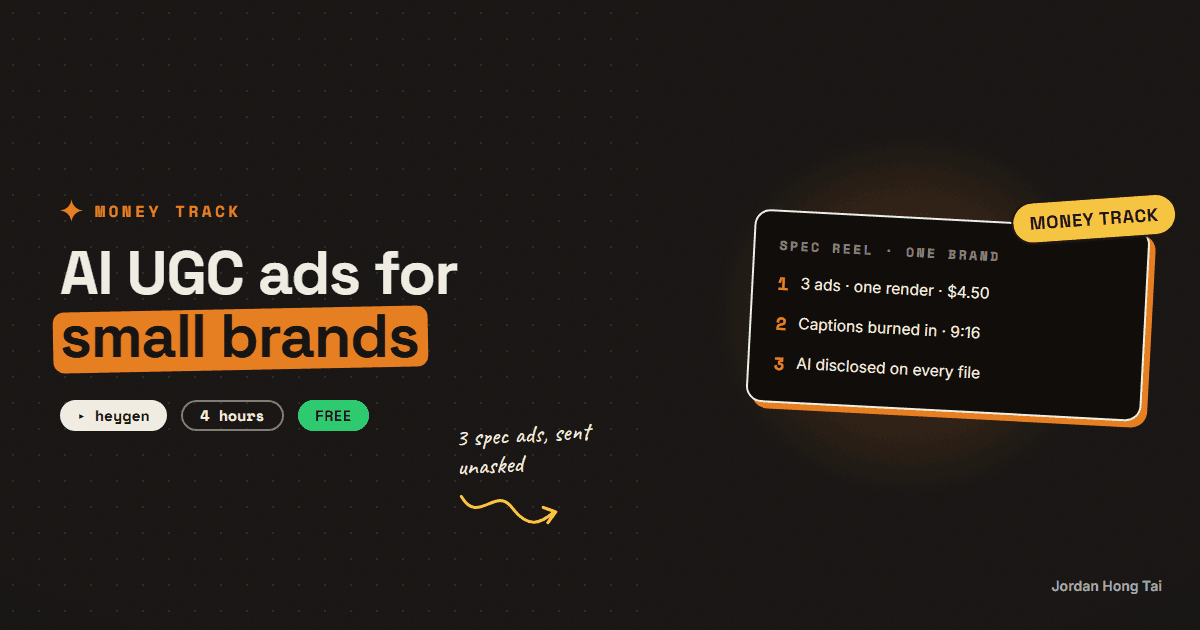
Small brands buy ads that look like a person talking, and they buy them by the batch because most of them fail. The people getting paid for this now are not creators with an audience. They are operators with HeyGen, a voice from ElevenLabs, and three sample ads made for a brand that never asked for them. This guide is that whole loop: the script structure, the production, the spec reel, the outreach message, and what the work is priced at.
Small brands running paid social burn through creative faster than they can make it. An ad that works stops working in about two weeks, and the fix is not a better ad, it is more ads. That is the whole reason UGC became a category, and it is the reason AI production walked straight into it.
The people getting paid for this right now are mostly not creators with an audience. They are operators with a HeyGen account, a voice from ElevenLabs, a CapCut timeline, and three sample ads made for a brand that never asked for them.
Before the money talk: every figure in this guide is a publicly advertised rate for this category on UGC marketplaces and creator platforms. It is what the work is listed at, not a forecast of what you will earn.
What you'll have when you're done
- One finished 30-second AI UGC ad you can play for anyone
- The 4-part script structure written out, filled in, and reusable for any product
- A 3-ad spec reel for a real brand that has not hired you
- The outreach message that goes with it, plus what to do with the replies
- A disclosure checklist so nothing you deliver gets a client's ad account flagged
- [SCREENSHOT: the three spec ads side by side in the CapCut timeline]
Before you start
- HeyGen. The API bills about $0.05 per second of finished video, so a 30-second ad is roughly $1.50 and a 3-ad spec reel is about $5. There is also an app subscription from around $29 a month if you prefer clicking to calling an API. Create your avatar once in the app; the API then reuses it by ID.
- ElevenLabs for the voice. Paid plans start around $5 a month. A cloned voice is a paid feature; the stock voices are fine to start and several of them read as a normal person rather than an announcer.
- CapCut, free, desktop or mobile. This is where the ad actually gets made.
- The brand's public assets. Product photos, their site, their existing videos. You will need these for the product section and you are not going to invent them.
- About 4 hours for the first spec reel. Under an hour for each one after that.
What an AI UGC ad actually is
A UGC ad is an ad shot to look like a customer talking to their phone rather than a brand talking to a market. Handheld framing, room lighting, one person, no logo animation. It performs because it does not look like an ad in a feed of things that are not ads.
An AI UGC ad is the same thing with the person replaced by an avatar reading a script in a cloned voice. What that changes is not quality, it is throughput:
| Creator UGC | AI UGC | |
|---|---|---|
| Cost per video | $100 to $500, publicly listed | About $1.50 to $4 in render cost for 30s |
| Turnaround | Days, plus shipping the product | Hours |
| 5 hook variants | 5 briefs, 5 creators, or 5 takes | One render, 5 cuts |
| Product in hand | Real, filmed | The brand's own assets or existing footage |
| Believability | Higher | Good at feed pace, weaker in close-up |
| Disclosure | None needed | Required on every major platform |
Read that table honestly, because a client will. AI UGC does not beat a real creator holding a real product on believability. It beats them on the number of variants you can put into a test on Tuesday, and variant count is what actually moves a paid social account. That is the pitch, and it survives contact with a sceptical buyer.
The 4-part script structure brands buy
Every UGC ad that works is the same four moves in the same order. Total 20 to 40 seconds, roughly 60 to 110 words.
1. Hook, 0 to 3 seconds, 8 to 14 words. Not the product. The state the viewer is in. It has to be sayable in one breath and it has to make the next second necessary.
2. Problem, 3 to 10 seconds. Name the specific irritation and how it played out, in the first person. Specific beats universal every time: "I was rebuying the same thing every three weeks" lands, "life gets busy" does not.
3. Product in hand, 10 to 25 seconds. The turn. What the thing is, what it does, and one concrete detail that reads as a real person noticing something rather than a brand claiming something. This is where the visual switches from the avatar's face to the product.
4. Call to action, 25 to 30 seconds. One instruction, one reason to act now. Never two.
Filled in, for a fictional product so nothing here is a claim about a real brand:
HOOK
I've bought four water bottles this year and lost all of them.

PROBLEM
Every one of them ended up in a car or on a desk somewhere.
I'd get to the gym, no bottle, buy another one. Four times.

PRODUCT
This one has a tracker in the base. Open the app, it tells you
which room it's in. Sounds ridiculous until you're standing in
your kitchen at 6am not doing that thing where you check every
bag you own.

CTA
Link's on their page. Get the one with the tracker, not the plain one.
Three things in that script are deliberate. The hook is a confession, not a benefit. The problem has a number in it. The CTA is oddly specific about which version to buy, which is what a person says and what a brand never says.
Generate the variants rather than writing them one at a time:
Here is a UGC ad script for [product], sold to [customer].

[paste the 4-part script]

Write 10 alternative HOOK lines only. Keep the rest of the script.

Rules:
- 8 to 14 words. One breath. First person.
- Each one from a different angle: a confession, a number, a
  mistake, a before/after, a question, a mild contrarian take,
  a scene, a piece of overheard dialogue, a price comparison,
  a warning.
- No product name in the hook.
- No adjectives doing the work. Concrete nouns and numbers only.
- Nothing that claims a result the product cannot deliver.

Then rank all 10 by how well the first four words alone would stop
a scroll, and say why the top one wins in a single sentence.
Check it worked: you have one script in four labelled parts, ten hook lines, and you can read the whole thing aloud in under 35 seconds without rushing.
Produce it with an avatar
Step 1: build the render script. Put the hook variants first, then the shared body, in one file. The avatar reads all of it in a single render, and you cut multiple ads out of one file. This is the entire cost advantage, so do not render each variant separately.
Step 2: write for a machine to say. Never use all-caps words in the script, because text-to-speech spells them out letter by letter. Spell odd brand names phonetically. Keep sentences short and put commas where you want a breath, because that is the only pacing control you have.
Step 3: render at 1080p, vertical, and do not go higher. Ad platforms compress everything anyway and 4K only costs more.
Step 4: swap the voice. HeyGen's own voices are fine and ElevenLabs is better at the specific thing that matters here, which is sounding slightly unpolished. Render the audio in ElevenLabs, then drive the avatar from that audio file rather than from text. Turn stability down a little; an over-stabilised voice reads as a corporate announcer, which is the exact register a UGC ad is trying to avoid.
Step 5: cut it in CapCut. The edit is what makes it read as UGC rather than as a rendered avatar:
- Cut every 2 to 3 seconds. Not because the shot is bad, because a static talking head at feed pace looks like a hostage video.
- Auto-captions on, always. Most of the feed is watched with the sound off. Big, centred, two to four words a card.
- Break to the product at second 10, on the word. The visual has to change at the exact moment the script turns, not a beat after.
- Add a light handheld drift to the avatar shots. A few pixels of movement over the clip. This one change does more for believability than anything else in the edit.
- Room tone under the whole thing. Silence between words is the tell.
Check it worked: watch your ad with the sound off, on a phone, at arm's length. If you can follow it from the captions alone and nothing sits still for more than three seconds, it is ready.
Build the 3-ad spec reel
Here is the part that gets people paid without an audience: you build finished ads for a brand that has not hired you, then send them.
Pick the brand carefully. You are looking for a small brand that is already spending on ads, because they already believe in the channel and they already know creative burns out. Signs: their ads show up in your own feed, they have an ads library entry you can look at, they have between roughly 5,000 and 100,000 followers, and the ads they are running are visibly thin. One product they are clearly pushing.
Make three ads, not one. One is a sample. Three is a demonstration that you can produce a test set, which is the actual service.
| Ad | Angle | What it proves |
|---|---|---|
| 1 | Confession hook, their bestseller | You can write in a real voice |
| 2 | Comparison hook, same product | You understand their competition |
| 3 | Number or price hook, same product | You can vary a hook without reshooting |
Same body, three hooks, one render. That is the point, and it is also the thing you tell them.
Build the product section from what they own. Their product photos, their site, a screen recording of their checkout. If they have existing video, use a few seconds of it. You are not staging anything you do not have, and you are going to say so on delivery.
Label it honestly on the file itself. A small line at the end: "Spec sample. Avatar and voice are AI. Product footage is from your own assets." Two reasons. It is the truth, and it pre-empts the first question they were going to ask.
Send it unasked
The move is not a pitch with samples attached. It is samples, with two lines.
Subject: made you three ads, no strings

Hi [name],

I make AI UGC ads for small brands. Instead of describing that,
I made three for [product] this morning. They're attached.

Same body script, three different hooks, one production run.
The avatar and voice are AI and it says so on the file. The
product shots are your own assets, since I don't have the product.

If they're useful, run them. If you want a batch with your real
product footage in the middle section, that's what I do.

[first name]
Why that message works: it opens with the thing instead of a claim, it makes the AI part obvious before they have to ask, it says the product footage limitation out loud, and it gives the ads away with no conditions. That last part is the whole move. A brand that runs your free ad has already worked with you.
Where to send it. Email the founder directly at a small brand. Instagram DM works for brands under about 20,000 followers where the founder still reads them. Never a contact form.
How many. Twenty brands is a real test. Below that you are reading noise. Each additional spec reel is roughly an hour once the pipeline exists, so twenty is a week of afternoons, not a quarter.
What comes back. Mostly silence. Then a few "how much?", one or two "we already have someone", and occasionally a brand that runs one of the ads and emails you afterwards. Handle "how much?" with the section below and never with a number invented on the spot.
Check it worked: three finished ads exported vertical with captions burned in, an AI disclosure line on each, and twenty brands in a sheet with a send date next to each name.
What this work is priced at
| Line item | Public rate band | Where the number comes from |
|---|---|---|
| Single UGC video, creator marketplaces | $100 to $500 | Advertised per-video pricing on UGC marketplaces, varying with length and usage rights |
| Add-on hook variants of the same ad | $25 to $75 each | Commonly listed as a per-variant add-on rather than a new video |
| Monthly package, 8 to 12 videos | Low thousands per month | Retainer packages listed alongside those per-video rates |
| Usage rights / whitelisting | Priced separately, often per 30 or 60 days | Standard practice in creator UGC contracts |
| Your production cost, AI | About $1.50 to $4 per 30s ad | HeyGen's per-second API rate plus an ElevenLabs plan |
Two things to notice. First, the gap between the production cost and the listed rate is the reason this is a business at all, and it is also why it is competitive. Second, usage rights are a separate line and most beginners give them away for free. Decide up front whether the brand can run your ad as a paid ad, for how long, and on which platforms, and write it in the invoice.
Practical structure for a first client: price the first batch at the bottom of the per-video band, deliver more variants than you quoted, and put a monthly package on the table only after one batch has actually run. Selling a retainer before anything has been tested is how you end up with a client who cancels in month two and tells people it did not work.
Disclosure, plainly
This is not the fine print. Get it wrong and your client's ad account takes the hit.
- TikTok requires realistic AI-generated content to be labelled, has an AI-generated content toggle in the publishing flow, and applies automatic labels to some uploads.
- YouTube requires disclosure of realistic synthetic or significantly altered content in the upload flow, and shows it to viewers in the description or on the player.
- Meta labels AI-generated content across Facebook and Instagram and expects advertisers to disclose realistic synthetic media.
Your delivery checklist, every time:
- The disclosure toggle is switched on when the client uploads. Tell them which one, in writing, in the delivery email.
- The avatar is either your own likeness or a platform-provided one with consent handled. Never someone else's face.
- No claim in the script the product cannot support. An AI avatar making a health or income claim is two violations, not one.
- Product footage is the brand's own or clearly staged as illustrative. No composite that implies the avatar physically held something it did not.
- The delivery note says the ad is AI-produced, in one sentence, so it is on the record.
Doing this cleanly is a selling point rather than a cost. A brand that has been burned by an agency once will notice that you brought up the rules before they had to.
Check it worked: every file you deliver has a disclosure line, and the delivery email names the exact platform toggle the client has to switch on.
The AI UGC ads pack: 4-part script template, 10 hooks, spec-reel brief, outreach set
FAQ
Why HeyGen and not just filming it myself?
Because the job is volume, not performance. A brand testing creative needs 5 to 10 variants of the same ad with different hooks, and filming ten takes of the same 30 seconds is a bad afternoon. With HeyGen the script file holds ten hooks, the avatar reads all of them, and you cut ten ads from one render at roughly $0.05 per second of finished video. If you enjoy being on camera and only need one ad, film it. The moment the brief says 'give me five hook variants by Friday', the avatar wins.
Do I have to tell people the ad is AI?
Yes, and it is not optional. TikTok, YouTube and Meta all require AI-generated or significantly digitally altered realistic content to be labelled, and each has an in-platform toggle for it. Some platforms also detect and label automatically. Build the disclosure into your delivery checklist and tell the client in writing which toggle they need to switch on before publishing, because the account that gets penalised is theirs, not yours.
How do I show the product if I don't have it?
You do not fake it. The product-in-hand section is built from assets the brand already owns: their product photography, their existing footage, a screen recording of their app or checkout, or a clean pack shot from their site. In a spec sample you say so on the delivery: 'built entirely from your public assets, and a real shoot would replace this section.' Brands find that credible. A composite that pretends an avatar is holding a product it never touched is the fastest way to lose the account.
What is this priced at?
Public UGC marketplaces list single videos in roughly the $100 to $500 range depending on length and usage rights, and monthly retainers for a steady batch of videos are commonly listed in the low thousands. AI production sits at the lower end of the per-video band because you are not paying a person to be on camera, and the leverage is in the batch: the same render produces multiple hook variants. Those are the category's advertised rates, not a prediction about your income.
Can I use a real person's face as the avatar?
Only your own, or someone who has given explicit recorded consent, and HeyGen enforces a consent step for exactly this reason. Using a stock avatar the platform provides is the safe default when you are producing for a client, and it removes an entire category of problem later when the client wants to keep running the ad after you stop working together.
Will brands take a spec sample seriously?
Some will ignore it, which is fine because it cost you about an hour once the pipeline exists. What makes it work is that it removes the brand's biggest question, which is not price, it is whether you can actually do it. A written pitch asks them to imagine the result. Three finished ads for their own product means there is nothing left to imagine. Expect most of the replies to come from small brands running paid social already, because they are the ones who know how fast creative burns out.
Related guides
I stopped filming my reels (my AI avatar reads the script)
You'll set up a pipeline where a text file becomes a talking-head clip of your own AI avatar, in your voice, with no camera. Claude Code calls HeyGen's API from a skill file, waits for the render, and drops the clip in your editing folder. After the 30-minute setup, a reel starts with a paragraph, not a tripod.
Make AI sound exactly like you (the voice file trick)
AI content sounds like AI because the model has never met you. In 15 minutes you'll build the one file that fixes it: a voice file the AI loads before writing anything.
I made Claude Code my video editor (cuts, captions, exports)
You'll give Claude Code a skill file that edits your videos: transcribe, cut the dead air, burn captions, export 9:16. After the 30-minute setup, editing a clip is one sentence in a terminal.
Get the next build in your inbox
One email a week: the newest guides, plus one thing I only share with the list.
No spam. Unsubscribe anytime.
Build alongside others
Join the free community and share what you're shipping.

Jordan Hong Tai
I've scaled products to over 500K users, and now I build AI systems in public from a balcony in Tokyo.