Sell AI virtual staging to real estate agents: $0.95 a photo in software, what human stagers charge, and the disclosure rule
Last updated October 2026 · About 1 hour per 5-photo listing once the template is set · Virtual Staging AI from $16/mo (6 photos); Standard $19/mo for 20 photos · Beginner
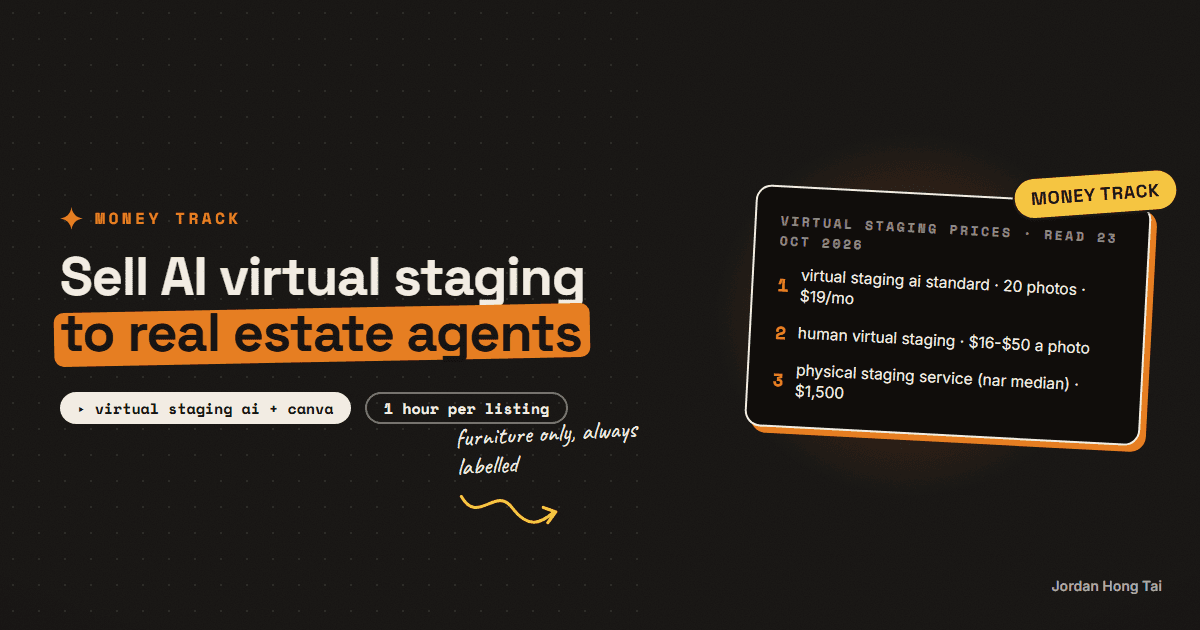
Virtual Staging AI's Standard plan is $19 a month for 20 photos, about 95 cents a photo. Human virtual staging services list about $16 to $50 a photo, and NAR's 2025 staging report puts the median physical staging service at $1,500. That gap is the business: agents with empty listings who want furnished photos by tomorrow, labelled properly.
Virtual Staging AI's Standard plan is $19 a month for 20 photos, about 95 cents a photo. That's from its prices page, read on 23 October 2026. A price roundup from July 2026 lists human-made virtual staging at about $16 to $50 a photo, and NAR's 2025 Profile of Home Staging puts the median physical staging service at $1,500.
So there's a gap. A listing agent with an empty three-bedroom has three choices: list it bare, pay a stager, or pay someone to furnish the photos. People are filling that third option with AI tools, selling a labelled set of staged photos back to the agent by the next morning.
This guide is that service: the photo checklist, the render, the labelled set, a price you can defend and the disclosure rule you can't skip. Results vary a lot. Nothing here is a forecast of what you or anyone will earn.
What you'll have when you're done
- A one-page photo checklist you send an agent before they shoot
- A staged version of each empty room, with furniture only and nothing about the house changed
- A labelled set: each staged photo marked "virtually staged", with the original next to it
- A tool cost sheet that says what one listing costs you
- A pitch message with a sample room from the agent's own listing
- [SCREENSHOT: a before and after pair of one living room, with the "Virtually staged" label on the after]
Before you start
- Virtual Staging AI. Basic is $16 a month for 6 photos, Standard $19 for 20, Professional $39 for 60. Each plan comes with a free image-editing trial, but the staging itself is paid, so start on the smallest plan that covers your first listing.
- Canva or any image editor, free tier, for the label.
- A spreadsheet for the cost sheet and the listing log.
- One empty room photo. Your own, a friend's rental, or a vacant listing you'll use only as a private test.
- About an hour per five-photo listing once your template is set.
Virtual Staging AI: virtualstagingai.app
There's no download pack for this one. The checklist, the cost sheet and the pitch are all on the page.
Step 1: Know what each photo costs you
Here's what Virtual Staging AI lists, read on 23 October 2026.
| Plan | Price a month | Photos a month | About per photo |
|---|---|---|---|
| Basic | $16 | 6 | $2.67 |
| Standard | $19 | 20 | $0.95 |
| Professional | $39 | 60 | $0.65 |
| Enterprise | $79 | 150 | $0.53 |
And here's what people already pay for the human version. Bella Virtual Staging's July 2026 roundup lists Styldod at $23 a photo, BoxBrownie at $30 and Stuccco at $35, with designer staging generally running about $16 to $50. Those are list prices, and they move.
The configuration I'd plan around is Standard, five photos a listing, so four listings a month at about $4.75 each in software. Your time is the bigger cost, so log it from the first job.
Staging cost sheet (one row per listing)
plan:                    standard $19 / 20 photos
photos in this listing:  ______  (start at 5)
software cost:           photos x $0.95
re-renders:              ______  (count them, they eat photos)
your minutes:            ______
Check it worked: you can say what one five-photo listing costs you in software and in minutes. If you can't, don't quote yet.
Step 2: Send the agent a photo checklist first
Bad source photos make bad staging, and no tool fixes a dark, tilted room. Send this before the photographer goes in.
Photo checklist for virtual staging
- empty room, no boxes or leftover furniture
- lights on, blinds open, shot in daylight
- camera at chest height, level, wide lens but not fisheye
- one corner-to-corner shot per room
- living room, primary bedroom and dining room first
- send the full-size JPGs, not screenshots from the listing site
NAR's 2025 report found the rooms sellers' agents stage most are the living room (91%), the primary bedroom (83%) and the dining room (69%). Start there.
Check it worked: the photos you get back are level, bright and empty. If one isn't, ask for a reshoot of that room now rather than staging it badly.
Step 3: Stage one room and judge it like a buyer
Upload the photo, set the room type and pick a style that fits the house and the price point. A modern style in a farmhouse looks wrong to anyone who walks in later.
Then look at the result the way a buyer would. Check the scale (a sofa that would never fit through the door), the shadows, and whether the furniture blocks a window or a fireplace the listing should show off. Re-render until it's believable, and count each re-render, because they use up photos.
Check it worked: the staged room could pass for a real photo at phone size, and nothing about the room itself changed: same walls, floors, windows and view.
Step 4: Furniture only, and label every photo
This is the rule that keeps the agent out of trouble. The NAR Code of Ethics asks Realtors to present a true picture in their advertising, and many MLSs turn that into a concrete rule: label the photo as virtually staged, and often put the unedited original right next to it. Rules differ by MLS, so ask the agent which one they list on and follow its rulebook.
So add furniture and decor only. Don't remove damage, change the paint, swap the flooring or fix the view. Then label every staged photo in Canva before you send it.
Label spec
text:      Virtually staged
position:  top or bottom edge, readable at phone size
pairing:   original photo delivered with the same filename + "-original"
Check it worked: every staged photo carries the label, and every one has its original in the folder. If an agent asks you to drop the label or hide a crack, say no.
Step 5: Deliver a set the agent can upload as-is
Agents are busy, and I think this step wins more repeat work than the staging does. A folder they can drag straight into the listing gets you the next job.
Delivery folder: [address]-staged
01-living-staged.jpg      01-living-original.jpg
02-bedroom-staged.jpg     02-bedroom-original.jpg
03-dining-staged.jpg      03-dining-original.jpg
notes.txt: style used, MLS label added, one free re-render per room
Check it worked: the agent can upload the folder without renaming anything or asking you a question.
Step 6: Price per listing, and pitch with their own room
Price per listing, not per photo. I figure agents think in listings, so that's how they compare quotes. Human services listing $16 to $50 a photo put a five-photo set at roughly $80 to $250 from them, so that's the range an agent has seen. Where you land inside or under it depends on speed, quality and how many listings the agent sends. Physical staging is a different product: NAR's median for a staging service is $1,500.
Don't promise a higher sale price. NAR's report says 29% of sellers' agents saw a 1% to 10% increase in the dollar value offered from staging, but that's agents' opinions, mostly about physical staging. Sell better photos, fast.
Hi [name], I saw [address] is listed with empty rooms.
I virtually staged your living room photo as a sample (attached),
labelled "virtually staged" with the original next to it.

I can do the main rooms for the listing by tomorrow, labelled for
your MLS, for one fixed price per listing.

Want me to do the rest?
Jordan
Check it worked: your pitch includes a staged room from their own listing, the label, a turnaround and a price per listing. If it promises a higher sale price, rewrite it.
The honest part about this market
The software is $19 a month and the agent can sign up for it too. Some will, and honestly, I think that's fine. What a busy agent pays for is not doing it themselves: the checklist, the re-renders until it looks real, the labels and a folder they can upload in one go.
The other honest part is disclosure. A staged photo that hides something is the fastest way to lose an agent's trust and to get them in trouble with their MLS. Furniture only, labelled, original attached, every time.
What I'd do differently
Send the checklist before the shoot. It saves more re-renders than any setting in the tool.
Pitch with their own room. A sample from someone else's listing proves nothing to this agent.
Count re-renders. They're where the per-photo cost quietly doubles.
Start on Standard with one agent. Move up a plan when a second agent sends listings, not before.
FAQ
How much does AI virtual staging software cost?
Virtual Staging AI's prices page, read 23 October 2026, lists Basic at $16 a month for 6 photos, Standard at $19 for 20, Professional at $39 for 60 and Enterprise at $79 for 150. That works out to about $2.67, $0.95, $0.65 and $0.53 a photo. Other tools exist, so compare before you commit.
What do human virtual staging companies charge?
A price roundup published by Bella Virtual Staging on 20 July 2026 lists designer-made virtual staging at about $16 to $50 a photo, with Styldod at $23, BoxBrownie at $30 and Stuccco at $35. Those are list prices from the companies themselves and they change, so check before you quote against them.
Do you have to disclose virtual staging in a listing?
In practice, yes. The NAR Code of Ethics asks Realtors to present a true picture in their advertising, and many MLSs turn that into a rule: label the photo as virtually staged and often show the original next to it. Rules differ by MLS, so ask the agent which one they list on and follow its rulebook.
Does staging actually help a home sell?
NAR's 2025 Profile of Home Staging found that 29% of sellers' agents said staging led to a 1% to 10% increase in the dollar value offered. That report is mostly about physical staging, and it's agents' opinions, not a controlled test. Don't promise a higher price; sell faster, better-looking photos.
Who should I pitch first?
Listing agents with vacant homes on the market right now. Search your local listings for empty rooms in the photos, and pitch the agent with one room already staged from their own listing photo, labelled as a sample.
Can AI virtual staging change the room itself?
It shouldn't. Add furniture and decor only. Don't remove damage, change the view, repaint walls or alter fixtures, because that misrepresents the property. If the agent asks for that, say no.
Related guides
Sell AI product photos to small online shops: the Higgsfield cost per image, what Fiverr sellers ask, and the label rule
One lifestyle product photo made with Nano Banana Pro on Higgsfield costs 2 credits, about 10 cents on the $59 Plus plan. On Fiverr, the first page of AI product photography gigs started at $5 to $250, and half started at $15 or less. The image is close to free. The service is keeping the real label, passing the marketplace's first-image rule, and handing back a set the shop can upload.
Sell one AI automation to a local business: the 3 to pitch first and what they pay
A dentist who misses 20 calls a month is not losing 20 calls. They are losing the ones that ring a competitor 30 seconds later. This guide covers the three automations local businesses will actually pay for, how to build each one in Make.com in an afternoon, what freelancers publicly charge for this category of work, and the outreach move that turns a cold walk-in into a paid setup fee plus a monthly retainer.
Selling print-on-demand with AI designs and mockups: the real cost sheet, the fees, and Etsy's AI disclosure rule
A $24.99 t-shirt on Etsy with $4.99 shipping brings in $29.98. Etsy's transaction fee, payment processing and listing fee take $3.30. The tee and its shipping from a Printify provider cost $16.26. About $10.42 is left, or $5.92 if the sale came through Etsy's Offsite Ads at 15%. The design and the mockup are cheap now. The fees stayed where they were, and Etsy requires you to say in the listing description that the item was made with AI.
Get the next build in your inbox
One email a week: the newest guides, plus one thing I only share with the list.
No spam. Unsubscribe anytime.
Build alongside others
Join the free community and share what you're shipping.

Jordan Hong Tai
I've scaled products to over 500K users, and now I build AI systems in public from a balcony in Tokyo.