A $0 newsletter about AI tools: the beehiiv stack and the three ways it earns
Last updated September 2026 · 2 hours to launch, about 3 hours a week to run · $0 on beehiiv's free plan. A custom domain is optional and runs about $12 a year. · Beginner
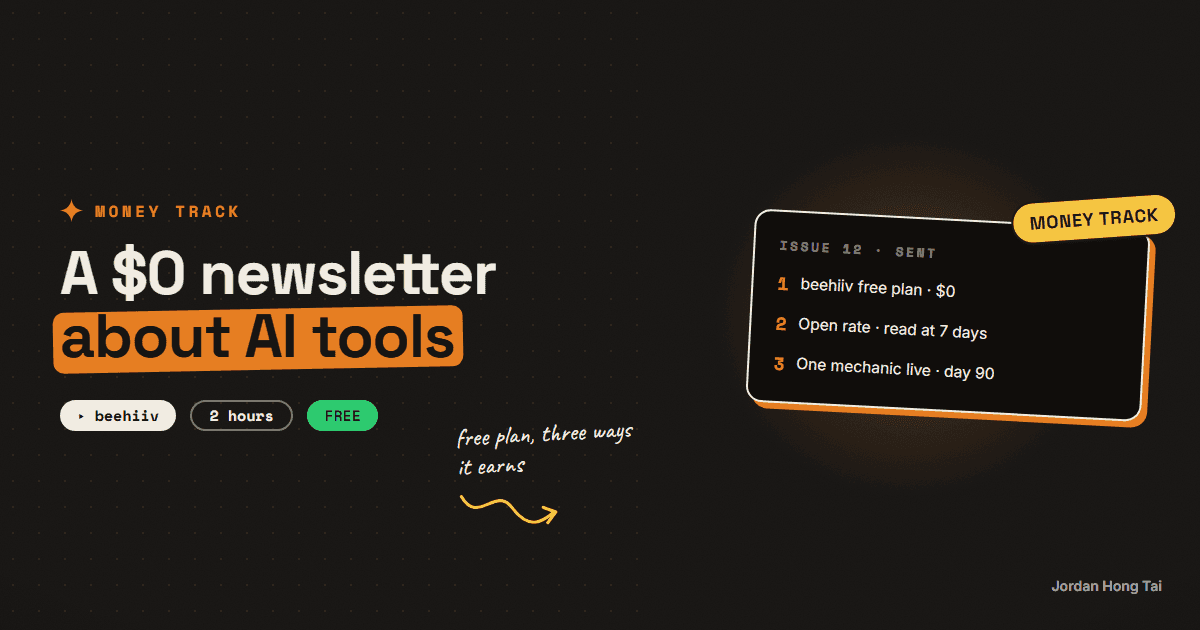
A newsletter is the only asset in this stack you own outright. Not a follower count on a platform that can throttle you overnight, not a channel that can be suspended by a policy update, but a list of email addresses that goes with you. This guide is the full build for an AI-tools newsletter on beehiiv's free plan: the setup, the weekly issue format that stops you running out of things to say, the growth loop that turns one short-form platform into signups, and the three ways newsletters in this category actually make money, each with the public rate behind it.
A newsletter is the only asset in this stack you own outright. A follower count belongs to a platform that can throttle you overnight. A list of email addresses goes with you.
This is the full build for an AI-tools newsletter that costs $0 to run: beehiiv on the free plan, one repeatable weekly issue, one short-form platform pointed at one signup link, and the three ways newsletters in this category actually earn.
One thing up front about the money. Every figure below is a public rate for this category, taken from published sponsorship rate cards, from what newsletters visibly charge for a paid tier, and from how beehiiv describes its own ad network and paid recommendations. They are an anchor so you do not invent one. They are not a forecast of what you will earn.
What you'll have when you're done
- A live newsletter on beehiiv's free plan with a hosted signup page and a working send
- A five-block issue template you can fill in about 90 minutes a week
- A twelve-week topic bank, so week four is not the week you stall
- One growth loop: one short-form platform, one link, one CTA, repeated
- The three revenue mechanics set up in the order they actually switch on
- [SCREENSHOT: the beehiiv dashboard after the first send, subscriber count and open rate visible]
Before you start
- A beehiiv account on the free plan. It carries a hosted signup page, a newsletter website, unlimited sends and a ceiling of 2,500 subscribers (beehiiv's pricing page, read 2026-09-12). Plan limits move, so open the pricing page before you build anything around a number.
- One thing you are genuinely doing with AI tools. Not a topic you researched. A thing you use. The whole format below is a byproduct of work you were doing anyway, which is the only version of this that survives to week twelve.
- One short-form platform you will post on three times a week. One. Not four.
- About two hours to launch. Then about three hours a week: 90 minutes writing, 90 minutes on the loop.
- Optional: a custom domain, roughly $12 a year. Skip it for the first month. Nobody unsubscribes over a beehiiv subdomain.
The honest shape of 90 days
Ninety days is enough to build a list and switch one revenue mechanic on. It is not enough to replace an income, and any version of this promising otherwise is selling you the plan rather than running it.
| Days | What you are doing | What exists at the end |
|---|---|---|
| 1 to 14 | Launch, publish issues 1 and 2, wire the loop | A live newsletter, a signup link in one bio, two issues in the archive |
| 15 to 60 | Ship weekly, run the loop, do not add channels | Six to eight issues, a subscriber count, a real open rate |
| 61 to 90 | Turn on the first revenue mechanic that fits your size | One switch flipped, and enough data to know which of the three is yours |
The reason issues 1 and 2 come before any growth work: a signup page with an empty archive converts badly, and you will not know your own format until you have written it twice.
Step 1: Launch the publication in beehiiv
Create the publication, and spend the setup time on exactly three things. Everything else in the settings can wait.
The name and the one-line promise. The promise is what makes someone subscribe from a landing page they will read for nine seconds. Make it specific and falsifiable. "AI news" is not a promise. "One AI tool I actually used this week, what it replaced, and what it cost" is.
The signup page. beehiiv gives you a hosted landing page on the free plan. Put the promise at the top, the cadence directly under it, and one email field. Do not ask for a first name. Every additional field costs you signups and you have no use for the name in week one.
The welcome email. One email, sent on signup, doing three jobs: confirm what they get and when, link the best thing you have already published, and ask one question with a reply-to that reaches your inbox. Replies to a welcome email are the highest-signal thing a small newsletter gets, and they teach you the format faster than any analytics screen.
Check it worked: subscribe with your own email from an incognito window. The welcome email arrives, the link in it works, and hitting reply puts your address in the To field.
Step 2: Lock the weekly issue format
The reason most newsletters die around week five is not effort. It is that every issue is a blank page. A fixed format turns writing into filling in blanks.
Five blocks, in this order, every week:
| Block | Length | What goes in it |
|---|---|---|
| The one thing | 150 to 300 words | What you tried this week, what it replaced, what it cost, what broke |
| The receipt | 1 screenshot or 3 numbers | The actual output, the actual bill, the actual time |
| Three worth knowing | 3 lines | Three things that moved, one line each, your take not the headline |
| One I'd skip | 2 lines | A tool you tried and would not use again, and why |
| The ask | 1 line | One question with a reply-to |
"One I'd skip" is the block that does the disproportionate work. Every AI newsletter is enthusiastic about everything, so an honest negative is the rarest thing in the category and it is what makes the positives worth anything. It costs you nothing except the discipline to actually try things you end up not liking.
The subject line is written last, from the "one thing" block, and it is the concrete noun rather than the category. "I replaced my video editor with a 40-line script" travels. "This week in AI" does not.
Check it worked: your first issue took under two hours and you did not stare at an empty page once. If either failed, the format is not specific enough yet.
Step 3: One platform, one link, one CTA
The growth loop is the part people over-engineer. The version that works is embarrassingly small: one short-form platform, one signup link, the same CTA every time.
Pick the platform where you already post, or the one whose format you can stand. Then:
- The link goes in the bio. One link, to the signup page, not to a link tree with six destinations. Every hop loses people.
- Every post ends with the same line. The same words each time. Repetition is what makes a CTA get learned rather than read.
- The content is the issue, cut up. Your "one thing" block is a short-form video. Your "one I'd skip" block is another. You are not producing content for two channels, you are producing once and cutting twice.
- Tag the link so you can see what worked. Put UTM parameters on the signup URL and beehiiv will show you which source the subscriber came from.
https://yournewsletter.beehiiv.com/subscribe?utm_source=instagram&utm_medium=bio&utm_campaign=launchChange utm_source per platform if you eventually add a second one. Do not add a second one before day 60.
Why one platform: at a small size, three platforms is not three times the growth, it is one third of the reps on each. Reps are what makes short-form work. Pick the one you can post on three times a week for twelve weeks without negotiating with yourself.
Check it worked: a stranger can go from your bio to a confirmed subscription in two taps, and beehiiv's subscriber list shows the source on the ones who came through it.
Step 4: The three ways this category earns
Here is what each mechanic is, what it requires, and the public rate behind it. They switch on in roughly this order.
Mechanic 1: beehiiv's own ad network and paid recommendations
Two separate products, both built into the platform.
The ad network places sponsors into your newsletter for you. You do not sell, negotiate, or invoice. beehiiv matches an advertiser to your audience, the placement runs in your issue, and you are paid on the performance of that placement. The gate has two halves and beehiiv publishes both. On size, its ads-cost page says "With beehiiv's Ad Network, you can earn with just 2,500 subscribers" (read 2026-09-12). On plan, its Ad Network FAQ says the network is open to publications on the Scale plan or above that are actively sending, and the pricing page puts Scale at $43 a month. That makes this the one mechanic here that costs something before it pays: the free plan stops at 2,500 subscribers, which is the same number the ads-cost page names, so reaching the subscriber bar and leaving the free plan tend to arrive together. Check both in your own dashboard, because these are the kind of numbers that move.
Paid recommendations, which beehiiv ran under the name Boosts until it renamed the feature, is the two-sided one, and it is the more interesting mechanic at small scale. As a recipient, you pay other newsletters a set amount per verified subscriber they send you, which turns money into list growth at a price you set. As a Boost provider, you recommend other newsletters to your readers and are paid per verified subscriber you send them. Provider-side paid recommendations, the feature beehiiv used to call Boosts, are the earliest thing on this list that can pay a small list, because you are being paid on referrals rather than on your own size. Which plan tiers can use which side of paid recommendations has changed before, and beehiiv has renamed the feature at least once,, so confirm it on your plan before you build a month around it.
Mechanic 2: a paid tier
The standard shape in this category is a free weekly issue plus a paid tier at $5 to $10 a month, or $50 to $100 a year. That band is not a secret; it is what you see when you look at the pricing pages of newsletters that run one.
The arithmetic is the useful part, and it is unforgiving in a way worth seeing before you start:
| Paying subscribers | At $8/month | Per year |
|---|---|---|
| 25 | $200/mo | $2,400 |
| 100 | $800/mo | $9,600 |
| 500 | $4,000/mo | $48,000 |
Conversion from free to paid in this category is typically low single-digit percentages, so 100 paying readers is usually a free list of a few thousand. That is a year-two number for most people, not a day-90 number.
Two constraints. First, paid subscriptions on beehiiv require a paid beehiiv plan, so this mechanic is the one that stops the stack being $0. Do not turn it on until the free list justifies the plan cost. Second, a paid tier obliges you to produce something extra every single week, forever, for people who have paid. That is a real commitment and it is the reason to make this the third switch rather than the first.
Mechanic 3: affiliate links to tools you already use
The one that works from subscriber one, because it pays on a purchase and not on a size.
You are already naming tools in every issue. Some of those tools run affiliate programmes. Apply, use the tracked link when you name the tool, and disclose it. The mechanics that matter:
- Only link tools you actually use. In a newsletter whose entire premise is honest first-hand reporting, an affiliate link to something you have not run is the fastest way to be worth nothing.
- Disclose it in the same breath as the link. Not in a footer, not in a separate page. One plain line directly under or beside the link saying you earn a commission. This is a legal requirement in several jurisdictions and it is also just the thing that keeps a reader trusting the "One I'd skip" block.
- Keep the "one I'd skip" block free of affiliate links, always. The moment your negative reviews and your commissions interact, the newsletter's one differentiator is gone.
Direct sponsorships, when they come
Not one of the three switches, because it is a conversation rather than a mechanic, but it is where the numbers get bigger and you should know the band. Newsletter sponsorships are quoted as a CPM, and the unit matters: rate cards price per thousand opens, not per thousand sends, so a list with a weak open rate is worth less than its subscriber count suggests. beehiiv works its own example at a $25 CPM on a 10,000-subscriber list, which is $250 for one placement. Narrow, high-intent tech and business niches sit above that.
Run the arithmetic at your real size, not an imagined one:
| Opens per issue | At $30 CPM | At $50 CPM |
|---|---|---|
| 800 | $24 per issue | $40 per issue |
| 2,500 | $75 per issue | $125 per issue |
| 10,000 | $300 per issue | $500 per issue |
To get your own row, multiply subscribers by your open rate. A 2,000 subscriber list opening at 40 percent is 800 opens, so it is the first row, not the second.
This is the number people do not run before they start, and it is why the first year of a newsletter is a list-building exercise rather than a revenue one. It is also why the niche matters more than the size: a list of 2,000 people who buy AI tooling for a company is worth more to a sponsor than 20,000 general subscribers, and CPMs in that shape go well past the band above.
Step 5: The 90-day plan, week by week
WEEK 1     Publication live. Signup page. Welcome email. Issue 1 sent.
WEEK 2     Issue 2. Link in one bio. First 3 short-form posts.
WEEK 3-4   Weekly issue. 3 posts a week. Apply to 2 affiliate programmes
           for tools you already use.
WEEK 5-8   Weekly issue. 3 posts a week. Add the reply question to every
           issue and read every reply. Adjust the format from the replies,
           not from the analytics.
WEEK 9     Check ad network eligibility: 2,500 subscribers and a paid
           plan (Scale, $43 a month). If you are not there on either,
           note the gap and keep going.
WEEK 10    Turn on paid recommendations as a provider. Recommend only newsletters you
           would read.
WEEK 11-12 Weekly issue. 3 posts a week. Write the sponsor one-pager:
           subscriber count, open rate, who reads it, what a placement
           costs at your real CPM.
DAY 90     One mechanic live. A real open rate. Twelve issues in the
           archive that prove you ship.
The instruction that matters most in that plan is the one in weeks 5 to 8: adjust from the replies, not the analytics. At a few hundred subscribers your open rate is noise and one honest reply telling you which block they read first is worth more than a month of dashboards.
Check it worked: at day 90 you have twelve issues in the archive, an open rate you can quote, and one revenue mechanic switched on. If the archive is short, nothing else on this list matters yet.
What kills these in the first 90 days
Four failure modes, in the order they happen.
Launching on a topic you do not do. A newsletter about AI tools written by someone who does not use AI tools daily runs out of material in five weeks, because there is nothing behind it but other people's announcements. The format in step 2 only works if the "one thing" block is a real thing you did.
Adding a second platform in week three. The loop needs reps on one surface. Three platforms at a third of the reps is worse than one platform at full reps, and it feels like progress the whole time it is failing.
Optimising the send time before you have a format. At 300 subscribers there is no send-time signal in your data. There is a format signal in your replies.
Turning on monetisation before there is anything to monetise. A sponsor slot in an issue that goes to 200 people is worth about six dollars and costs you the one thing that made the issue worth reading. The order in this guide is the order for a reason.
The newsletter 90-day pack: issue template, 12-week topic bank, revenue mechanics sheet
FAQ
Is beehiiv really free, or does the free plan block the parts that matter?
The free plan carries the parts you need to launch: a hosted signup page, a newsletter website, unlimited sends and a ceiling of 2,500 subscribers (beehiiv's pricing page, read 2026-09-12). What sits behind the paid tiers moves, so check the current pricing page before you plan around it. The limit worth knowing on day one is that two of the three revenue mechanics in this guide sit behind a paid plan: paid subscriptions, and the ad network and paid recommendations, which beehiiv's pricing page lists from the Scale tier at $43 a month. Affiliate links are the one that works on the free plan from subscriber one. That is why the guide starts you on affiliates and treats the rest as later switches.
How many subscribers do I need before any of this earns?
It depends which mechanic. Affiliate links work from subscriber one, because they pay on a purchase and not on a size. beehiiv's ad network publishes a number: its ads-cost page says "With beehiiv's Ad Network, you can earn with just 2,500 subscribers" (read 2026-09-12), and its Ad Network FAQ adds the other half of the gate, which is that the network is open to publications on the Scale plan or above that are actively sending. Scale is $43 a month on the pricing page, so the ad network is a month-three-or-later switch for most people and it is not a free-plan mechanic. Direct sponsorships are a conversation, so they start when you have a number a sponsor recognises, which in a narrow niche is smaller than people assume. Paid tiers need not size but proof that a specific group of readers would miss you.
Why beehiiv rather than Substack, ConvertKit or Ghost?
beehiiv is the one that has the monetisation plumbing built into the platform rather than bolted on: the ad network, paid recommendations and referral mechanics ship with the product, so you are not integrating three services to earn from a list of 800 people. Be clear-eyed about where they sit, though. beehiiv's pricing page lists the ad network and recommendations from the Scale tier at $43 a month, not on the free plan (read 2026-09-12). Substack is simpler and takes a percentage of paid subscriptions. ConvertKit is stronger if the newsletter is a front door to selling your own products. Ghost is the answer if you want to own the software. All four send email fine. Pick beehiiv when the money mechanics are the thing you do not want to build.
What do I actually write about every week without running out?
Not tool announcements. Every AI newsletter covers those and they age in a week. The format that survives is one thing you tried, what it replaced, what it cost and what broke, plus a short list of what moved that week. The trying is what makes it repeatable, because you were going to use these tools anyway and the issue is a byproduct rather than a second job. The pack includes a twelve-week topic bank built on that shape so week four is not the week you stall.
Can I write the issues with Claude or ChatGPT?
Use them for the parts that are labour and not judgment: turning your notes into a first draft, tightening a paragraph, generating subject-line options, summarising a long release note. Do not use them for the opinion, because the opinion is the only thing that makes one AI newsletter different from the four hundred others. A useful test is whether a reader could have gotten your issue by asking a model the same question. If they could, the issue did not need to exist.
How honest are the money numbers in this guide?
They are public rates for this category, quoted so you have an anchor before you invent one. Sponsorship CPMs come from published rate cards, paid-tier prices come from what newsletters visibly charge, and the beehiiv mechanics come from how the platform describes its own products. None of them is a forecast of your result, and the arithmetic in the revenue section deliberately shows the small numbers rather than the impressive ones, because 800 subscribers at a $40 CPM is $32 an issue and it is more useful to know that before you start than after.
Related guides
The comment-to-DM system that grows your email list on autopilot
You'll build the flow where one word in your comments turns into a DM with your link and an email on your list. Twenty-five minutes in ManyChat, on the free plan.
The exact system that writes a week of my content in an hour
You'll build the AI content creation system that turns one topic into a week of platform-ready drafts, in your voice. One hour to set it up, and after that Monday runs the week.
Turn one guide into 21 X posts with a voice file
One guide holds about seven reusable atoms: a contrarian claim, a number, a mistake, a framework, a step, a tool tip and a question. Each atom becomes three posts in different forms, which is 21. A voice file keeps all 21 sounding like you instead of like a content calendar.
Get the next build in your inbox
One email a week: the newest guides, plus one thing I only share with the list.
No spam. Unsubscribe anytime.
Build alongside others
Join the free community and share what you're shipping.

Jordan Hong Tai
I've scaled products to over 500K users, and now I build AI systems in public from a balcony in Tokyo.