The page types AI answers cite most, and how to build each one for your business
Last updated October 2026 · A day to build the first ranked list page and the first single-question article; the rest over a month · Free; the citation studies are public and the tracking is a spreadsheet · Comfortable
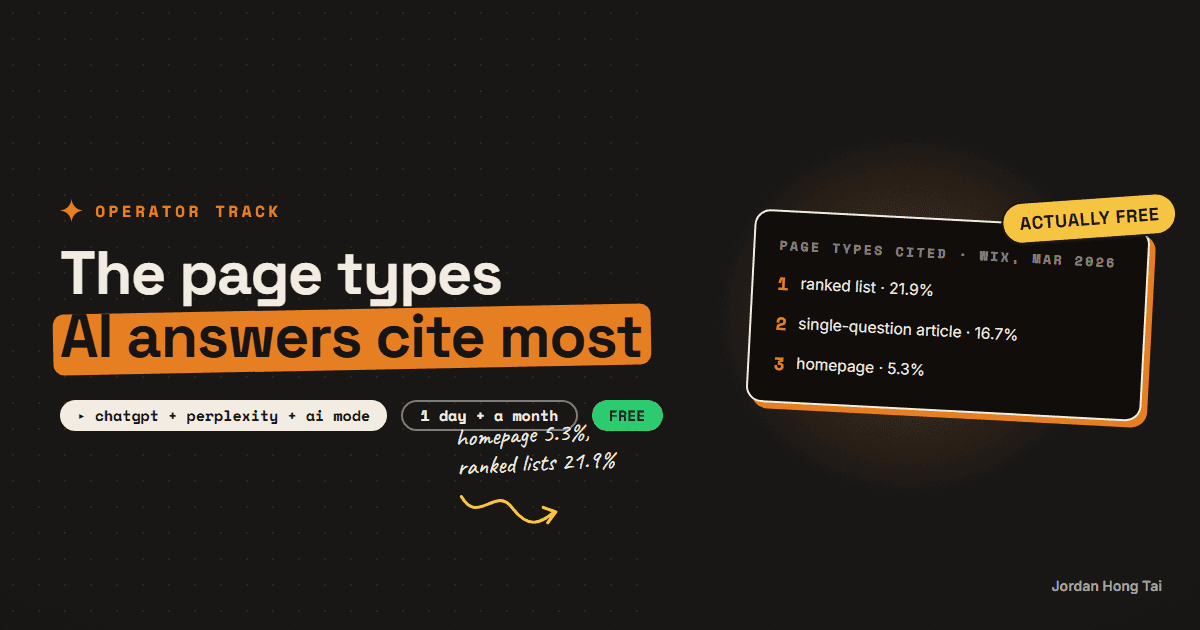
Your homepage is the page you polish most and the page AI answers cite least. In Wix's March 2026 study of 1,056,727 citations across ChatGPT, Google AI Mode and Perplexity, homepages took 5.3% of them. Ranked list pages took 21.9%, articles that answer one question took 16.7%, and product pages took 13.7%. So the question is not whether your site is good. It is whether you have built the page types the engines actually pull from, and most small business sites have built one of them, if that.
Your homepage is the page you polish most and the page AI answers cite least. In Wix's March 2026 study of 1,056,727 citations across ChatGPT, Google AI Mode and Perplexity, homepages took 5.26% of them. Ranked list pages took 21.88%. Articles that answer one question took 16.68%. Product pages took 13.66%.
So I think the question most small businesses are asking is the wrong one. It is not "is my site good enough to be cited". It is "have I built the page types the engines actually pull from", and most sites I look at have built one of them, if that.
This guide is a ranked list of those page types, with the number behind each one and where it came from, and then a build for each one that a one-person business can actually do. Every figure here comes from a study I opened, with the date and the link. Where a tool refused me, I say so rather than make a number up.
One honest line before the list. I am building CiteScore, a tool that measures whether AI answers name you, so I read these studies for a living now. The method at the end is the free version of what it does.
What you'll have when you're done
- A ranked list of the page types AI answers cite, with the percentage and the source for each
- One ranked list page, one single-question article and one product or service page rebuilt the way the citation data says
- A title and URL rule you can apply to every page in ten minutes
- A clear idea of what does not move the needle, so you stop spending on it
- A free three-run spreadsheet that tells you in four weeks whether any of it worked
- [SCREENSHOT: the page-type table from the Wix study next to the tracking sheet with week-one and week-four runs]
Before you start
- Your own site, with the ability to add pages and edit titles and URLs. Any CMS works.
- Free accounts on ChatGPT and Perplexity, and a browser for Google. The checking method needs nothing paid.
- A spreadsheet. Google Sheets is fine.
- A day for the first two pages. The rest can take a month and should.
The ranking, and where each number comes from
Four studies did most of the work here, and I'd rather you knew what each one measured before you trust a number from it.
Wix AI Search Lab, 23 March 2026. 75,000 AI answers, 1,056,727 citations, three engines (ChatGPT, Google AI Mode, Perplexity), every cited page classified into one of eleven content types. This is the only study I found that ranks page types directly, so it anchors the list.
Evertune, April 2026. Over 40,000 URLs that ChatGPT cited heavily across about 50 product categories over 60 days. It found 50% of those citations were listicles, and 58% of the listicles were ranked lists.
Ahrefs, 15 April 2026. 1.4 million ChatGPT prompts, looking at why a retrieved page got cited or did not. This is the "how to build it" study.
Semrush, 21 July 2025. 5,000 keywords, over 150,000 citations, four platforms. Its line about subpages beating homepages is the one I'd put on a wall.
Here is the ranking from the Wix data, which I have rounded to one decimal.
| Rank | Page type | Share of all citations | Where it wins |
|---|---|---|---|
| 1 | Ranked list ("best X for Y") | 21.9% | 40.9% of citations on commercial questions |
| 2 | Article that answers one question | 16.7% | 45.5% of citations on informational questions |
| 3 | Product or service page | 13.7% | 24.9% on transactional, 22.0% on navigational |
| 4 | Category or hub page | 11.3% | 18.3% on navigational, 15.0% on transactional |
| 5 | Discussion thread | 7.5% | 17.4% of Perplexity's citations |
| 6 | How-to guide | 6.2% | 9.2% on informational |
| 7 | Homepage | 5.3% | 13.6% on navigational, 0.4% on informational |
| 8 | Comparison page | 2.2% | 4.1% on commercial |
| 9 | "Alternatives to X" page | 0.3% | nowhere, really |
Two things jump out at me from that table. The homepage, the page every business spends the most on, is seventh. And the comparison page, the page every SEO deck tells you to write, is eighth. The engines are not rewarding the pages we were taught to build.
The rest of this guide is a build for each of the top four, then a note on the fifth, then what to stop doing.
Step 1: Build the ranked list page
This is the page type that wins the money questions. "Best accountants for a small e-commerce shop in Leeds." "Best CRM for a two-person agency." When Wix sorted citations by intent, listicles took 40.86% of the commercial ones, nearly double any other type. Evertune's read of ChatGPT was blunter: half of what it cited heavily was a list, and 58% of those lists were ranked.
A small business usually refuses to write this page, because it means naming competitors. I'd write it anyway, for two reasons. The engine is going to answer that question whether you wrote the page or not, and right now it is answering it from a page somebody else wrote. And a list that includes you and four honest alternatives is more likely to be cited than a page that only mentions you, because the question was plural.
The shape that the data rewards:
- A title that is the question. "The 7 best [service] for [specific customer] in 2026." Ahrefs measured the similarity between the prompt and the cited page's title at 0.602, against 0.484 for retrieved pages that were not cited. The title is doing most of the matching.
- A ranked, numbered list, each item with the same three fields: who it is for, what it costs, and the one thing it does that the others do not. Ranked beats unranked in Evertune's data by a wide margin.
- Yourself in the list, honestly placed. If you are the best choice for one kind of customer and not another, say so. An engine quoting that sentence is still naming you.
- A date in the title and a last-updated line. Ahrefs found cited URLs averaged 1,064 days old against 1,432 for organic results, 25.7% fresher, and in its ChatGPT study the median cited page was about 500 days old. Fresh is not "this week". It is "updated this year".
Title:  The [N] best [service] for [specific customer] in [year]
URL:    /best-[service]-for-[customer]
Intro:  One paragraph. Who this list is for and how you picked.
List:   Numbered. For each: who it suits · price · the one difference
You:    In the list, with the same three fields, at the rank you deserve
Footer: Last updated [month year]. How often you re-check it.
Check it worked: paste the title into ChatGPT as a question, without your brand name. If the answer's shape matches your page's shape, the page is built right. If the answer is a list of five and your page is a 2,000-word essay, rebuild.
Step 2: Build the single-question article
Second overall at 16.7%, and the clear winner on informational questions at 45.48% of citations, 2.7 times the average. This is the "what is", "how much does", "do I need" page.
The build rule here comes from the Ahrefs ChatGPT study, and I'd say it is the single most useful sentence in all this research. Cited pages had titles that matched the question. Pages with a natural-language URL slug were cited 89.78% of the time when retrieved, against 81.11% for pages without one. So the URL is part of the title now.
One question per page. Not a topic. A question.
- Title: the question as a customer types it, with one qualifier. "How much does a will cost in the UK in 2026" beats "Will writing: our guide".
- URL: the question in words.
/how-much-does-a-will-costnot/services/wills/pricing-info. - First two sentences answer it, with the number, the range or the yes/no. An engine quoting your opening is the whole point.
- Then the detail, in short sections with headings that are themselves questions.
- One fact the engine cannot get elsewhere. Your own price. Your own turnaround. A number from your own records. That is what makes your version of a common page the one worth citing.
Q: [the question, exactly as typed]
A (sentence 1): the answer with the number or the range
A (sentence 2): the one condition that changes it
H2: Why it costs that
H2: What changes the price
H2: What we charge, and what is included
Last updated: [month year]
Check it worked: read the URL aloud. If it sounds like a sentence a person would say, it passes. If it has a number, an ID or a folder in it, change it.
Step 3: Rebuild the product or service page with the facts in text
Third overall at 13.7%, and first on transactional questions at 24.88% of citations. This is the page someone lands on when they are ready to buy, and the engines know it.
Most service pages fail here in the same way. The price is in an image, a PDF or a "request a quote" form. The hours are in a widget. The service area is implied. The engine cannot quote what is not in the HTML as text, and the Semrush study's finding applies directly: the engines cite specific subpages and help articles that match the question's detail, not pillar pages that gesture at it.
So the rebuild is mostly subtraction and plain text.
- One page per product or service, not one page for all of them. A category page is a different page type and it is next.
- Price, range or starting price as text, with what it includes and what costs extra.
- The constraints as text: turnaround, area served, minimum order, what you do not do.
- The two or three questions people ask before buying, each with a short answer, on the page itself rather than in a separate FAQ.
- Last updated, because a price from 2023 is a page the engine will skip.
Check it worked: select all the text on the page and paste it into a blank document. If a stranger could quote your price, your area and your turnaround from that plain text alone, the page is readable. If they could not, neither can the engine.
Step 4: Give the category page a job
Fourth at 11.3%, and it earns its place on navigational and transactional questions, 18.31% and 14.97%. This is your "services" or "shop" page, and on most small sites it is a grid of boxes with no words.
The fix is not to make it long. It is to make it describe the set. One paragraph at the top that says who the category is for and how the items differ, then the list of items with one line each. The engine uses this page when the question is "what kinds of X does this company do", and a grid of icons cannot answer that.
Check it worked: the first paragraph of the category page answers "what are the options and how do they differ" without clicking anything.
Step 5: The pages you do not host
Discussion threads were fifth overall at 7.5%, and on Perplexity they were 17.35% of everything it cited, more than double the average. Profound's February 2026 read of about 700,000 ChatGPT citations to social platforms found 99% of its Reddit citations went to individual threads, not subreddits or profiles, 85.4% of its YouTube citations went to specific videos, and its LinkedIn citations split 25.4% personal profiles, 25.1% posts and 18.4% company pages.
These are page types. You just do not own the domain.
What that means in practice for a small business:
- Answer the real question in one thread where your customers already ask it, with the same detail you would put on your own article page. Link to your page at the end, not the start.
- One video that answers one question, titled as the question. Ahrefs' 75,000-brand study found YouTube mentions correlate with AI visibility at 0.737 for ChatGPT, higher than branded web mentions at 0.664 and far higher than Domain Rating at 0.266. I did not expect that, and I'd treat it as the cheapest lever on this list.
- A LinkedIn post that is the article, not a link to it, if your customers are there.
Check it worked: search your most common buying question on Reddit and YouTube. If the top result is three years old and wrong, you have found the thread or video to make.
What not to spend on
Three things the data says to stop doing, or at least stop expecting citations from.
Schema markup, on its own. Ahrefs tracked 1,885 pages that added JSON-LD schema between August 2025 and March 2026 against 4,000 control pages. AI Overview citations fell 4.6%, AI Mode rose 2.4%, ChatGPT rose 2.2%, and the two rises were statistically indistinguishable from zero. Keep schema for the other things it does. Do not build a page around it.
The comparison page. 2.2% of citations overall. I know every SEO template has "X vs Y" in it. The engines are answering comparison questions from ranked lists instead, and a ranked list that includes both X and Y does the job of five comparison pages.
Ranking on Google as the whole plan. It matters a lot for one engine and much less for the others. Ahrefs found 76.1% of pages cited by Google AI Overviews rank in Google's top 10. Across six AI platforms, only 12% of cited URLs ranked in the top 10 for the original prompt, 28.6% on Perplexity and about 8% on ChatGPT. Semrush found most ChatGPT citations in its sample came from URLs ranking beyond position 21. So Google rank is the AI Overviews lever. For ChatGPT and Perplexity, the page type and the title are the lever.
Step 6: Check whether it worked, three runs at a time
Here is where I'd be careful, because one check is not a measurement. Ask ChatGPT the same question twice and you will often get two different source lists. I wrote a whole guide on that, with the research behind it, and the method is free.
The short version. Ten to fifteen buying questions, written the way customers type them. Three engines. Three runs per question per engine, each in a fresh chat, each week. Log the URLs that come back. Read the change from week to week, never the single snapshot. By week four you will know whether the ranked list page is being cited, and on which engine, and you will have spent nothing.
I did try the paid route for this guide. Ahrefs has a Brand Radar report of cited pages, and I called it for jordanhongtai.com through its API on 5 October 2026. It returned "Insufficient plan". So there is no Ahrefs citation data in this guide, and I would rather tell you that than paste a number I did not get.
Check it worked: the sheet has a row per question per engine per run, a column for every URL cited, and a weekly diff column. If you cannot point at the week your new page first appeared, keep running it.
What I'd do differently
Write the ranked list first, even though it names competitors. It is the page type that wins the commercial question, and the engine is answering that question from someone else's list today.
Make every title a question and every URL a sentence. That is the cheapest change on this list and the one with the clearest number behind it.
Put the price in text. The product page is third for a reason, and most of them are unreadable to the thing that would cite them.
Make one video. I'd say the 0.737 correlation surprised everyone who read that study, me included.
Stop expecting the homepage to do this job. It is the front door. The engines cite the rooms.
FAQ
Which page type do AI answers cite most?
Ranked list pages. In Wix's AI Search Lab study of 75,000 answers and 1,056,727 citations across ChatGPT, Google AI Mode and Perplexity, published 23 March 2026, listicles took 21.88% of citations overall and 40.86% of citations on commercial questions. Evertune's April 2026 read of 40,000 heavily cited URLs found half of ChatGPT's citations were listicles, and 58% of those were ranked lists.
Does my homepage get cited by ChatGPT?
Rarely. Homepages took 5.26% of citations in the Wix study, and 13.56% only on navigational questions where someone was already looking for a specific company. Semrush's 5,000-keyword study said the same thing in words: the engines cite subpages, specific blog posts and help articles rather than the homepage. Build the specific page and let the homepage link to it.
Do I need schema markup to get cited by AI?
The best evidence says it does not move citations on its own. Ahrefs tracked 1,885 pages that added JSON-LD schema between August 2025 and March 2026 against 4,000 control pages and found AI Overview citations down 4.6%, AI Mode up 2.4% and ChatGPT up 2.2%, with the two gains statistically indistinguishable from zero. Schema is still worth having for other reasons. It is not the lever here.
Do I have to rank on Google to be cited?
It depends on the engine. Ahrefs found 76.1% of pages cited by Google AI Overviews rank in Google's top 10, but across six AI platforms only 12% of cited URLs ranked in the top 10 for the prompt, 28.6% on Perplexity and about 8% on ChatGPT. Semrush found most ChatGPT citations in its sample came from URLs ranking beyond position 21. For AI Overviews, rank first. For ChatGPT, match the question.
How do I check whether my new page is being cited?
Ask the question in ChatGPT, Perplexity and Google three times each in fresh sessions and log which URLs come back, then repeat weekly and read the change, not the snapshot. One run is a draw from a distribution, not a measurement. The free spreadsheet method is in my track-ai-visibility-spreadsheet guide. Paid tools like Ahrefs Brand Radar report cited pages, but the brand-radar endpoints refused my plan when I tried them for this guide.
Are Reddit threads and YouTube videos page types I should build?
They are page types other people host, and they count. Profound's February 2026 read of about 700,000 ChatGPT citations to social platforms found 99% of Reddit citations go to individual threads, 85.4% of YouTube citations go to specific videos, and LinkedIn citations split 25.4% personal profiles, 25.1% posts and 18.4% company pages. Ahrefs' 75,000-brand study found YouTube mentions correlate with AI visibility more strongly than anything else it tested, at 0.737 for ChatGPT. One thread or one video that answers the question is a page type.
Related guides
Track whether AI answers name you, with a spreadsheet and Claude
Ask ChatGPT the same buying question twice and you will often get two different lists of sources. NJIT researchers measured it across 11,500 real queries and found AI Overview source sets overlapping at a Jaccard score of 0.66 between two runs of the identical query, against 0.78 for the ordinary results page. A newer paper ran 50 questions across 6 engines 15 times each and found five of the six still naming brands they had never named before at run 15. So a single audit is not a measurement, it is one draw from a distribution. The repetition is the product, and you can get it with a spreadsheet for nothing.
AI Overviews vs Perplexity vs ChatGPT: what each one actually cites
Three AI engines answer the same buying question and cite three different kinds of source. Perplexity shows a numbered list you can read straight off the page. ChatGPT browses and names a handful inline. Google AI Overviews mostly pulls from pages already ranking underneath it. Those are three different games, and a single audit run tells you almost nothing about any of them, because the answers shuffle between runs. This is the test, the comparison, and the logging sheet that turns it into a trend.
Your site's next visitor is an AI assistant: five fixes to make your website readable by AI crawlers and agents
Vercel counted 569 million GPTBot requests and 370 million from Anthropic's crawler in one month on its network, and found that none of the major AI crawlers render JavaScript. Cloudflare has blocked AI crawlers by default on new domains since 1 July 2025 and set new defaults on 15 September 2026. So plenty of sites are unreadable to their fastest-growing kind of visitor, and their owners do not know it.
Get the next build in your inbox
One email a week: the newest guides, plus one thing I only share with the list.
No spam. Unsubscribe anytime.
Build alongside others
Join the free community and share what you're shipping.

Jordan Hong Tai
I've scaled products to over 500K users, and now I build AI systems in public from a balcony in Tokyo.