Getting paid when other people use your cloned voice: the ElevenLabs Voice Library, how payouts work, and what it takes
Last updated September 2026 · An afternoon of recording, then 3 to 6 hours of fine-tuning · Creator plan $22/mo (first month 50% off); a decent USB mic · Beginner
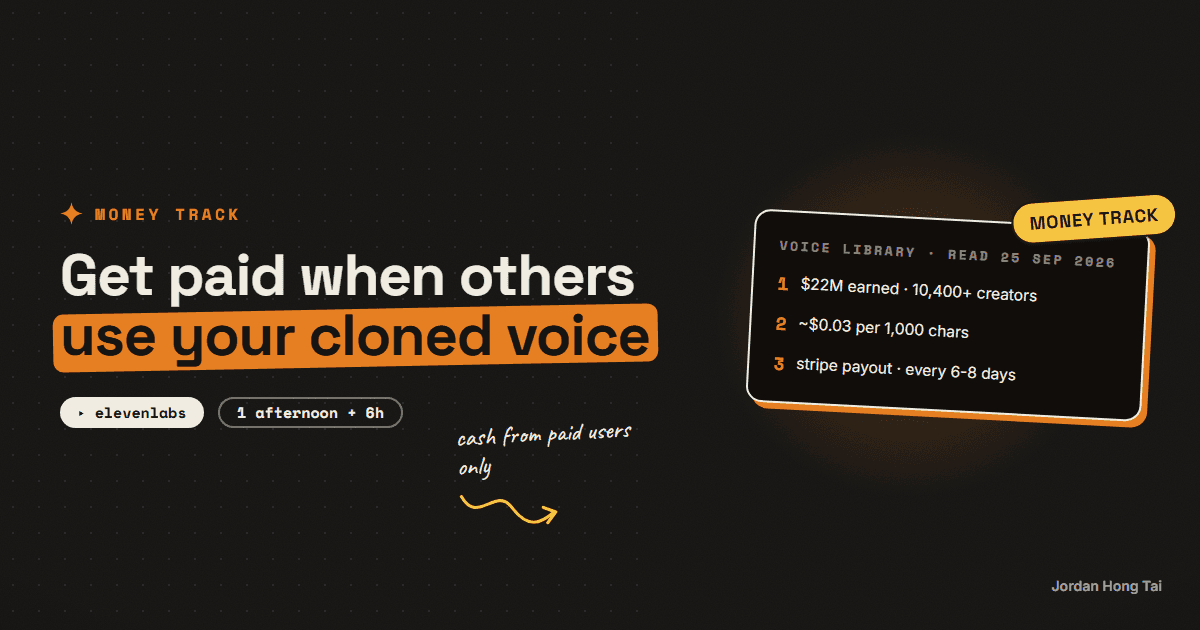
ElevenLabs says voice creators on its platform have earned $22 million, across more than 10,400 creators, up from $11 million in November 2025. You clone your own voice, share it in the Voice Library, and when a paying user generates audio with it you get paid in cash. The default rate is around $0.03 per 1,000 characters, so a million characters of other people's audio is about $30. The total is real. The split is very uneven.
ElevenLabs says voice creators on its platform have earned $22 million, across 10,400+ creators in 32 languages. The figure comes from its own blog, first published on 22 May 2026 and updated on 22 September 2026. In November 2025 the same total was $11 million.
The mechanism is simple. You clone your own voice properly, share it in the ElevenLabs Voice Library, and when a paying user generates audio with it, you get paid in cash.
That total is real and it is split across ten thousand people, very unevenly. So this guide covers how the payout actually works, what the rate is, what it takes to qualify, and the math that tells you whether a voice is worth sharing. Everything here comes from ElevenLabs' own docs, help centre, pricing page and blog, read on 25 September 2026.
Results vary a lot. ElevenLabs itself says the rates are not a guarantee of earnings, and nothing below is a forecast of what you will make.
What you'll have when you're done
- A Professional Voice Clone of your own voice that passes ElevenLabs' verification
- A Voice Library listing with a name, description and tags that people searching for a narrator can find
- Payouts connected through Stripe, with the tax form done
- A notice period you picked on purpose, knowing you can raise it later and never lower it
- A simple sheet that turns characters generated into dollars, so you read your own numbers without guessing
- [SCREENSHOT: the Voice Library listing and the payouts dashboard]
Before you start
- The Creator plan or above. ElevenLabs' pricing page lists Professional Voice Cloning from Creator, which is $22 a month with the first month at 50% off. Starter at $6 does not include it. Pro is $99.
- At least 30 minutes of clean audio of your own voice. ElevenLabs recommends two to three hours for the best result. One speaker, one mic, one room, no music.
- Your own voice only. The Professional Voice Clone must be your voice, and you prove it with a live verification read.
- A Stripe account for payouts. A paid plan is not required to receive payouts, only to create the clone.
- About a day. Recording takes an afternoon, and fine-tuning the clone takes three to six hours on ElevenLabs' side.
Step 1: Record audio that clones well
The clone copies everything, including the room. A laptop mic in a kitchen gives you a clone that sounds like a laptop mic in a kitchen, forever.
- One microphone, the same distance from your mouth every session
- A small, soft room: a closet full of clothes is the classic cheap booth
- Read the kind of material you want people to use your voice for. Narration voices should record narration, not phone-call chatter.
- Keep your energy even across the whole set. The clone averages you.
- Export as WAV or high-bitrate MP3, then cut out coughs, long pauses and any other voice.
Check it worked: play back one minute on headphones. If you can hear the room, a hum or the fridge, re-record that session before you upload anything.
Step 2: Create the Professional Voice Clone
In ElevenLabs, go to Voices → Add a new voice → Professional Voice Clone. Upload the audio, then complete the verification: ElevenLabs shows you a short passage and you read it live, so it can check the voice matches the recordings.
Fine-tuning then runs for three to six hours. You get an email when it finishes.
Check it worked: generate a paragraph you did not record. If a friend cannot tell it is the clone on a phone speaker, it is ready. If they can, add more audio and fine-tune again.
Step 3: Share it to the Voice Library
Only Professional Voice Clones can be published to the Voice Library, and ElevenLabs reviews them first and may decline a voice. Open your voice, choose Share, and fill in the listing.
The listing is a small search page, so write it the way a buyer searches:
Name: [first name] - [one-word character, e.g. "Warm Narrator"]
Description: Calm, clear [accent] [gender] voice for audiobooks,
explainer videos and e-learning. Even pacing, low energy, no vocal fry.
Best for: long-form narration, documentaries, course lessons.
Tags: narration, audiobook, calm, [accent], [age range]
Then pick the notice period. This is the most important setting on the page. It is how long anyone who has added your voice keeps access if you later decide to remove it. It runs from immediate removal up to two years.
Two things ElevenLabs is clear about. The default payout rate is set by the notice period you pick, and you can raise the notice period later but never reduce it. So a longer notice period tends to pay more, and it is a longer promise you cannot take back.
Check it worked: search the Voice Library for your own tags from a second account. If your voice does not appear in the first few pages for its main tag, rewrite the description with the words buyers use.
Step 4: Understand exactly what you get paid for
Read this part slowly, because it is where the expectations go wrong.
Cash, from paid users only. ElevenLabs' docs say Voice Actor Payouts pay cash rewards when paid users generate audio with your Professional Voice Clone, and that payouts exclude use by free users. The 2024 launch also offered credits. Today's docs describe cash, so plan on cash.
The rate is per 1,000 characters generated. ElevenLabs' blog from 25 June 2025 puts the default rate at around $0.03 per 1,000 characters, and up to $0.20 for rare voices. Custom rates are a legacy feature that is no longer available for newly shared voices.
So here is the arithmetic at the default rate:
| Characters generated with your voice | At ~$0.03 per 1,000 |
|---|---|
| 100,000 (roughly two hours of narration) | ~$3 |
| 1,000,000 (roughly a day of narration) | ~$30 |
| 10,000,000 | ~$300 |
The hours assume about 15,000 characters of speech per 20 minutes at a normal narration pace.
Ten million characters is a lot of other people's audio. That is why the $22 million total and the typical creator's month are very different numbers.
When the money arrives. Payouts go through Stripe Connect every six to eight days once your earnings pass the minimum threshold, usually $10. US creators file a W-9, and everyone else files a W-8. Non-US creators face 30% withholding by default unless a tax treaty and the right form reduce it, and ElevenLabs issues a 1042-S.
Check it worked: connect Stripe and file the tax form the same day you share the voice, so the first payout does not stall on paperwork.
Step 5: Read your numbers every week
The payouts page shows usage of your voice. Keep a small log so you can see the trend instead of refreshing the dashboard.
Voice payout log
week_of | characters_generated | earned_usd | notice_period | listing_changes
Change one thing at a time: the name, the description, the tags, the sample. Leave it for two weeks, then compare. A listing change is the only lever you control after the voice is live.
Check it worked: after four weeks you can say which listing change moved usage, or that nothing did.
The trade you are actually making
This is the part to think about before you click Share, because some of it cannot be undone.
Other people will say things in your voice. Live moderation blocks prohibited categories, but inside the rules, you do not choose the scripts. If you would mind hearing your voice in an ad for something you dislike, do not share it.
The notice period is a promise. Raise it and you cannot lower it. Remove the voice and existing users keep access for that long.
ElevenLabs can remove a voice at its sole discretion, and its own pages say the rates are not a guarantee of earnings.
Keeping the plan. You need Creator or above to create the clone. Whether sharing and payouts continue unchanged if you later drop below Creator is not something ElevenLabs' pages state consistently, so check your own account's terms before you downgrade.
The math is volume-bound. At about $0.03 per 1,000 characters, the $22 a month plan needs roughly 730,000 characters of other people's generation to pay for itself. ElevenLabs' blog has stories of individual creators earning a few hundred dollars a month. They are stories, not data, and the average of 10,400 creators is not a number anyone published.
So it makes sense in one case. You already need the clone for your own work, so the plan is a cost you carry anyway, and the voice fits a gap in the library: a clear narration voice in an accent or language that is under-supplied. Then sharing is a small bet on top of something you use.
What I'd do differently
Record for the library, not for yourself. The voice people search for is calm and even. The voice that sells a reel is fast and punchy. Those can be two different recording sessions.
Pick the notice period last and slowly. Everything else on the listing can change on a Tuesday. That setting only goes one way.
Treat the listing like a product page. The description and tags are the only marketing the voice gets.
Do the tax form on day one. A payout that stalls for paperwork is the most avoidable problem on this page.
FAQ
Does ElevenLabs really pay people for their voices?
Yes. ElevenLabs' docs describe Voice Actor Payouts as cash rewards when paid users generate audio with your Professional Voice Clone, and payouts exclude use by free users. Its blog reports $22 million earned by voice creators across 10,400+ creators, in a post first published 22 May 2026 and updated 22 September 2026.
How much does ElevenLabs pay per character?
ElevenLabs' blog from June 2025 says the default rate is around $0.03 per 1,000 characters, and up to $0.20 for rare voices. The docs say the default rate is determined by the notice period you select. Custom rates are a legacy feature and no longer available for newly shared voices. At $0.03, a million characters is about $30.
Which ElevenLabs plan do I need?
Creator or above to make a Professional Voice Clone, which is the only kind of voice that can be shared to the Voice Library. Creator is $22 a month with the first month at 50% off, read on 25 September 2026. A paid plan is not required to receive payouts, and ElevenLabs' pages are not consistent on what happens to a shared voice if you downgrade, so check before you do.
What is the notice period?
It is how long people who added your voice keep access if you remove it, from immediate removal up to two years. It also sets your default payout rate. You can increase it later but never reduce it, so pick it carefully.
How and when do payouts arrive?
Through Stripe Connect, every 6 to 8 days once your earnings pass the minimum threshold, usually $10. US creators file a W-9 and others a W-8; non-US creators face 30% withholding by default unless a treaty and the right form reduce it.
Can I clone someone else's voice and share it?
No. The Professional Voice Clone must be your own voice, and you prove it with a live verification read. ElevenLabs also runs live moderation on prohibited content and can remove a voice at its sole discretion.
Related guides
I stopped filming my reels (my AI avatar reads the script)
You'll set up a pipeline where a text file becomes a talking-head clip of your own AI avatar, in your voice, with no camera. Claude Code calls HeyGen's API from a skill file, waits for the render, and drops the clip in your editing folder. After the 30-minute setup, a reel starts with a paragraph, not a tripod.
AI avatar videos for local businesses: the build, the pitch and the price
A 40-second AI avatar video costs about $2 to produce. On Fiverr the cheapest gigs selling that work start at $5. That gap is why the marketplace is crowded and why the marketplace is the wrong place to sell this, and the rest of this page is the version that works instead: the three videos a local business will actually pay for, the real per-video cost from my own render log, the public asking range read off live listings, and the three ways the deal goes wrong.
One-person content agency: 30 short videos a week, the real cost sheet
Seven avatar reels cost me $14.71 last week. That is the whole render bill, measured, not estimated. This guide takes the per-unit costs from a pipeline that actually runs every week and does the arithmetic for 30 short videos a week: what HeyGen bills per finished second, what ElevenLabs charges per character, what local editing costs, and what the whole month comes to per finished video. Then it puts that next to what agencies and freelancers publicly charge for short-form retainers, so you can see the gap the business lives in.
Get the next build in your inbox
One email a week: the newest guides, plus one thing I only share with the list.
No spam. Unsubscribe anytime.
Build alongside others
Join the free community and share what you're shipping.

Jordan Hong Tai
I've scaled products to over 500K users, and now I build AI systems in public from a balcony in Tokyo.