Set up an AI phone receptionist for a local business and charge monthly: Retell AI cost per minute, the build and the pitch
Last updated October 2026 · An afternoon for the build, plus a week to count missed calls · Retell AI pay as you go, $10 free credits, about $0.11 to $0.125 a minute plus $2/mo per number · Comfortable
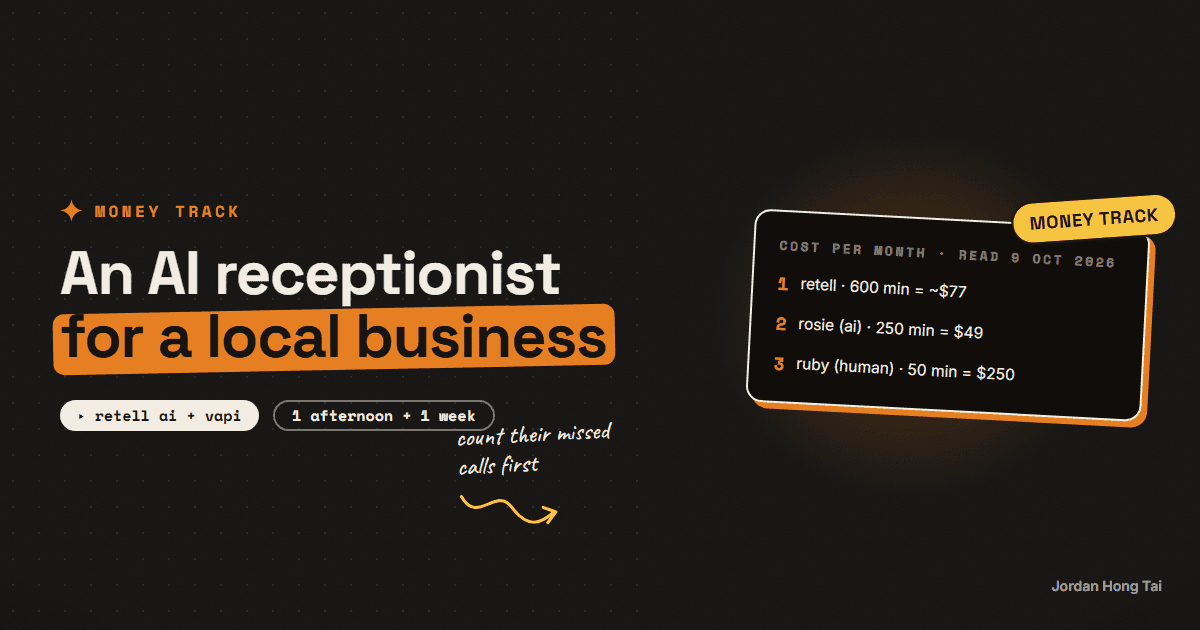
An AI receptionist on Retell AI costs about 11 cents a minute in Retell's own example, about 12.5 cents with its phone line. A plumber with 600 minutes of calls a month is looking at about $77 in usage. A human answering service like Ruby lists $250 a month for 50 minutes. The minutes are cheap. The service is the real price list, the transfer that works when a caller is angry, and the monthly report.
An AI receptionist built on Retell AI costs about 11 cents a minute in Retell's own worked example with a GPT 5 class model, read on 9 October 2026, plus about 1.5 cents a minute if you use one of its phone numbers. A plumber who gets 600 minutes of calls a month is looking at about $77 in usage. A human answering service like Ruby lists $250 a month for 50 minutes.
So the minutes are cheap. What a local business will pay for is somebody who sets it up to answer with their real prices and hours and book the job. That person also hands the angry caller to a human and sends a report every month showing the calls it caught.
This guide is the cost sheet from Retell's and Vapi's pricing pages, read on 9 October 2026, what freelancers and finished products ask for the same job, the setup, the pitch, and the three ways these agents go wrong in front of a customer. Results vary a lot. None of this is a forecast of what you or anyone will earn.
What you'll have when you're done
- A per-minute and per-month cost sheet for Retell, with Vapi as the comparison
- A working receptionist on a test number that answers, books and transfers
- A one-week missed-call count from a real business, which is the only number your pitch needs
- A test script of twenty calls that catches the failures before a customer does
- A monthly offer with a call report behind it
- [SCREENSHOT: the Retell agent's call log with three test calls, one booked and one transferred]
Before you start
- A Retell AI account. Pay as you go, no plan, and it gives $10 in free credits on signup, which is about 80 test minutes at the rates below.
- A phone you can test from, and ideally a second one, so you can hear a transfer land.
- One local business that will let you count its missed calls for a week. A friend's salon, a cousin's HVAC company, anything that answers a phone.
- A Cal.com account for the business, if you want booking. Retell's built-in booking function books into Cal.com.
- An afternoon for the build, then a week for the count.
Retell AI: retellai.com Vapi: vapi.ai
There's no download pack for this one. The cost sheet, the prompt and the test script are all on the page.
Step 1: Do the cost sheet before the pitch
Retell bills by the minute, to the nearest second, and each minute is built from parts. Here's what its pricing page listed on 9 October 2026.
| Part | Rate per minute | Note |
|---|---|---|
| Retell Voice Infra | $0.055 | The voice engine, always on |
| LLM | $0.0016 to $0.32 | Depends on the model you pick |
| Text-to-speech | $0.015 | Retell's own voices; ElevenLabs runs $0.04 to $0.10 |
| Telephony | $0.015 | Retell's numbers; $0 on your own SIP trunk |
| Phone number | $2 a month | Per Retell number |
Retell's own example on the page adds up to $0.11 a minute: $0.055 voice, $0.04 for the LLM and $0.015 for the voice, with no telephony charge. That $0.04 is a model like GPT 5. The calculator now opens on GPT 5.4, which reads $0.15 a minute, so pick the model before you quote a client. Add Retell's telephony and it's about $0.125. Failed calls aren't billed, but silence and hold time are, and the agent fee stops after a transfer while telephony keeps running.
| Calls a month | Minutes (3 a call) | Usage at $0.125 | Plus the number |
|---|---|---|---|
| 100 | 300 | $37.50 | $39.50 |
| 200 | 600 | $75 | $77 |
| 500 | 1,500 | $187.50 | $189.50 |
Vapi prices the same job a different way. Its pricing page lists a $0.05 a minute platform fee and passes provider costs through with no markup. That's a transcriber at about a cent, the model at under a cent to about 4.5 cents and the voice at about 1.5 to 2.4 cents, plus your carrier, which is $0.008 a minute for Twilio inbound. Vapi's own estimate for 1,000 minutes is $82 to $129 a month. So the two land in the same place. I'd pick Retell for a first client because the whole agent, the number and the transfer live in one dashboard. Synthflow's public page lists only an enterprise plan from $30,000 a year, so it's not the tool for this.
Cost sheet (one row per client)
calls a month:            ______  (from step 2, not a guess)
average minutes a call:   ______  (start at 3)
cost per minute:          0.125 (retell with its number) / 0.11 (own number)
usage:                    calls x minutes x cost per minute
number:                   2.00
your time a month:        ______ hours  (prompt fixes, report)
price for the month:      ______
Check it worked: fill the sheet for a business you know. If you can't say what one month costs in usage and in your own hours, you aren't ready to quote.
Step 2: Count the missed calls, don't quote a statistic
Every AI receptionist pitch I've read leads with a missed-call number. Most of them don't survive a click. The widely repeated "62% of calls go unanswered" traces back to a study of 85 businesses, and several write-ups date it to 2016, not 2024. It also counts voicemail as unanswered. The "$126,000 a year in lost revenue" line has no primary source anyone can produce.
The best recent data I could open is Invoca's 2026 benchmark, published July 2026, from over 70 million calls. It says 56% of calls to businesses are answered by a person, rising to 65% for calls longer than 15 seconds. That's a real number, but Invoca's customers are businesses that already pay for call tracking, so it isn't your plumber.
So I'd skip the statistic and measure the client. Ask the owner to screenshot their phone's recent calls, or pull the carrier's call log, for seven days. Count three things.
Missed-call count (7 days)
calls during open hours:          ______
  of those, missed:               ______
calls after hours and weekends:   ______
  of those, missed:               ______
missed callers who never called back:  ______
Check it worked: you have a number for missed calls in one week from the client's own phone. That number is the pitch. If you don't have it, you're selling a statistic.
Step 3: Build the agent with the real price list
In Retell, create a single-prompt agent, pick a voice, and paste a prompt built from the business's own facts. The facts do the work. An agent that guesses a price is worse than voicemail.
You are the receptionist for [Business], a [trade] in [town].
Hours: [days and times]. Today is {{current_time}}.
Services and prices (say only these, never estimate):
- [service]: [price or "from $X, exact quote after a visit"]
- [service]: [price]
Service area: [towns or zip codes]. Outside it, say so politely.

On every call:
1. Say: "Thanks for calling [Business], this call may be recorded.
   How can I help?"
2. Get the caller's name, number, address and what they need.
3. If it's a booking, offer the next two open slots and book one.
4. If the caller is upset, has an emergency, or asks for a person,
   transfer the call to the owner.
5. If you don't know the answer, say the owner will call back
   today, and take a message.
Never quote a price that isn't on the list above.
Then add the knowledge base, a short page with the FAQ the owner answers ten times a week, and the Call Transfer function pointed at the owner's mobile. Retell offers cold transfer, where the caller goes straight through, and warm transfer, where the agent briefs the owner first. Use warm for this, because it tells the owner who's calling before they pick up. Transfers only work on phone calls, not web test calls.
Check it worked: call the agent and ask for a price that isn't on the list. If it makes one up, tighten the prompt until it says the owner will call back.
Step 4: Keep the business's own number
Nobody wants to change the number on their van. So the business keeps its number and forwards to the agent. Buy one Retell number, then have the owner turn on conditional call forwarding with their carrier, which sends calls to another number when they're busy or don't answer after a few rings. Every carrier calls it something slightly different, so search "[carrier] forward when no answer".
That gives the owner a choice, and I think it's the right first setup. They still answer when they can. The agent only catches what they'd have missed.
Check it worked: call the business number, let it ring out, and hear the agent pick up. Then call while the owner's line is busy and hear it again.
Step 5: Run twenty test calls before a customer does
The agent sounds great on the first call and falls apart on the twelfth. So call it twenty times, from two phones, and try to break it.
Test script (one row per call)
1-5    normal bookings, different days and times
6-8    a price question, one on the list and two not
9-10   a caller who interrupts mid-sentence
11-12  a strong accent or a noisy car
13-14  "can I speak to a real person"
15     an angry caller about a late job
16     an emergency ("water everywhere")
17     a caller outside the service area
18     a spam or sales call
19     a caller who spells a hard name
20     a caller who says nothing for five seconds
Listen for three failures. Latency: a pause long enough that the caller says "hello?" again. Pick a faster model or a shorter prompt until it's gone. Invented answers: any price, time or promise that isn't in the prompt. Bad handoffs: a transfer that drops, or one that doesn't happen when the caller is upset. Retell's call log shows each call, so you can play them back with the owner.
Check it worked: all twenty calls end with a booking, a message or a transfer, and none of them has a made-up price. If one doesn't, fix the prompt and run all twenty again.
Step 6: Say the recording line, and check your state
Retell records and transcribes calls, which is what makes the monthly report possible. Recording law in the US is set by each state. Federal law generally allows recording with one party's consent, but a group of states, including California, Florida, Illinois and Washington, require every party to agree, and the published lists disagree on exactly how many there are. I'm not a lawyer and this isn't legal advice. Check your state and the client's state, and keep the "this call may be recorded" line at the start of every call, which is in the prompt above.
One more line. Keep this service inbound. In February 2024 the FCC ruled that AI-generated voices count as "artificial" under the Telephone Consumer Protection Act, so outbound calls with an AI voice need the person's prior consent. Answering calls that come in is a different job from calling people who didn't ask.
Check it worked: the first sentence of every test call includes the recording line.
Step 7: Pitch with their own missed calls
Don't pitch with a demo of someone else's business. Build the agent with their price list on your test number, then send the owner two things: the missed-call count from step 2, and a phone number they can call right now.
Hi [name], last week your phone missed [N] calls, [M] of them after
hours. I built a receptionist that answers with your prices and your
hours, books into your calendar and passes upset callers straight to
you. Call it now on [test number] and try to break it.

If you like it, it goes live on your existing number in a day. You
pay a setup fee once and a monthly fee that covers the calls, and at
the end of every month I send you a list of every call it caught.

Jordan
Check it worked: the owner can try the agent in under a minute without reading anything else. If they need a call with you first, the pitch is too long.
Step 8: Price for the month, and know what you're up against
Here's what the same job costs elsewhere, read on 9 October 2026.
Freelancers. Fiverr blocked my browser with a human check, so what I have is the starting price in gig titles as search engines index them. Nine titles for building an AI receptionist on Vapi or Retell read $10, $20, $20, $30, $50, $50, $90, $160 and $175. One $175 seller says its basic package is a blueprint only, with no live deployment, and several say the Vapi or Retell usage is billed to you separately. So those are setup prices, and the cheap ones often aren't a working phone line.
Products. Rosie, an AI answering product, lists $49 a month for 250 minutes, $149 for 1,000 and $299 for 2,000. Ruby, a human receptionist service, lists $250 a month for 50 minutes, $395 for 100 and $720 for 200. The same 50 minutes on Retell, at about $0.125 a minute, is about $6.25 in usage.
So a local owner can buy a do-it-yourself AI tool for $49 or a human for $250 and up. I'd price in between: a one-time setup fee for the build and the twenty test calls, then a monthly fee that covers the usage from your cost sheet, your time fixing the prompt, and the report. The report is what makes it worth more than the $49 tool.
Monthly call report
calls answered by the agent:     ______
bookings made:                   ______
transfers to you:                ______
messages taken:                  ______
calls it got wrong (and the fix): ______
Check it worked: your offer says the setup price, the monthly price, how many minutes it covers and what's in the report. If it only says a price, rewrite it.
The honest part about this market
The minutes are about 11 cents and falling. The build takes an afternoon. A determined owner can do it themselves with Rosie for $49, and some will. So the agent alone isn't something you can charge much for for long.
What I think owners actually pay for is the price list being right, the transfer working when someone's angry, the recording line being there, and a person who fixes it when it says something dumb. That's a real service. It also means you're on the hook when a customer has a bad call, so test like it.
What I'd do differently
Count before you pitch. One week of the client's own missed calls beats any statistic.
Write the price list into the prompt, and nothing else. An agent that guesses prices is a liability.
Keep their number. Conditional forwarding means the owner still answers when they can.
Send the report before they ask. It's the only thing that makes month two feel obvious.
FAQ
How much does an AI receptionist cost per minute?
On Retell AI, the pricing page read 9 October 2026 shows a worked example of $0.11 a minute: $0.055 for the voice engine, $0.04 for the LLM and $0.015 for the voice. Retell's telephony adds $0.015 a minute and each number is $2 a month. At about $0.125 a minute, 300 minutes is $37.50 and 600 minutes is $75 before the number. Vapi's own estimate for 1,000 minutes is $82 to $129.
Retell AI or Vapi for a first client?
They land at similar per-minute costs. I'd pick Retell for a first client because the agent, the phone number, the call log and the transfer live in one dashboard and it gives $10 of free credits. Vapi is a $0.05 platform fee plus pass-through provider costs and suits builders who want to choose each piece. Synthflow's public page lists only an enterprise plan from $30,000 a year.
What do people charge to set up an AI receptionist?
Fiverr blocked my browser on 9 October 2026, so I read gig titles as indexed by search engines: $10, $20, $20, $30, $50, $50, $90, $160 and $175 for Vapi or Retell builds. Those are starting prices, one $175 seller's basic tier is a blueprint with no live deployment, and usage is usually billed separately. Finished products give the monthly range: Rosie lists $49 for 250 AI minutes and Ruby lists $250 for 50 minutes of human reception.
How many calls do small businesses miss?
The often-quoted 62% comes from a study of 85 businesses that several write-ups date to 2016, and it counts voicemail as unanswered. Invoca's July 2026 benchmark of over 70 million calls found 56% of calls to businesses answered by a person, but its customers already pay for call tracking. The honest move is to count one week of the client's own missed calls from their phone or carrier log.
Do I need consent to record calls with an AI receptionist?
Recording law is set by each US state. Federal law generally allows one-party consent, but states including California, Florida, Illinois and Washington require every party to agree, and published lists disagree on the exact count. This isn't legal advice: check your state and the client's, and have the agent say the call may be recorded at the start of every call.
Can the AI receptionist make outbound calls too?
Keep it inbound. In February 2024 the FCC ruled that AI-generated voices are 'artificial' under the Telephone Consumer Protection Act, so outbound calls using one need the called person's prior consent. Answering calls that come in is a different and simpler job.
Related guides
Sell one AI automation to a local business: the 3 to pitch first and what they pay
A dentist who misses 20 calls a month is not losing 20 calls. They are losing the ones that ring a competitor 30 seconds later. This guide covers the three automations local businesses will actually pay for, how to build each one in Make.com in an afternoon, what freelancers publicly charge for this category of work, and the outreach move that turns a cold walk-in into a paid setup fee plus a monthly retainer.
AI avatar videos for local businesses: the build, the pitch and the price
A 40-second AI avatar video costs about $2 to produce. On Fiverr the cheapest gigs selling that work start at $5. That gap is why the marketplace is crowded and why the marketplace is the wrong place to sell this, and the rest of this page is the version that works instead: the three videos a local business will actually pay for, the real per-video cost from my own render log, the public asking range read off live listings, and the three ways the deal goes wrong.
One-person content agency: 30 short videos a week, the real cost sheet
Seven avatar reels cost me $14.71 last week. That is the whole render bill, measured, not estimated. This guide takes the per-unit costs from a pipeline that actually runs every week and does the arithmetic for 30 short videos a week: what HeyGen bills per finished second, what ElevenLabs charges per character, what local editing costs, and what the whole month comes to per finished video. Then it puts that next to what agencies and freelancers publicly charge for short-form retainers, so you can see the gap the business lives in.
Get the next build in your inbox
One email a week: the newest guides, plus one thing I only share with the list.
No spam. Unsubscribe anytime.
Build alongside others
Join the free community and share what you're shipping.

Jordan Hong Tai
I've scaled products to over 500K users, and now I build AI systems in public from a balcony in Tokyo.