The creator program starter kit: a one-page brief, a pay calculator and a contract checklist
Last updated November 2026 · About 2 hours to fill in all three documents · Free; budget one paid test video per creator · Beginner
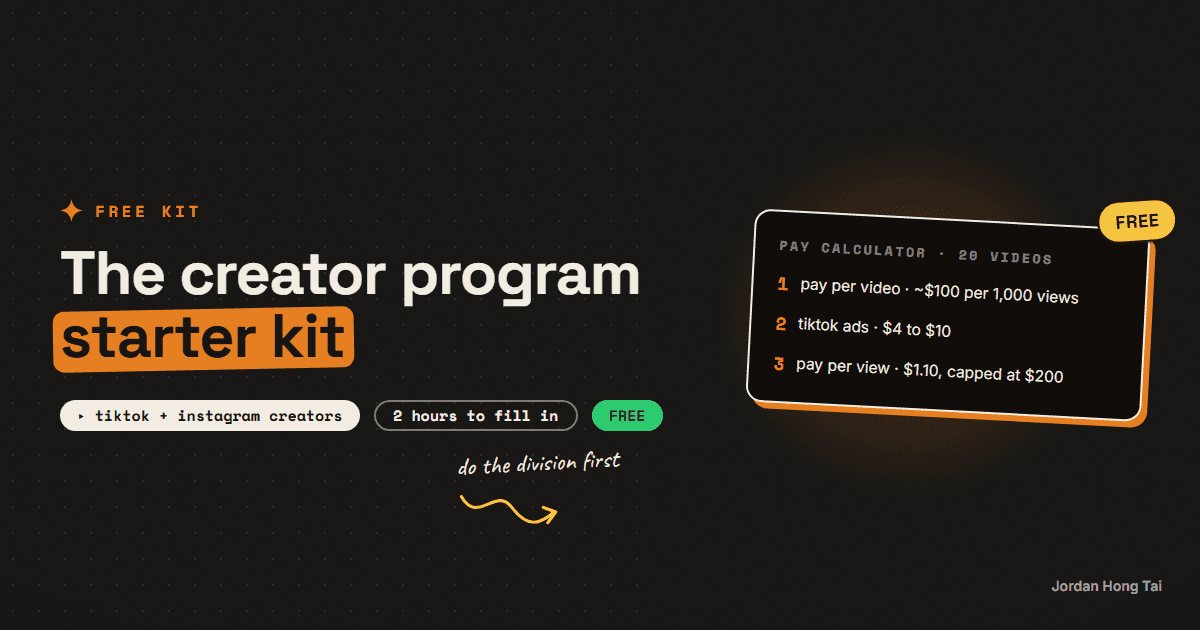
The median price for one creator video is around $150, and the median TikTok gets around 866 views. Paid per video, that works out at about $100 per 1,000 views, when TikTok ads sell the same thousand for $4 to $10. This kit is the brief, the pay calculator and the contract checklist I'd use to fix that.
The median price for one creator video is around $150. The median TikTok gets around 866 views. So if you pay per video, I think you're buying views at about $100 per 1,000, and TikTok ads sell that same thousand for somewhere between $4 and $10.
That one division is why most creator programs lose money. It's also fixable, because it comes from what you chose to pay for, not from the creators.
This is the kit from my video on creator programs. It has three things you can copy today: a one-page creator brief, a pay calculator with the arithmetic worked out, and a contract and setup checklist. They follow the five decisions from the video: the unit, the accounts, the formats, the people and the loop. Results vary a lot, and nothing here is a forecast of what your program will do.
What you'll have when you're done
- A one-page brief with between three and six hooks, talking points, a short list of don'ts and a 15-video swipe table
- A pay calculator that shows your cost per 1,000 views for pay per video and for pay per view, plus the cap and the break-even against ads
- A contract and setup checklist you can take to your lawyer
- A scorecard for the first month, so you know who to keep and who to cut
Before you start
- A product people decide on fast. I doubt this works if you sell to a handful of big buyers, or if you need results this quarter.
- A budget for a paid test. You pay each creator for one real video before you commit. The median advertised price is around $150 a video in Pitchlo's job-board data, measured 7 November 2026 on 193 briefs. Those are advertised budgets, not invoices.
- A company email domain and a phone the company controls. You need both for the account setup in Part 3.
- A lawyer for one hour. The checklist here is a starting point. It isn't legal advice, and I'm not a lawyer.
- About 2 hours to fill in all three documents.
There's no download pack for this one. The brief, the calculator and the checklist are all on the page, so copy the blocks straight into your own doc.
Part 1: The pay calculator
Start here, because the unit you pay for decides everything else. I got this one wrong myself before I did the math.
The numbers the example uses
| Number | Value | Where it comes from |
|---|---|---|
| Median price of one creator video | about $150 | Pitchlo job-board data, 193 briefs, measured 7 November 2026 (advertised pay) |
| Median views on a TikTok | about 866 | viral.app study of 3.3 million videos, updated 1 October 2026 |
| A post beats its own account's median by 3 times | about 1 post in 7 | same study |
| A post beats its own account's median by 10 times | about 1 post in 20 | same study |
| TikTok ads, cost per 1,000 views | about $4 to $10 | Triple Whale median $4.08, Benchmarketing median $9.50 |
| Median pay-per-view rate | $1.10 per 1,000 views | ClippingAlpha, 2,157 pay terms across 904 campaigns, published 24 October 2026 |
| Deals that cap what one clip can earn | 98% | same dataset |
| Median cap per clip | $200 | same dataset |
| Median minimum before a clip pays anything | 2,000 views | same dataset |
Pay per video, worked out
Say you buy 20 videos on new accounts at the median price. This is my own rough model from the rates above, so treat the view count as a sketch.
Pay per video: 20 videos on new accounts

Cost:   20 videos x $150                      = $3,000

Views:  16 ordinary posts x 866 views         = 13,856
         3 posts at 3 times the median (2,598) =  7,794
         1 post at 10 times the median (8,660) =  8,660
         Total                                 = about 30,300 views

Cost per 1,000 views:  $3,000 / 30.3          = about $99
TikTok ads, same 1,000 views:                   $4 to $10
So paid per video, you're somewhere between 10 and 25 times worse than buying the ad. And the breakout post in that batch did about 9,000 views, so it didn't save the average.
The break-even tells you how far off you are:
Break-even views per video = price per video / ad cost per 1,000 x 1,000

$150 / $10 x 1,000 = 15,000 views per video (against expensive ads)
$150 / $4  x 1,000 = 37,500 views per video (against cheap ads)
A new account's median is around 866. That's the gap you'd have to close on every single video, not just on the winner.
Pay per view, worked out
Now flip the unit and pay for views. The median advertised rate in the ClippingAlpha data is $1.10 per 1,000 views. Bloomberg reported a MrBeast campaign that ran at $50 per 100,000 views, so 50 cents per 1,000.
Pay per view: the same 30,300 views

30.3 x $1.10                                  = about $33
Cost per 1,000 views                          = $1.10
TikTok ads, same 1,000 views:                   $4 to $10
Same creators and same videos, and now you beat the ad price. But read two lines of the fine print before you copy it. Most of these deals pay nothing under a minimum, and the median minimum is 2,000 views. So on brand-new accounts, most of those 20 posts would pay the creator $0. I think that's why pay per view attracts people who post a lot of clips, and why somebody filming a custom video for you will want a fee.
The cap is the real decision
The cap is the most a single video can earn. 98% of the deals in that dataset have one, and the median is $200.
Views where the cap kicks in = cap / rate per 1,000 x 1,000
$200 / $1.10 x 1,000 = about 182,000 views

Your cost per 1,000 views after the cap = cap / views x 1,000
At 500,000 views:    $200 / 500   = $0.40
At 1,000,000 views:  $200 / 1,000 = $0.20
The dataset's own numbers land close to mine. It reports that pay stops at about 167,000 views, and that a clip with 1 million views should pay $1,100 at the advertised rate and actually pays a median of $189.
So once you set a cap, you've built a flat fee with a view condition attached. That's fine. Just pick the cap on purpose, because it's your real price.
The version I'd start with: a fee with a view floor
Cal AI's founder described his deals to TechCrunch on 15 October 2026. "We'll pay you this, but we need to get at least this amount of views." That's a fee with a floor, and I think it's the cleanest shape for a brand that wants custom videos.
Fee with a view floor

Worst-case cost per 1,000 views = fee / floor x 1,000
Floor you need = fee / the cost per 1,000 you'll accept x 1,000

Fee $150, you'll accept $10 per 1,000:  floor = 15,000 views
Fee $150, you'll accept $25 per 1,000:  floor =  6,000 views
The contract has to say what happens when a video misses the floor. Two options I'd look at are that the creator posts again until the views add up, or that part of the fee is held back until they do. Pick one and write it down.
Your numbers
| Line | Formula | Yours |
|---|---|---|
| A. Price per video | what you'll pay | ____ |
| B. Videos per month | creators x posts each | ____ |
| C. Monthly cost, pay per video | A x B | ____ |
| D. Median views per post on these accounts | measure it, or use 866 for new TikTok accounts | ____ |
| E. Expected views per month | B x D, plus your breakouts | ____ |
| F. Cost per 1,000 views, pay per video | C / E x 1,000 | ____ |
| G. Your ad cost per 1,000 views | from your own ads account, or $4 to $10 | ____ |
| H. Break-even views per video | A / G x 1,000 | ____ |
| I. Pay-per-view rate per 1,000 | what you'll offer | ____ |
| J. Cap per video | the most one video can earn | ____ |
| K. Views where the cap kicks in | J / I x 1,000 | ____ |
| L. Minimum views before a video pays | your floor | ____ |
| M. Worst-case cost per 1,000 with a floor | A / L x 1,000 | ____ |
Check it worked: line F or line M is at or under line G. If your cost per 1,000 views is higher than your ad cost, change the unit, the cap or the floor before you recruit anybody.
Part 2: The one-page creator brief
Your creators aren't going to invent what works. You hand it to them. Keep the brief to one page, and give them hooks to choose from, not a script to read.
CREATOR BRIEF: [brand], [product], [month]

1. THE ONE THING
What a viewer should know or feel after 20 seconds:
[one sentence]

2. HOOKS (pick one, say it your own way)
A. [the result]      "______"
B. [the mistake]     "______"
C. [the question]    "______"
D. [the comparison]  "______"
(between three and six options, never one)

3. TALKING POINTS (use any two or three)
- [what it does, in plain words]
- [who it's for]
- [the detail people don't expect]
- [price or offer, only if it's approved]

4. DON'TS (keep this shorter than the talking points)
- No claims about health, money or results we haven't approved in writing
- No trending or commercial music. Use sounds from the Commercial Music Library only
- Don't repost another creator's video or read their script
- Don't post without the paid partnership label switched on

5. FORMAT
- Vertical 9:16, 720p or better
- The point of the video lands in the first 3 seconds
- Length: [__] to [__] seconds
- Your face, your voice, your room

6. DISCLOSURE (required on every post)
- Turn on the platform's commercial content or paid partnership label
- Say or show that it's a partnership in the video itself
- Free product counts as payment

7. DELIVERY
- Post by: [date]
- Send us the link within 24 hours of posting
- Questions: [name, email]

8. REFERENCE VIDEOS
See the swipe table. Copy the structure, never the script.
The format lines come from TikTok's own creative guidance, last updated June 2025: the proposition in the first 3 seconds, the hook inside 6, vertical at 720p or better.
The swipe table: 15 videos that already worked
Don't pick these by view count. Views tell you how big an account is, and they don't tell you if the idea pulls. The number I use on my own channels is the outlier score. It's a video's views divided by that account's own median.
Outlier score = this video's views / that account's median views
(leave the video out of its own median, and skip anything under 48 hours old)

140,000 views on an account that normally gets 20,000 = 7
Then be suspicious of it. A study by Overseeros of 7,642 outliers across 1,048 channels found that about 29% were a channel on a hot streak, not an idea that worked. So a format only goes in the table once you've seen it work on two or three unrelated accounts.
| # | Link | Account's median views | This video's views | Outlier score | Seen on 2 or 3 unrelated accounts? | What to copy (one line, structure only) |
|---|---|---|---|---|---|---|
| 1 | ____ | ____ | ____ | ____ | yes / no | ____ |
| 2 | ____ | ____ | ____ | ____ | yes / no | ____ |
| 3 | ____ | ____ | ____ | ____ | yes / no | ____ |
| 4 | ____ | ____ | ____ | ____ | yes / no | ____ |
| 5 | ____ | ____ | ____ | ____ | yes / no | ____ |
| 6 | ____ | ____ | ____ | ____ | yes / no | ____ |
| 7 | ____ | ____ | ____ | ____ | yes / no | ____ |
| 8 | ____ | ____ | ____ | ____ | yes / no | ____ |
| 9 | ____ | ____ | ____ | ____ | yes / no | ____ |
| 10 | ____ | ____ | ____ | ____ | yes / no | ____ |
| 11 | ____ | ____ | ____ | ____ | yes / no | ____ |
| 12 | ____ | ____ | ____ | ____ | yes / no | ____ |
| 13 | ____ | ____ | ____ | ____ | yes / no | ____ |
| 14 | ____ | ____ | ____ | ____ | yes / no | ____ |
| 15 | ____ | ____ | ____ | ____ | yes / no | ____ |
The last column is where most briefs go wrong. Write what the video does, not what it says.
What to copy: good lines
- Opens on the finished result, then rewinds to the start
- Asks a question in the first second and answers it at the very end
- Shows the wrong way for 5 seconds before the right way
- One continuous shot, with the product in frame by second 2
- A list of three, with the surprising one saved for last

What to copy: bad lines
- "Use this exact hook"
- "Say what she says"
- "Same caption"
There's a platform reason for that rule too. In April 2026 Instagram said accounts that mostly post content they didn't make, or didn't really change, stop getting recommended to new people. So one video copied across 30 accounts is dead. Thirty different people doing one proven format is the version that survives.
Check it worked: a creator who has never heard of your brand can read the brief in under two minutes and tell you which hook they'd pick. If the don'ts list is longer than the talking points, cut it.
Part 3: The contract and setup checklist
Take this list to a lawyer and have them write the actual agreement. I'm not one, and the rules change by country and by platform. What I can give you is the list of things the agreement and the setup need to cover, and why each one is there.
1. Account registration
Your contract can't really hand you an account, because the platforms don't let anyone transfer one. TikTok Shop's seller terms call any attempt void. So the control that works is how the account gets registered on day one.
[ ] Every brand-named account is registered on a company email address
[ ] Two-factor codes go to a phone or an authenticator the company controls
[ ] Recovery email and recovery phone belong to the company too
[ ] One sheet lists every account: handle, platform, email, who posts, date opened
[ ] The agreement says the creator posts on the account and doesn't own it
[ ] Each account has one real person behind it. No fake names, no bought followers
[ ] When someone leaves, the password and the two-factor device change that day
A pile of accounts is allowed, and I expected the opposite. TikTok's community guidelines, effective 24 September 2026, say you can have multiple accounts, but not to deceive others or break the rules. Fake identities and bought engagement are what's banned.
2. Content usage rights and Spark Ads
[ ] What the brand can do with each video: organic reposts, paid ads, website, email
[ ] How long those rights last, and in which countries
[ ] Whether the brand can edit the video or cut it into new versions
[ ] Spark Ad authorization: the creator agrees to send an authorization code on request
[ ] How long each code stays valid (TikTok's default is 365 days)
[ ] The creator knows they can't delete the post while it's authorized as an ad
[ ] What the creator gets paid extra, if anything, when a post is boosted
[ ] What happens to the videos if the creator leaves the program
A Spark Ad lets you run the creator's own post as an ad, from their account, and the engagement lands on their original post. In my opinion this is the clause that pays for the whole program, because cheap volume finds the winner and then you pay to multiply only that one.
3. Disclosure, training and monitoring
Disclosure is on you as well as on the creator. The FTC's Endorsement Guides FAQ says the brand is responsible too, that you need reasonable programs in place to train and monitor the people posting for you, and that handing the work to an agency doesn't move that off you.
[ ] The agreement requires disclosure on every post, in the video and with the platform label
[ ] A one-page disclosure sheet goes out with the brief, and each creator confirms they read it
[ ] Free product is treated as payment, so gifted posts get disclosed too
[ ] Claims list: what creators can say about the product, approved in writing
[ ] No staged results, no fake reviews, no pretending to be a customer who isn't one
[ ] Someone on your team checks a sample of posts every week and logs what they checked
[ ] What happens on a miss: fix it within 24 hours, and a second miss ends the deal
[ ] If an agency runs the roster, the same rules are in the agency's contract
TikTok's branded content policy also requires the commercial content toggle, and it counts gifted product as payment. And the FTC's FAQ says a visual endorsement needs a disclosure people can see, so a line in the caption doesn't cover a video.
4. Music and commercial sounds
I had this one backwards. A brand's Business Account on TikTok only sees the Commercial Music Library, so there's very little risk there. The risk is the product account that somebody set up as a personal account to get the trending sounds. TikTok's own help page says using the general library to promote a business puts you at risk of copyright infringement. And the labels go after the brand. Gymshark, Chili's and Crumbl have all settled cases over music in social posts.
[ ] Brand-named accounts are set up as Business Accounts
[ ] Creators use only sounds from the Commercial Music Library, original audio or licensed tracks
[ ] No trending songs on any post that promotes the product, on any account
[ ] The agreement says the creator replaces or removes a post if a sound turns out to be unlicensed
[ ] Your weekly check looks at the sound on each post, not just the disclosure
5. The paid test
Run this before anyone joins the roster. You're not testing whether they can film. You're testing whether they can follow a brief.
[ ] Two samples of their past work
[ ] One short clip to camera, so you can hear how they talk
[ ] One real video against your brief, paid at your normal rate
[ ] The test fee, the deadline and the usage rights for the test video are in writing
[ ] Pass means on time, on brief, disclosed, with the right sound
Plan for people dropping out. A case study published by Ridge's agency, Aligned Growth Management, reported that about 19% of the creators they contacted opted in, and about half of the ones who were sent product ever posted. That's a vendor's own numbers, so read them as a direction. I'd still size the roster as if half the people who say yes will never post.
6. Tiers and the monthly cut
[ ] Tier 1: posts every week and sells. Gets the best rate and first look at new products
[ ] Tier 2: does the job. Stays on the standard deal
[ ] Tier 3: took the product and went quiet. Removed at the monthly review
[ ] The agreement says how many posts a month keep someone on the roster
[ ] Either side can end it with [__] days' notice
[ ] The review happens on the same day every month, from the scorecard below
7. Pay terms
[ ] The unit: per video, per 1,000 views, or a fee with a view floor
[ ] The rate, the cap per video and the minimum views (from your calculator)
[ ] Which views count: which platform, measured on which day, from whose screenshot or tool
[ ] What happens when a video misses the floor
[ ] When and how people get paid
[ ] Bought views or bots end the deal and the payment
8. The measurement window
Last-click tracking will make this look dead before it works, because it hands the sale to a branded search or a retargeting ad. So agree on what you count before the first post goes up.
[ ] Each creator has their own link and their own code
[ ] The attribution window is at least two weeks, and up to about a month
[ ] You count cost per 1,000 views for each creator
[ ] You count how many posts beat that creator's own median by 3 times
[ ] You don't judge the program on week six
The two-week-to-a-month window is a range from attribution vendors, so it's a direction and not a rule. The ramp is the same kind of number: one vendor model with about 100 weekly creators took around six months to reach 400 videos a month.
Monthly scorecard (one row per creator)
creator:                         ______
tier:                            1 / 2 / 3
posts this month:                ______
total views:                     ______
paid this month:                 $______
cost per 1,000 views:            paid / views x 1,000
posts at 3 times their median:   ______
disclosure misses:               ______
winner sent to Spark Ads:        yes / no
keep, move tier, or cut:         ______
Check it worked: a lawyer has read sections 1 to 4 and 7, every account on your sheet is on a company email with company two-factor, and each creator on the roster has passed the paid test.
The honest part about creator programs
I think the hard part is patience. The math only works on average, the average needs volume, and volume takes months to build. If you need a result this quarter, buy the ads.
The other hard part is that you're responsible for what dozens of people post in your name. The disclosure sheet and the weekly check are boring, and they're the difference between a program and a headline. And honestly, a small roster you can actually monitor beats a big one you can't.
What I'd do differently
Do the division first. Cost per 1,000 views, before anything else. I got the unit wrong myself.
Register every account on a company email. If you only do one thing from this page, I'd make it that one.
Pick formats by outlier score. A big view count on a big account tells you nothing about the idea.
Pay for a test video. It's the cheapest way to find the half who will actually post.
Ask for the Spark Ad code in the contract. Asking after a post takes off is a harder conversation.
FAQ
What is a creator program?
It's a brand paying many creators to post about one product on a steady schedule, often on accounts made for that product. It's different from a single influencer deal, because you're buying a lot of posts and expecting a few of them to break out.
How much does a UGC creator video cost?
Pitchlo's job-board data, measured 7 November 2026 on 193 briefs, puts the median advertised price at about $150 a video. Those are advertised budgets, not invoices. Collabstr's 2026 report, on about 21,000 collaborations, found about 80% of brand collaborations cost under $300.
Should I pay creators per video or per view?
Do the division first. At about $150 a video and a median of about 866 views on TikTok, pay per video works out near $100 per 1,000 views, and TikTok ads run about $4 to $10. Pay-per-view deals have a median rate of $1.10 per 1,000 views in ClippingAlpha's October 2026 data, but most pay nothing under a minimum. A fee with a view floor sits between the two.
What is a pay cap in a pay-per-view deal?
It's the most one video can earn, whatever the views. In ClippingAlpha's data, 98% of pay terms had a cap and the median was $200. At $1.10 per 1,000 views, a $200 cap kicks in at about 182,000 views, so the cap is your real price for a breakout video.
Who owns the accounts creators post on?
Platforms don't let anyone transfer an account, and TikTok Shop's seller terms call any attempt void. So ownership comes down to registration: put every brand-named account on a company email, with two-factor codes going to a phone or authenticator the company controls, from day one.
Who is responsible for disclosing a paid post, the brand or the creator?
Both. The FTC's Endorsement Guides FAQ says responsibility sits with the brand as well as the creator, that advertisers need reasonable programs to train and monitor the people posting for them, and that using an agency doesn't remove it. TikTok's branded content policy also counts gifted product as payment.
Is the contract checklist legal advice?
No. It's a list of what the agreement and the setup should cover, written by a marketer. Take it to a lawyer in your country and have them write the actual contract.
Related guides
AI UGC ads for small brands: how people land the first paid client with no audience
Small brands buy ads that look like a person talking, and they buy them by the batch because most of them fail. The people getting paid for this now are not creators with an audience. They are operators with HeyGen, a voice from ElevenLabs, and three sample ads made for a brand that never asked for them. This guide is that whole loop: the script structure, the production, the spec reel, the outreach message, and what the work is priced at.
One-person content agency: 30 short videos a week, the real cost sheet
Seven avatar reels cost me $14.71 last week. That is the whole render bill, measured, not estimated. This guide takes the per-unit costs from a pipeline that actually runs every week and does the arithmetic for 30 short videos a week: what HeyGen bills per finished second, what ElevenLabs charges per character, what local editing costs, and what the whole month comes to per finished video. Then it puts that next to what agencies and freelancers publicly charge for short-form retainers, so you can see the gap the business lives in.
Is my YouTube Short breaking out? The day-2 check before you make a part two (free Claude Code skill + sheet formula)
One of my Shorts hit three times my usual views on day one and my tracker told me to make a part two. A day and a half later it had 38 more views. This is the day-2 check I use now before I make a follow-up to any Short.
Get the next build in your inbox
One email a week: the newest guides, plus one thing I only share with the list.
No spam. Unsubscribe anytime.
Build alongside others
Join the free community and share what you're shipping.

Jordan Hong Tai
I've scaled products to over 500K users, and now I build AI systems in public from a balcony in Tokyo.